
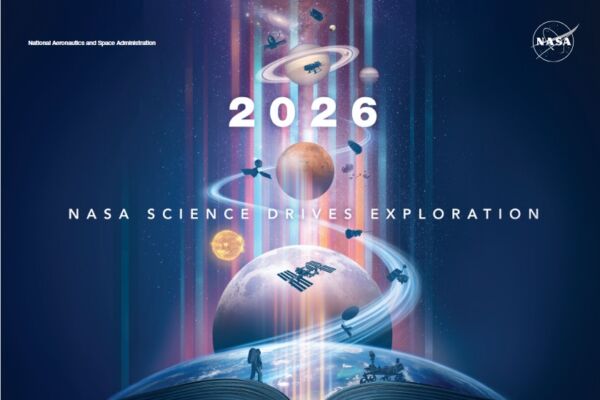
As 2026 approaches, the National Aeronautics and Space Administration (NASA) of the United States has unveiled a new exquisite calendar for the upcoming year. Through a series of high-precision data visualizations, it showcases the dynamic changes in the universe.
NASA pointed out that each month’s theme image focuses on a specific breakthrough mission, such as January highlighting the “Cosmic Tornado” observed by the agency’s James Webb Space Telescope.
These images transform the invisible light frequencies and scientific principles behind the data into simple and understandable narratives, demonstrating how rapidly people’s understanding of space and Earth is developing.
Here are the introductions to the images for each of the 12 months:
In August 2024, the Webb Space Telescope observed Herbig-Haro 49/50 using high-resolution near-infrared and mid-infrared bands, showcasing a complex structure of red-orange jets emitted by a star still in the process of formation, providing detailed clues about the formation of young stars, including low-mass stars like the Sun in their early stages and how their jet activities influence the surrounding environment.
The beautiful variations in the rocks around Gale Crater on Mars hold crucial clues that help understand the planet’s climate changes over millions of years and whether it ever had conditions supporting microbial life. NASA’s Curiosity rover explored the compositions of these rocks and sediments, discovering signs of past liquid water in the crater millions of years ago.
This image, captured by NASA’s Lunar Reconnaissance Orbiter Camera (LROC) on August 30, 2023, shows the morning sun illuminating the west wall of an unnamed crater, casting deep shadows on the ground and interior.
Known as actinoform clouds, these low clouds over the Pacific near Peru present radial patterns resembling snowflakes under a magnifying glass or aerial views of towering peaks. Researchers use satellite data to study the aggregation, movement, and dissipation of clouds to gain a comprehensive understanding of this vital component in Earth’s weather and energy balance.
With NASA preparing to return to the Moon, studying the effects of the space environment on blood clot formation in the human body is crucial. Researchers used models of megakaryocytes (special cells in bone marrow responsible for producing platelets) to explore this issue, cultivating megakaryocytes on the International Space Station and then analyzing them back on Earth.
Located on the edge of the Small Magellanic Cloud, NGC 602 is a star cluster about 200,000 light-years from Earth, one of the closest galaxies to the Milky Way. Its stars have lower heavy element contents compared to most stars in the Sun and Milky Way, resembling environments of early universe stars billions of years ago, offering insights into the evolution of the cosmos before the formation of the Milky Way, solar system, and planets.
This image from December 2024 combines data from the Chandra X-ray Observatory and the Webb Space Telescope.
On February 14, 2024, the National Oceanic and Atmospheric Administration (NOAA) and NASA’s Joint Polar Satellite System (JPSS) captured a nor’easter storm extending from eastern Canada to the Caribbean Sea.
In October 2024, Pyramid Lake in western Nevada, United States, was covered with dense layers of blue-green algae. These annual algal blooms, with some producing toxins harmful to human and animal health, are monitored using satellite data to identify key areas for water quality testing and prompt warnings to swimmers and boaters when necessary.
A total solar eclipse was captured on April 8, 2024, in Dallas, Texas. Following the eclipse, the moon obscured the blazing light of the sun, allowing people to catch a glimpse of the solar corona. Scientists collect data along the eclipse path to aid researchers in studying the innermost layers of the solar corona visible only during a total solar eclipse.
For astronauts to travel farther and stay longer in space, they need sustainable sources of nutrition. NASA is studying how different plants adapt to space’s harsh environment, offering insights for future space crops. The image showcases leaf cell of Brachypodium distachyon.
On April 20, 2025, NASA’s Lucy spacecraft captured a photo of the asteroid “Donaldjohanson” on its way to the Jupiter Trojan asteroid belt.
Bright red auroras are rare and only appear during intense solar activity. The image from October 10, 2024, shows NASA astronauts encountering a red aurora in space.