
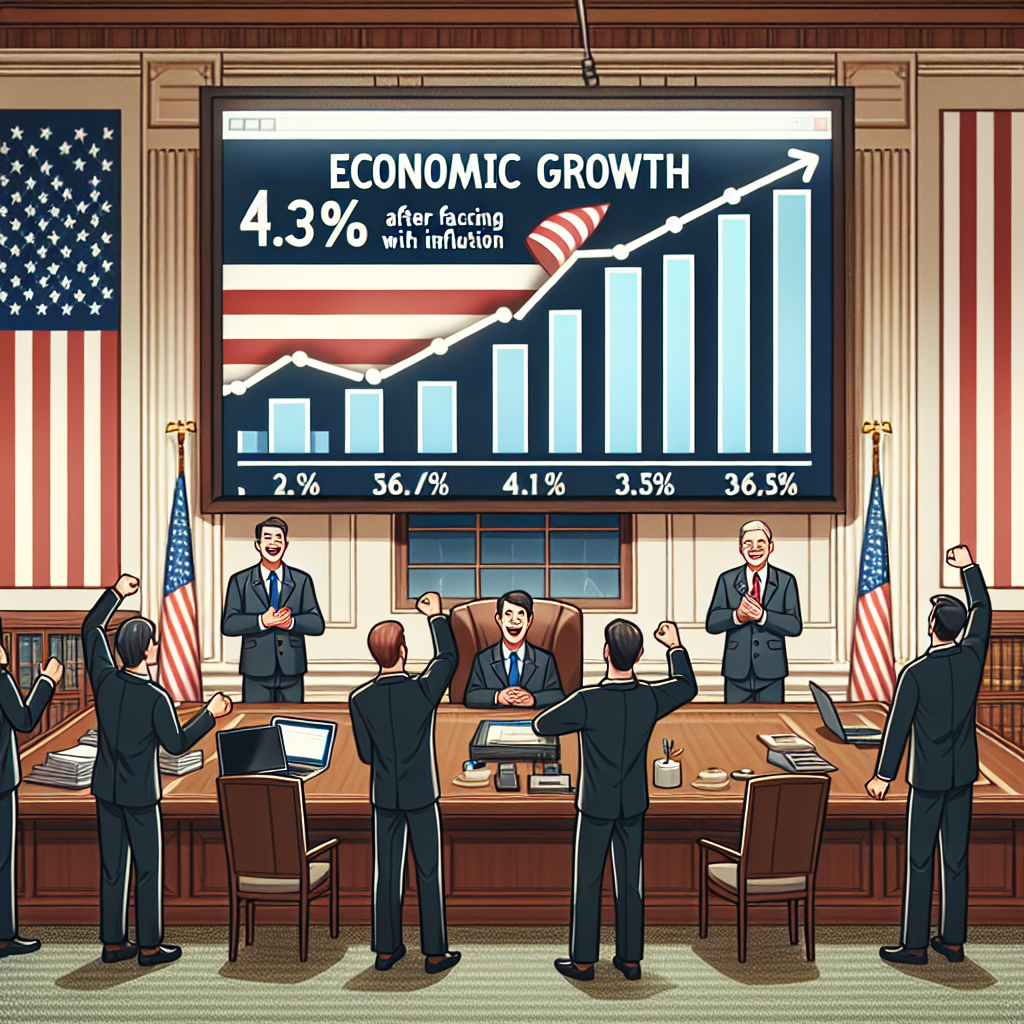
The United States government led by President Donald Trump has received an exciting piece of news: strong economic growth in the third quarter of this year. Even after factoring out inflation, the economic growth rate reached 4.3%. This data boosts confidence in the White House and may help solidify President Trump’s approval ratings, as they seemed to have plateaued before. This report will undoubtedly bring exciting news.
President Trump returned to the White House this year amidst predictions of imminent economic collapse as he initiated a protectionist/tariff offensive. The last time the U.S. imposed such high tariffs dates back to the 1930 Smoot-Hawley Act. Many economists believe that the Act exacerbated the economic crisis at that time. The lesson learned was so profound that post-World War II, all tariff powers were transferred to the executive branch because of concerns that Congress was incapable of effectively exercising that power.
Contrary to expectations, tariffs did not severely impact the economy but instead benefited GDP reports due to the calculation method of Gross Domestic Product (GDP). Exports increase the GDP calculation, while imports decrease it. President Trump’s entire economic policy revolves around promoting exports and imposing tariffs on imports. Therefore, GDP data may appear better than the actual situation.
Nonetheless, this report does indeed reflect economic growth, which is reassuring.
At the same time, there are some noteworthy caveats worth mentioning. This comforting report was released in the midst of years of chaotic GDP data and reports, which raised deep skepticism about the credibility of these numbers. The sharp decline in GDP and rapid rebound post-global pandemic lockdowns leave room for questioning. To what extent did economic turmoil occur during that period? Can we truly quantify the level of chaos we experienced during that time using these figures? How much (if any) of the suffering we endured in that period was alleviated by the decline in GDP?
It remains unclear whether the growth data from 2021 to 2024 is reliable and to what extent. For that period, data reports themselves have been reduced, with employment reports and inflation data showing discrepancies. Adjusting the data to align with industry independent reports reveals that the economy did not grow but experienced a decline.
Moreover, one cannot help but question, what does growth mean after experiencing such turmoil? If all we do is rebuild what was destroyed, in the end, we have no net gain. Just as after a hurricane hits your house, and you rebuild it, you remain at a net loss because you invested resources in a project that could have been avoided. Additionally, surface-level economic growth may be more due to anomalies in report time spans.
Of particular concern is that considering a longer time span stretching back to the 1950s, when quarterly actual growth rates of 5% to 10% were not uncommon. High birth rates, lower fiscal deficits, controlled government spending, and high savings rates meant investments could be made without significant leverage. These conditions no longer exist today. Furthermore, current economic growth relies on astonishingly high leverage rates.
In the financial markets, it is challenging to find individuals who genuinely believe that the current market is stable. In fact, almost everyone privately acknowledges that we are amidst the biggest bubble in history, on the verge of bursting. Indeed, few can fathom why the bubble has not burst yet.
Personal savings rates continue to decrease, currently falling to 4.7%. In comparison, these figures were 10% and 12% in the 1950s and 60s. Total corporate debt has just surpassed $14 trillion. Such figures were unimaginable 50 to 75 years ago when companies were expected to operate debt-free and pay dividends. Today, any company not leveraging to the fullest extent risks being downgraded for missing out on profit opportunities.
Looking closely at the artificial intelligence sector, sometimes we find that a few highly leveraged companies are merely investing in each other, boosting stock prices through mutual endorsements. One cannot help but question how much of this is genuine or if it should be labeled as “artificial innovation” instead? It is indeed hard to say.
What truly worries me is that much of what we call economic growth is not actual growth but unsustainable debt supported by fiat currency. This situation cannot last indefinitely, yet we do not know when a turning point will arrive.
Furthermore, it is disheartening that the achievements that could have been realized over the past thirty years have not materialized. By historical standards, the past few decades resemble relative stagnation. Given the plethora of innovations emerging in our lives – from internet databases to the app economy to artificial intelligence – this situation seems particularly perplexing. All these innovations should have propelled significant economic growth, with growth rates on par with the Gilded Age of the 19th century U.S., which lifted a significant portion of the population out of poverty. Yet now, we can barely sustain growth rates of 2% to 4%, often experiencing economic recessions and crises.
The reality we face now is a regrettable one: missed opportunities. We should have experienced robust development, yet now we struggle to maintain economic operations.
The primary reasons for sluggish economic growth are inflation and an excessively large government that severely impedes growth. In essence, these are just two manifestations of deeper issues with the fiat currency system. The currency system collapsed over half a century ago, and we have yet to recover from that disaster.
In conclusion, this new GDP report has injected a new vigor into the Trump administration and instills optimism in the public for the Republican mid-term elections. This is said under an important premise: inflation must be brought under control to allay fears among the populace about the increasing cost of living. This is the most direct and challenging issue affecting the American people.
The views expressed in this article are solely those of the author and do not necessarily reflect the stance of the newspaper.