
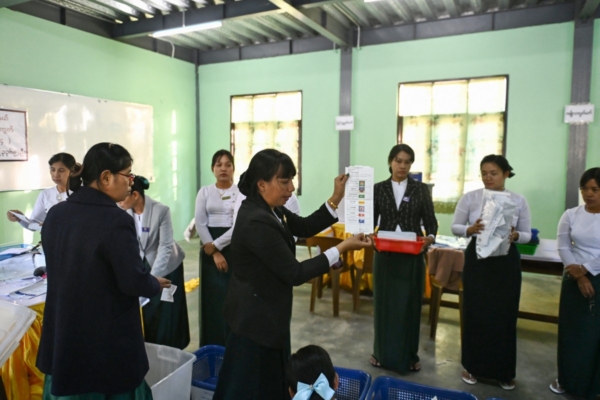
On Sunday, December 28, amid the shadows of civil war and doubts about the fairness of the election, Burmese voters began casting their votes in the general election. This is the first election held since the military coup in Myanmar in 2021 that overthrew the previous civilian government. The international community has condemned this election led by the military government as a “sham” election.
Polling stations opened at 6 a.m. local time on Sunday and closed at 4 p.m. According to the Union Election Commission, a total of 21,517 polling stations were set up nationwide. Sunday’s election marked the first phase of the three-stage Myanmar general election, with the remaining two stages scheduled to take place in January.
The military-backed election commission stated that over 50,000 electronic voting machines will expedite the vote-counting process, but did not specify when the results would be announced.
Since coming into power, the military government has claimed that holding the election would be an opportunity for the country to restart politically and economically. However, the United Nations, the European Union, some Western countries, and human rights organizations have condemned this election, viewing it as unfree, unfair, and untrustworthy, with no anti-military government parties allowed to compete.
Five years ago, the Myanmar military staged a coup, overthrowing the National League for Democracy government, which had won the 2020 Myanmar parliamentary elections, and arrested leaders like Aung San Suu Kyi. The party led by Aung San Suu Kyi was also dissolved, and the overthrow of the civilian government sparked a brutal civil war in Myanmar.
Observers noted that with support from the Chinese government, the Myanmar military government is attempting to legitimize its power to break free from this destructive deadlock.
Analysts cited by Reuters pointed out that the military government’s attempt to establish a stable regime amidst the conflict is unlikely to succeed, as any military-controlled government disguised in civilian apparel would struggle to gain broad international recognition.
In this election led by the military government in Myanmar, only six parties were allowed to participate at the national level, while 51 other parties and independent candidates could only participate at the regional or state level. Many parties that participated in the previous two elections have been dissolved, and anti-military government armed groups have refused to participate.
Under a new law, over 200 individuals opposing or causing disruptions to the election may face prosecution, with severe punishments including the death penalty.
Since the military seized power nearly five years ago, a large number of people have fled the war-torn country, including many young men of conscription age. Even among the youth remaining in Myanmar, there is little enthusiasm for participating in the election, with international human rights activists denouncing the vote as a sham.
The European Parliament issued a statement before the Myanmar election, calling it a “sham election.”
The European Parliament stated that Myanmar’s military coup has faced opposition from a resistance alliance composed of various ethnic groups, leading to widespread human rights violations due to the brutal crackdown by the military government.
The military government has fueled the proliferation of illicit activities, including fraud centers and opium cultivation.
With support from major arms suppliers like China and Russia,
controlling only 20% of the national territory, Myanmar’s military government is preparing for the national election. Several institutions, including the United Nations Independent Expert on the Situation of Human Rights in Myanmar, have labeled this election a “farce,” with experts suggesting that it is more an attempt by the military to seek international legitimacy.
UN Special Rapporteur on the situation of human rights in Myanmar, Tom Andrews, stated on Sunday that this election is not the way for Myanmar to escape its crisis and must be strongly opposed.
According to Reuters, the Myanmar election is divided into three stages. The first stage took place on Sunday (December 28), covering 102 townships; the second stage is scheduled for January 11, 2026, covering 100 townships; and the third stage will be on January 25, covering 63 townships. The election will encompass 265 of the 330 townships in total. Myanmar’s military leader, Min Aung Hlaing, acknowledged that the election did not cover all regions in the country.
Due to ongoing conflicts between the military government and ethnic and democratic armed forces in some mountainous border areas and central plains, certain regions in Myanmar will not hold elections. A year ago, these anti-military armed forces dealt a series of blows to the military, and many opposition groups once hoped that the military leaders would be overthrown, ending their dominance over Myanmar’s politics and economy. However, this year, the military government conscripted tens of thousands of soldiers under a new conscription law and received support from China in modern weapons, enabling them to recapture some territories.