
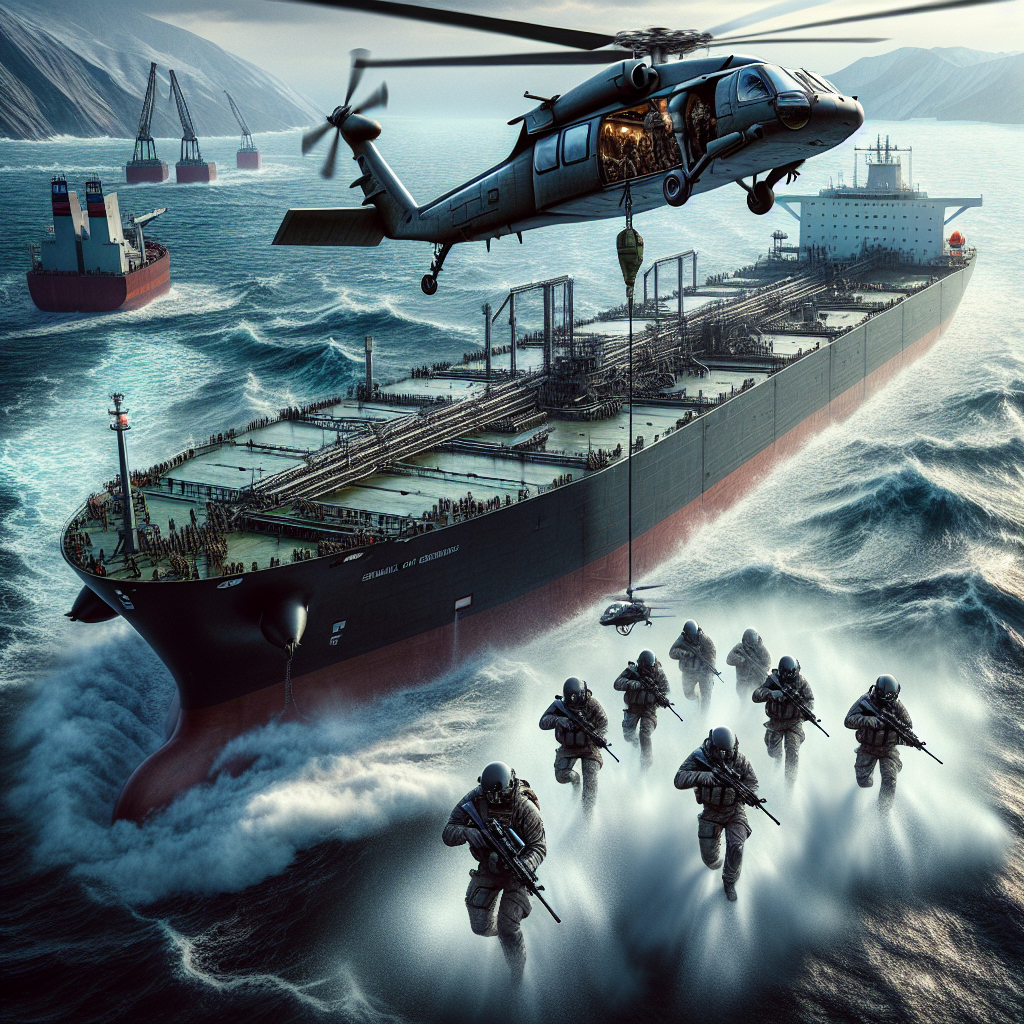
In the footage we are currently viewing, a US military Seahawk helicopter is seen approaching a large oil tanker departing from Venezuela. The helicopter hovers above the tanker, and then US special forces personnel descend onto the tanker, armed, enter the tanker, and take control of it.
The captured US tanker is named Captain, and the video was filmed on December 10, 2025. This marks the first capture of an oil tanker by the US military in the Caribbean. US President Trump announced on December 17th the “comprehensive blockade” on sanctioned oil tankers traveling to and from Venezuela. At least three oil tankers have been captured by the US in the Caribbean so far. Today, we will focus on the latest situation in the Caribbean, especially in Venezuela.
Satellite images of the Captain tanker show the vessel loading 1,100,000 barrels of crude oil at the Jose port in Venezuela before departing eastward. During the operation, the ship continuously transmitted falsified AIS location information.
AIS, the Automatic Identification System, is primarily used for ship identification and ensuring navigation safety. However, in recent years, countries like Iran, Venezuela, and Russia have operated numerous shadow fleets, using these tankers to transmit falsified AIS location information to deceive other nations.
From November to December this year, AIS signals showed the vessel near the coast of Guyana. However, through satellite images taken on November 14th and 18th, it is confirmed that the ship was actually operating near Venezuela. The images captured the ship loading crude oil at the Jose petroleum dock in Venezuela.
The Captain tanker has been under sanctions by the US Treasury Department since November 2022. Its shipping records include multiple instances of loading crude oil from Venezuela and Iran. After its journey to Iranian waters, the AIS records show a two-month gap. With the vast amount of oil it carries, its destination is China.
In February and July, the Captain tanker transported over a million barrels of Iranian crude oil to China. By examining open-source intelligence analyses on the ship’s recent voyages, not relying on AIS systems but verifying the ship’s location through satellite images. From March to September this year, the tanker transported oil from Iran, crossing the Indian Ocean, the Malacca Strait, arriving near Guangdong, China, and then journeying to Africa. On October 3rd, satellite images captured it west of Madagascar, crossing the Cape of Good Hope, and reaching Venezuela.
In February, the Captain tanker delivered 1,800,000 barrels of oil from Iran to China, followed by another 1,950,000 barrels in July.
On December 20th, a second oil tanker departing from Venezuela was seized by the US. The operation, led by the US Coast Guard, similar to the previous one, saw a tactical team boarding the vessel, which was detained in international waters. US Homeland Security Secretary Noem shared a seven-minute video of the operation. The video, likely filmed in the morning, shows a US Seahawk helicopter circling the tanker, then landing on its deck, while the Coast Guard ship closely monitors nearby.
The large tanker, named Century, flies the Panamanian flag, but has also flown the flags of Greece and Liberia in the past five years.
The Century is a very large crude carrier, with a tonnage of 300,000 tons, a length of 333 meters, and construction dating back to 2001. This scale comparison illustrates that its tonnage is three times that of the US Ford-class aircraft carrier.
Public data indicates that the ship is owned by a Chinese company, Century Shipping, but has been registered in Panama since 2021.
Military enthusiasts, using satellite images, discovered that the Century loaded 1,800,000 barrels of crude oil at the west berth of the Jose port from December 7th to 11th. On December 18th, another satellite image captured the ship sailing eastward off the coast of eastern Venezuela, escorted by three Venezuelan naval vessels, until reaching the end of Venezuela’s exclusive economic zone.
This marked the Century’s seventh trip to Venezuela. US officials suggest the ship is suspected of transporting sanctioned oil, part of the shadow fleet aimed at evading international sanctions. Venezuela exports approximately 749,000 barrels of oil per day, with at least half going to China. Despite Venezuela’s oil production being less than 1% of global supply, the announcement of sanctions resulted in a 3% increase in US West Texas Intermediate crude futures to around $56.5 per barrel.
On December 21st, the US announced the seizure of a third tanker, named Bella I, registered in Panama.
When US forces approached the Bella I, it did not fly a valid flag, rendering it a stateless vessel subject to boarding inspection under international law. The US authorities obtained a detention order from a federal judge based on Bella I’s prior involvement in Iranian oil trade, not its connection to Venezuela. However, the ship refused inspection and continued sailing, prompting a US Navy pursuit resulting in it being boarded.
Bella I, due to its prior involvement in Iranian oil trade, was sanctioned by the US Department of Commerce, not due to its ties with Venezuela. As the vessel did not comply with inspection and attempted to evade, it steered into the Atlantic.
The ship remains at large, evading capture for a week now, with the US Coast Guard continuing its pursuit. The Guard awaits a specialized Maritime Security Response Team for boarding operations.
The full name of this team is the US Coast Guard Maritime Safety and Response Team, established in 2006 following the events of 9/11, with a core mission of maritime counter-terrorism, high-risk boarding, and assault operations. In essence, they are the Coast Guard’s special forces.
Some may wonder why the US Coast Guard, rather than the Navy, is executing these operations in the Caribbean, and this is due to US laws. The military does not engage in law enforcement activities unless specifically authorized by Congress. The detention of oil tankers is a law enforcement action, not a combat operation.
Bella I was built in 2002 and is a very large crude carrier, with a tonnage of 300,000 tons. The ship has changed names several times and was previously known as Overseas Mulan. At present, all three large tankers appear to have intricate connections with the Chinese government. Two had sanctions imposed by the US Department of Commerce for their oil trade with Iran and are now involved with Venezuela.
Currently in China, the cost of domestically extracting oil is higher than importing it from overseas. The primary source of imported oil is not Western countries, but third-party states with good relations with China, such as Venezuela, Angola, Iran, and Russia. These countries face international sanctions, resulting in their oil being sold at low prices. China utilizes shadow fleets to import this oil, refines it domestically, and exports it internationally.
Therefore, the lack of success of recent Western economic sanctions can be attributed to the involvement of China. Venezuela heavily relies on oil exports for its economy. Trump’s decision to block Venezuela’s oil imports and exports not only weakens the Venezuelan economy but also impacts China’s interests.
Meanwhile, the US continues to bolster its military presence in the Caribbean. The Ford-class aircraft carrier strike group has been deployed in the region for two months. It is accompanied by a Wasp-class amphibious assault ship, two San Antonio-class amphibious transport docks, two Ticonderoga-class cruisers, at least five Burke-class destroyers, and at least one attack nuclear submarine.
Recently, the US Air Force deployed F-35 fighter jets from the mainland to an airbase in Puerto Rico. F-35A fighters from the 158th Fighter Squadron of the Vermont Air National Guard have arrived at Roosevelt Roads Naval Base in Puerto Rico for the Southern Spear operation. Military enthusiasts captured footage of at least 11 F-35 fighters, with one seen moving at low speed.
Many may be aware that F-35 fighters have previously been deployed in the Caribbean. However, this time, a new development is the deployment of F-35A fighters, belonging to the Air Force, capable of carrying and targeting 2,000-pound precision-guided bombs deep into Venezuelan territory. Unlike the F-35B variants, F-35A jets can carry larger munitions and have better range.
Over the past week, various US military aircraft have been flying along the coast. A US Navy F/A-18 Super Hornet was circling north of the Venezuelan capital, Caracas, less than 50 kilometers away, as of December 18th.
Many might question when, if ever, the US will take military action considering the prolonged build-up in the Caribbean. Trump’s decision to engage in conflict is uncertain. Given the festive season and lack of immediate urgency in resolving the Venezuela situation, military action seems unlikely in the remaining days of 2025. The unique circumstances of Venezuela, distinct from Iran’s nuclear threat, leave the US with minimal urgency for intervention.
In conclusion, the likelihood of military strikes in Venezuela remains uncertain in the near term.