
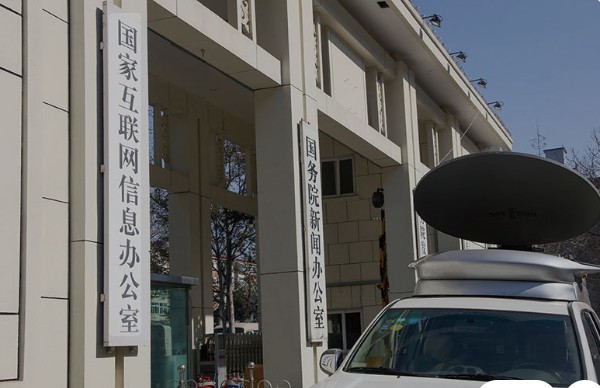
The Chinese Communist Party’s Cyberspace Administration recently issued new regulations for managing internet celebrities, explicitly prohibiting expressions such as “lying flat” and “being lazy,” sparking public backlash. This move comes after Chinese President Xi Jinping emphasized strengthening the governance of self-media and online platforms at a Political Bureau meeting, making it the latest regulatory action by the CCP’s Cyberspace Administration.
On December 26th, the Cyberspace Administration of China released a notice regarding the management of online celebrity accounts, listing 13 “negative behaviors” that are prohibited for influencer accounts with a large number of followers. The notice explicitly bans the promotion of ideologies like “lying flat and being lazy,” “decadent and nihilistic attitudes,” “flaunting wealth and materialism,” as well as intentionally using language in a non-standard manner and “fabricating nonsense and bad puns.” Furthermore, it prohibits actions such as “taking things out of context, interpreting national policy in opposition,” and “collecting negative information in the name of ‘proxy rights protection reporting.'”
This list quickly sparked strong backlash on the internet. Some netizens bluntly stated: “Even talking about lying flat and being lazy is not allowed, this has reached a point where not praising is considered to have an ulterior motive.”
Others sharply pointed out: “One cannot work hard openly for fear of being criticized; one cannot be lazy and carefree openly for fear of being labeled politically incorrect, so in the end, everything has to be done sneakily.” Critics believe that the authorities are categorizing the everyday struggles of ordinary people as “negative energy.”
Earlier, on November 28th, Chinese leader Xi Jinping emphasized the need to “improve the long-term mechanism for governing the online ecosystem” during the 23rd collective study of the Political Bureau, urging for enhanced guidance on online platforms and self-media to “use the internet to spread China’s voice and tell China’s story well.” This set the tone for recent regulatory actions.
Political blogger “Yuan Cheng” pointed out that the authorities are directly targeting the popular lying flat and lazy cultural trends, but these expressions actually reflect the real-life challenges faced by young people – unable to afford homes, unable to get married. “Everyone can only self-deprecatingly say lying flat and being lazy, and now this is defined as negative worldly-wise.”
This new regulation was not introduced suddenly. Since September of this year, the Chinese Communist Party’s cyberspace authorities have launched multiple rounds of internet rectification.
In September, citing reasons such as “hyping up celebrities’ personal lives” and “hot search lists filled with negative information,” the Cyberspace Administration of China summoned and penalized mainstream platforms like Xiaohongshu, Weibo, and Kwai. Prominent internet celebrities accounts such as Hu Chenfeng, Zhang Xuefeng, and Lan Zhanfei with tens of millions of followers were successively banned or restricted, making it the strictest “celebrity gossip ban” in the history of the CCP’s Cyberspace Administration.
It is reported that the catalyst for this crackdown was the death of actor Yu Menglong in a fall on September 11th. Various speculations about his cause of death quickly spread on the internet, prompting successive actions from the Cyberspace Administration.
On September 22nd, the Cyberspace Administration of China announced a two-month special operation called “Cleaning up and rectifying maliciously instigating negative emotions,” targeting discussions on social, political, and economic issues.
However, the lack of transparency in official control measures has raised doubts. The Shandong Provincial Party Committee’s official newspaper, “People’s Daily,” published a rare article on October 1st criticizing the reasons for banning internet celebrities as “mostly cryptic,” lacking specifics on why users were penalized, based on what criteria, and what avenues for appeal were available.
The article pointed out that internet celebrity accounts are often core assets of companies, affecting the livelihoods of tens or hundreds of employees, yet the disposal process lacks transparency. The article called for “clear rules are better than guessing games.”
In response, former Chinese media personnel and political observer Zeng Jieming told the Epoch Times that this indicates internal divisions within the CCP regarding speech control.
“Yuan Cheng” believes that the Cyberspace Administration is ostensibly cracking down on “gossip and negative energy” under the guise of “cleaning up” the internet, but the real purpose is to stifle discussions on societal contradictions. “Rather than singular complaints, the authorities fear the spread of resonating voices. Lying flat has become the language of a generation; it is a silent form of resistance.”