
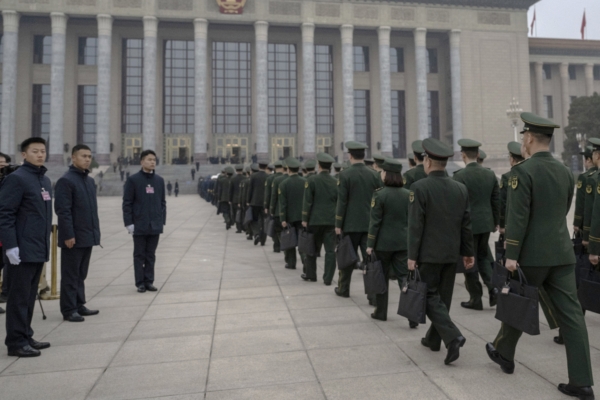
[Epoch Times News December 26, 2025] This September, behind the neatly lined-up parade formations in the Beijing military parade, few truly see the daily lives of the Chinese Communist soldiers. Soldiers who are stationed for long periods, under strict control, and separated from their families face uncertainty upon retirement. The corruption within the Chinese Communist military has made the soldiers’ morale unstable, rendering hollow Party leader Xi Jinping’s slogan of “being able to win wars.”
After 1949, especially during the Cultural Revolution, joining the military became a rare way for rural Chinese youth to change their destinies. However, after the so-called reform and opening up in 1979, the appeal of military service gradually declined. The 1989 Tiananmen Square incident dealt a heavy blow to the image of the Chinese Communist military. Since then, Chinese Communist soldiers are not allowed to serve in their home provinces to prevent them from siding with the people in protest activities. The one-child policy in China has also made joining the military more difficult, as soldiers need to be stationed for long periods, leading to no one being available to care for elderly parents.
Today, the main recruits for the Chinese Communist military still come from rural areas, but the military has significantly raised the educational requirements. The revised “Military Service Law” in 2021 and the “Military Conscription Regulations” in 2023 both emphasize recruiting university students as the focus.
An employee named Wu Wei (pseudonym) from a military vocational school in Beijing (referred to as the “Military Transition College”) told Epoch Times that before 2023, there were still many people with a high school education serving in the military, but this number significantly decreased after 2023.
The youth unemployment rate in mainland China is rising, and the official Chinese media continuously extols the image of soldiers, with military salaries and benefits becoming more competitive. However, the treatment of retired soldiers remains unbalanced.
Serving in the military in China can bring significant losses to one’s future job prospects.
Wu Wei said that times have changed, and finding a job after serving in the military may be even more challenging than for university students. “University students (end up unemployed) are already in a tough spot. For example, someone who has gone to university and then joins the military, serving for 2 or 5 years, comes out at an older age, forgetting what they learned in university, and unable to apply the skills taught in the military. For example, if they studied bomb disposal, what job can they find? Or if they studied tank maintenance, where are there tanks to repair outside?”
As a result, discharged soldiers have to change their direction themselves, such as by taking the civil service exam. Wu Wei said the government has already given them money and won’t arrange jobs for them anymore. Only non-commissioned officers who have served for 12 years have a chance of getting job placements; ordinary soldiers are not considered.
However, becoming a civil servant requires a diploma from a higher education institution. If one fails to become a civil servant, they can only learn new survival skills. Wu Wei mentioned that 90% of their students are former soldiers who couldn’t find jobs, so they learn skills such as content creation, video production, and more.
Unlike the United States, China does not have a comprehensive system of education or medical support for retired soldiers. Many retired soldiers end up working in security-related jobs, act as security guards, or become “employed thugs.”
Wu Wei stated that those with higher education backgrounds, such as communication experts in the military, can generally find corresponding jobs after discharge. However, those who only have completed primary or secondary education might have spent their discharge money and struggle to find other work, leading to options like working as security guards or going to factories like Foxconn.
Xiao Hua mentioned that finding work after discharge is indeed challenging. When he was in the military, he served in logistics, answered phones in the office, and cleaned. After returning home, he worked as a delivery driver, a full-time firefighter, applied for courier and security jobs.
“Years of enclosed training in the military have disconnected me from society. I lack resources and credentials. Most of the skills I learned in the military are no longer applicable, leading to confusion and helplessness about the future,” he said.
During their service in the Chinese Communist military, many soldiers gradually became aware of internal flaws within the system. Bureaucratic culture and instances of “superiors pressuring subordinates” are more prevalent within the Chinese military than in most other countries’ armies.
The Chinese Communist officer system is weak, and promotion opportunities are quite limited. The severe influence of the culture of corruption is widespread, and the practice of selling military ranks is common in the Chinese military. Following the downfall of several “old military tigers” such as Xu Caihou and Guo Boxiong, in recent times, two successive top personnel managers in the military, Zhang Yang and Miao Hua, were accused of corruption and toppled.
Despite President Xi Jinping’s three terms in office and continuous efforts to combat corruption, the issue remains rampant. Most top military officials who have been taken down in recent years are those he personally promoted. Xi Jinping, who never served in the military, rose to the rank of general and controlled the overall military operations but was relieved of his duties due to his involvement in corruption.
Due to the widespread corruption in the military, the negative impact extends to the mechanism for soldiers’ post-discharge arrangements.
Xiao Hua mentioned that it’s not easy for soldiers whose service terms have ended to stay in the military (to transition into permanent soldiers; professional soldiers with full-time positions). “Many assessments are required, and you even need to pay 100,000 yuan,” he added.
Wu Wei also stated that staying in the military relies on connections. “The military is still quite dark. You need to pay tens of thousands, or else you can’t stay,” he said.
He complained, “Corruption is mainly pervasive among the top leadership in the military. If the leaders are corrupt, the subordinates will naturally follow suit. If you want to stay, you have to give gifts. Even non-outstanding individuals can stay by giving gifts. Then how can I protect my home and country? It will definitely make one selfish.”
Wu Wei disclosed that some units outright demanded 100,000 yuan to allow soldiers to stay. “They can directly say this without fear of being recorded. How corrupt is that? For example, a very outstanding discharged soldier, suitable in all aspects, but if they haven’t paid money, they will not be allowed to stay. The impact of this is enormous.”
A former Chinese female soldier named Bai Liusu, speaking in a previous interview with Epoch Times, remarked on her time being assigned to a communication unit in Beijing:
“When new recruits arrived, they were physically abused, and the squad leader even made us undress in a perverted manner. They demanded money from us, and we had to comply. Some female soldiers were forced by leaders to accompany drinking sessions. Two female soldiers who were promoted in the same year at Jingxi Hotel, everyone said they gained promotions through accompanying superiors for ‘private activities’ after drinking, which was particularly disgraceful.”
Bai Liusu also revealed that a male soldier from Shanxi was badly injured to the point of necrosis of the femur from being beaten in the new recruits’ platoon.
Xi Jinping urged the military to “listen to the Party’s commands, be capable of winning battles, and have good conduct.” However, Canadian writer and senior commentator Sheng Xue told Epoch Times that corruption at the top levels within the Chinese Communist military has become systemic. Middle-ranking military officers perform tasks passively, and rank-and-file soldiers are merely forced to obey, lacking genuine combat capability or strong will.
She used the example of the Sino-Indian border conflict in the past few years to illustrate that the Chinese Communist Party (CCP) dares not truly engage its military in combat but also wants to maintain its authority, resulting in the CCP’s soldiers becoming sacrificial pawns. After conflicts, the CCP desperately tries to conceal casualty figures.
“It is foreseeable that more and more soldiers will realize they are not fighting for the country but are risking themselves for the highest interests of the CCP’s interest group,” she said.
On September 3 this year, the Chinese Communist Party showcased its military might, flaunting its latest weapons and soldiers’ prowess. However, videos circulated online after the parade revealed that many soldiers had severely sunburned skin on their arms, legs, and necks after removing their uniforms post-parade.
The living conditions for Chinese Communist soldiers have long been very basic, and although there have been some improvements in terms of food, life on the base remains monotonous. Especially in remote border regions, there are hardly any entertainment facilities. Military marriages also face challenges, with some soldiers spending only about 40 days a year with their spouses and having to wait over 10 years to be granted permission to live with their families. Military wives face restrictions in divorce proceedings as well. These systems were originally meant to stabilize military morale but have made it more difficult for soldiers to start families.
In their daily routine, Chinese Communist soldiers, like soldiers of other nations, engage in activities revolving around maintenance and training. However, the emphasis within the Chinese Communist military is on political loyalty, with political commissars responsible for soldiers’ ideological education and morale, while also supervising the political loyalty of officers.
Military life is closed off and highly controlled, and it wasn’t until 2015 that Chinese Communist soldiers were allowed to use mobile phones. Even then, they face stricter monitoring and restrictions compared to Western armies.
Xiao Hua, a retired soldier from Henan, mentioned the strict regulations on smartphones within the military, as they are afraid of soldiers leaking information. “Using smartphones is allowed, but there are limited time regulations. In my unit, we only had access to our phones on Sundays; the rest of the time, they were kept in custody.”
A recent report from a Chinese Communist military newspaper exposed the dilemma faced by military personnel in managing the use of mobile phones. The report stated, “Some departments have strict regulations, and soldiers are not allowed to use their phones, leading to difficulties in gathering personnel information during emergency situations. In other departments with less stringent management, a soldier was caught playing mobile games during class.”
The Chinese Communist Party has tightened its management of both officers and soldiers, as reflected in related documents. In June 2023, the Chinese Communist military issued a document governing the social interactions of military leadership personnel, urging them to continually purify their social circles, living environment, and friends’ circles. On December 23, 2024, a Chinese Communist military newspaper emphasized the need to crack down on the violation of circumventing the Great Firewall – that is, bypassing the internet restrictions to access outside information freely.
Sheng Xue told Epoch Times that this official information reveals that in the past, Chinese Communist soldiers were cut off from the outside world, but the situation is changing. The fact that the military newspaper strictly prohibits circumventing internet restrictions indicates that there are still numerous covert channels within the military to access free information. (Previously reported: Former Armed Police personnel flee China, reveal inside story of CCP military thought control.)
On November 11, General Zhang Youxia, Vice Chairman of the Chinese Communist Military Commission, published an article in the People’s Daily, demanding firm prevention of being “two-faced,” embedding core values maintenance and CCP obedience into the minds of officers and soldiers.
Wang Yonghong, a former Chinese Communist military officer now living in exile in the United States, told Epoch Times that brainwashing within the military is more severe than the general populace. Scheduled political studies are conducted, but, in his case, the CCP’s political indoctrination was not entirely successful.
“I spent 10 years in the military, and the Communist Party didn’t shape me into what they wanted. Instead, they pushed me to a completely different direction they never expected. They wanted me to be a loyal party member, I spent 10 years in the military without joining the Party, and I was openly against the Party,” he said.
Wang served in the military from 1989, later attended military school to become an officer, stayed in the military for a decade, then transitioned to work in the China Aviation Port Construction Corporation in 1999. He publicly reported collective corruption within the organization.
Wang participated in the 2013 New Citizens Movement, was arrested and imprisoned in April of the same year, and was rearrested after his release. He fled to the United States in 2018.
Independent commentator Du Zheng revealed in early this year in Taiwanese media a message from within a Chinese Communist military district. Some officers, dissatisfied with the dismal state of the Chinese military, are contemplating emulating the Wuchang Uprising, waiting for the right moment to act. This might occur during Taiwan’s subjugation to the CCP or during a period of chaos following Xi Jinping’s sudden death within the Party. The choice of either of these scenarios is challenging due to the stringent security measures in place within the CCP.
Sheng Xue told Epoch Times that there are still conscientious individuals within the Chinese Communist military, including those who seek freedom and democracy. They may not become heroes of military uprisings, but when China reaches a political turning point, they could be a variable. “When a genuine political change comes, they will stand up, not to oppress the people, and may possibly shift their focus. This scenario is quite common in history.”