
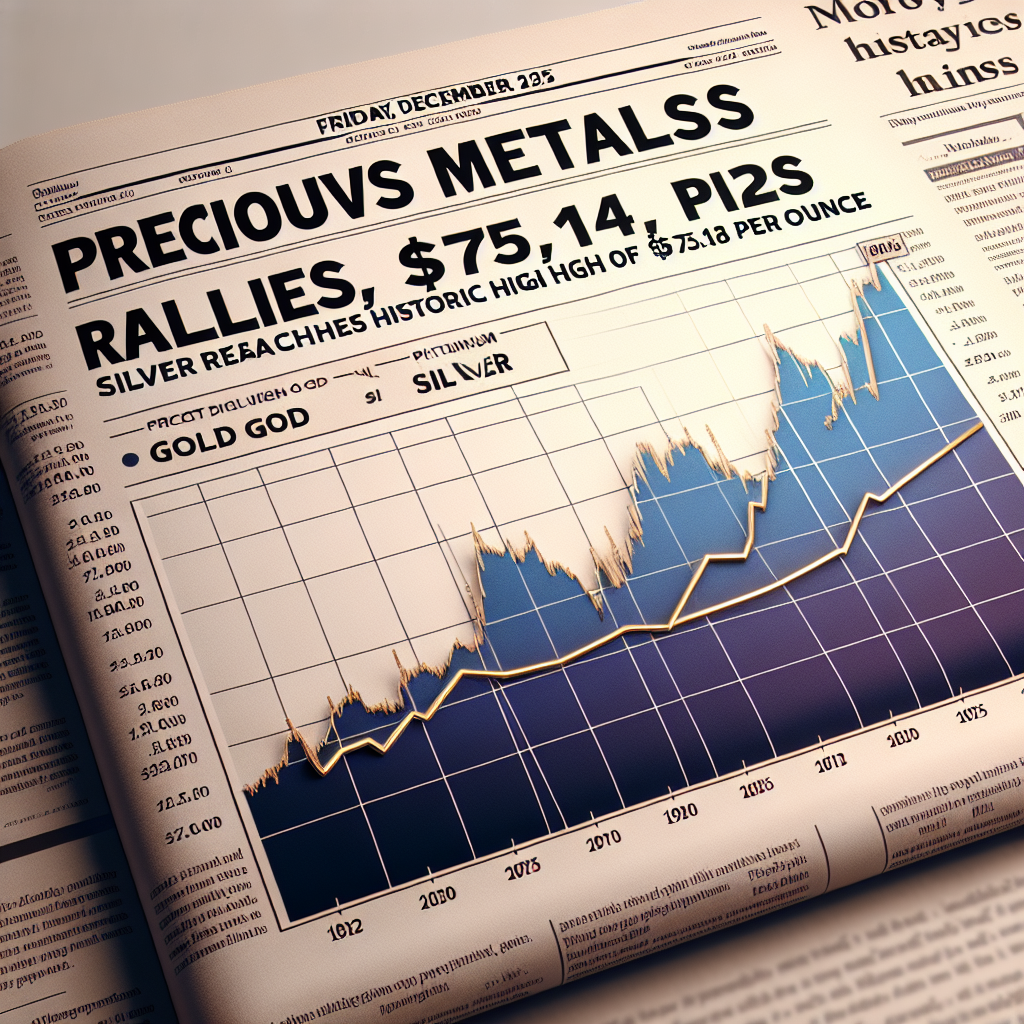
On Friday, December 26, 2025, the precious metals market experienced a strong rally, with the price of silver surpassing the $75 per ounce mark for the first time, reaching a historical high of $75.14 per ounce. Spot gold, silver, and platinum all hit record highs, with spot gold reaching as high as $4,530.60 per ounce.
This record-breaking surge indicates that funds are accelerating into physical assets and safe-haven markets as the year comes to an end.
Furthermore, factors such as the increasing expectations of a Federal Reserve rate cut and geopolitical turmoil are also contributing to the rise in precious metals prices.
Silver has emerged as the leader in the precious metals market this year. Spot silver reached a historical high of $75.14 per ounce on Friday, with an increase of over 4%. Benefiting from structural supply shortages, being classified as a critical mineral in the U.S., and strong industrial demand, silver prices have soared by 158% this year, outperforming gold significantly.
Spot gold hit a new high of $4,530.60 per ounce, with a nearly 72% increase so far this year, potentially achieving its strongest annual performance since 1979.
Platinum surged by 7.8% on Friday to reach a high of $2,429.98 per ounce. Supported by tight supply and demand for automotive catalytic converters, platinum has seen an accumulated increase of around 165% this year.
Palladium also continued its rise by 5.2% to $1,771.14, extending its momentum to hit a three-year high and recording a growth of over 90% this year.
Market analysts point out that this rally is supported by both fundamental and technical factors.
Kelvin Wong, senior market analyst for the Asia-Pacific region at Oanda, told Reuters that since early December, speculative and momentum trading has been ongoing, combined with reduced end-of-year liquidity, pushing precious metals to new highs.
Market expectations of a shift in monetary policy are a major driving factor. Traders generally anticipate the Fed to cut rates at least twice in 2026, with a low-interest environment favorable for non-yielding assets like gold.
Moreover, the U.S.’s “blockade” policy on Venezuelan oil, as well as efforts to combat the Islamic State in Nigeria, have heightened risk aversion sentiment.
Soojin Kim, a commodities analyst at MUFG, informed Reuters that this upward trend is supported by massive central bank purchases, strong inflows into gold ETFs, and concerns among investors about currency devaluation and rising national debts.
Analysts hold a fairly optimistic view on the future of precious metals. Wong suggested that gold may approach $5,000 in the first half of 2026, while silver could potentially reach around $90.
According to Reuters, Jigar Trivedi, senior research analyst at Reliance Securities, highlighted that platinum prices are supported by robust industrial demand, and the replenishing of positions by U.S. inventory holders amid sanction-related concerns also aids in maintaining prices at high levels.
With expectations of rate cuts impacting it, the U.S. dollar index is forecasted to drop by 0.8% this week, marking its weakest weekly performance since July and providing further momentum for the rise in precious metals.
Amid the surge in precious metals, global markets continue to exhibit the peculiar situation of “coexisting risk and hedge sentiment.” On Wednesday, U.S. stocks showed strong performance in the shortened trading session ahead of the Christmas holiday, with the Dow rising by 0.60%, S&P 500 by 0.32%, and Nasdaq by over 0.22%, continuing the year-end “Santa Claus rally.”
At the same time, Asian stocks rose to six-week highs on Friday. The Tokyo Stock Exchange (Topix) hit a historical record, and the Korean stock market led global major markets with a 72% increase this year.
Despite a slight rebound in the Japanese yen under official verbal intervention, it remains at a relatively low level overall. In an environment of uncertain interest rates, exchange rates, and political-economic conditions, precious metals are expected to remain one of the primary havens for funds in 2026.