
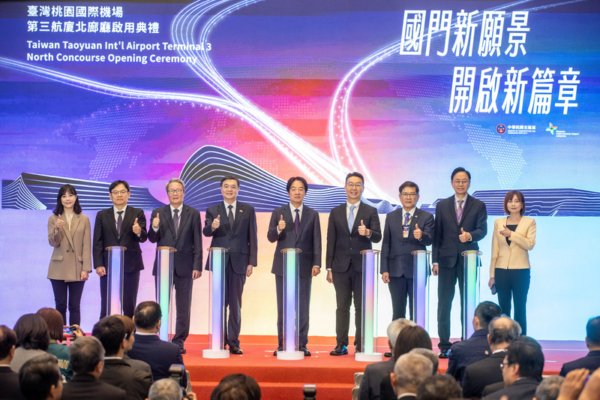
President of the Republic of China, Lai Ching-te, attended the inauguration ceremony of the North Concourse Hall of the Third Terminal at Taoyuan International Airport today (25th). He expressed his hope that the construction of the third terminal at Taoyuan Airport will be completed as scheduled in 2027, leading Taiwan’s economy to new heights.
In the afternoon, President Lai Ching-te, along with Premier Cho Rong-tai, Minister without Portfolio and Chairman of the Public Construction Commission Chen Chin-te, Minister without Portfolio and Chairman of the National Development Council Yeh Chun-hsien, Minister of Transportation Chen Shih-kai, Mayor of Taoyuan City Cheng Shan-cheng, and several legislators and officials attended the event.
President Lai Ching-te stated in his speech that he was honored to host the inauguration ceremony of the North Concourse Hall of the Third Terminal at Taoyuan International Airport and witness a new chapter in Taiwan’s aviation industry. He thanked the administration team for overseeing the progress of the third terminal’s construction at Taoyuan Airport and addressing issues in a timely manner.
He praised the world-class development of the third terminal, designed by the Pritzker Prize-winning architect from the UK. He acknowledged the efforts of the construction team in overcoming challenges and expressed gratitude to the “Taoyuan Airport Alliance,” consisting of 240 civic units and 35,000 individuals, for their dedicated service to passengers. President Lai hoped that the third terminal would enhance service quality and contribute to the further advancement of the national economy.
President Lai emphasized the crucial role Taoyuan International Airport has played in safeguarding the nation’s gateway and connecting Taiwan to the world for decades. With the passenger volume exceeding design standards at the existing terminals, the need for a new terminal is essential to accommodate growth and improve services. He highlighted the importance of the third terminal in supporting various national initiatives such as promoting AI infrastructure, establishing the Asia-Pacific Asset Management Center, attracting international talents, technology, and investment, as well as fostering domestic market demands and tourism industry development.
Moreover, President Lai pointed out the significance of Taiwan’s continued development in the global industry chain and intense international competition. He stressed the imperative role of aviation in securing Taiwan’s presence on the international stage, citing it as a key reason for the proactive planning of the third terminal during former President Tsai Ing-wen’s administration. President Lai’s presidential campaign in 2024 included the “National Hope Project,” where the completion of the third terminal was prioritized as one of the significant policy goals. He outlined three key objectives that must be achieved collectively.
Firstly, the final steel beam of the main terminal’s roof structure will be installed on December 29, aiming for the smooth and timely completion of the third terminal by 2027. Due to the policy of building first and relocating afterward, the construction of the third runway can only proceed upon the completion of the third terminal. President Lai hoped for the project to be completed within the original schedule to avoid surpassing the deadline of 2032.
Secondly, given the expansion of the infrastructure, efficient external transportation is crucial. The completion of the National Expressway No. 1 and National Expressway No. 2 is essential, along with the prompt development of the “Airport MRT A14 Station” beneath the main terminal to alleviate future traffic pressure.
Thirdly, the long-term vision aims to achieve a passenger volume of 83 million, cargo volume of 3.85 million tons, and aircraft movements of 435,000 by 2045 at Taoyuan International Airport, creating an economic benefit of 2.2 trillion NTD.
President Lai emphasized that this vision requires collaboration from central and local governments, construction teams, the airport alliance, and the collective efforts of all stakeholders to ensure the realization of the major goal by 2045.
Premier Cho Rong-tai highlighted that the third terminal excels in international assessments, with clear objectives and timelines. Anticipating the use of significant international projects, such as the Tamkang Bridge, next year, he emphasized the importance of joint efforts between the central government, local authorities, and private sectors in driving national advancements.
President Lai emphasized the continuous progress of the nation and the abundant collective power of the private sector. He urged the parliament to support and assist in the nation’s progress, urging the prompt review of the central government’s general budget. He noted the significance of addressing the budget approval process before the year-end deadline of December 31, which is currently pending at the procedural committee, and appealed to the legislature not to impede the necessary budget for national development and people’s needs due to political reasons.
He expressed that every budget item proposed by the government is carefully considered and aligns with the needs of national and public development. The special defense budget is based on the nation’s self-defense requirements. Lai called for a fair examination of the budget proposals and urged the legislative branch not to obstruct the process for various reasons.
As the year-end approaches, President Lai hoped for bipartisan cooperation to expedite the review of the central government’s general budget and the special defense budget. Following his remarks, he participated in the activation ceremony with dignitaries present and received a guided tour of the North Concourse Hall of the third terminal.