
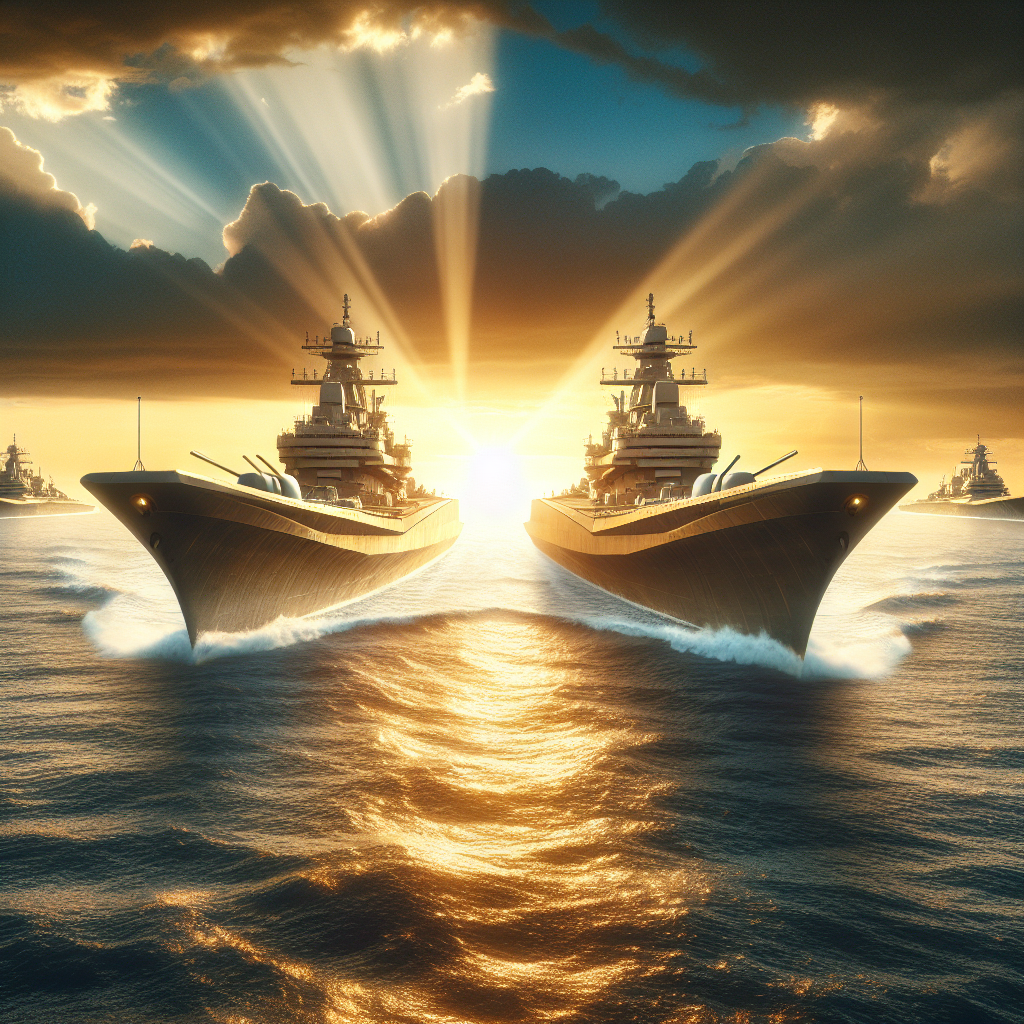
On December 25, 2025, President Trump of the United States announced the construction of two new Trump-class battleships by the U.S. Navy, planning to form the “Golden Fleet.” Experts pointed out that Trump’s declaration is a response to China’s shift from land power to sea power, as the U.S. aims to counter China’s anti-access strategies by projecting naval power towards the coast.
On December 22, President Trump announced the approval of a plan to build two new Trump-class battleships for the U.S. Navy. These battleships will be entirely manufactured in the United States, with faster speeds, larger sizes, and greater deterrent capabilities. The two battleships will be part of the “Golden Fleet,” along with smaller patrol ships.
The Director of the National Defense Policy and Resource Research Institute of the Taiwanese Ministry of National Defense, Su Ziyun, wrote an immediate analysis titled “Trump Battle Ship: From Great White Fleet to Golden Fleet, Sea Power Still at the Core of Geopolitics,” which was published on the official website of the National Defense Institute.
Su Ziyun stated that President Trump’s unveiling of the “Trump-class Battleship” and the plan to build the Golden Fleet has sparked discussions on whether the era of “gunboat diplomacy” is making a comeback. However, Trump’s announcement is not without context, as it aligns with debates within the U.S. Navy on the post-Cold War military buildup, the maturation of new naval technologies such as electromagnetic railguns, and, most importantly, China’s shift from land to sea power, prompting Trump during his first term to emphasize the rebuilding of the First Fleet and revitalizing America’s maritime power.
Comparing President Trump’s homage to the Great White Fleet of President Theodore Roosevelt in the early 20th century with his Golden Fleet concept, Su Ziyun highlighted how the formation of a blue-water navy by China post-1922 Washington Naval Treaty contrasted with the present, indicating a resurgence of maritime power competition.
Analyzing the tactical aspects, Su Ziyun explained that according to information from the U.S. Navy’s official website, the Trump-class battleships are heavily armed. With a displacement of 35,000 tons, a length of 260 meters, and a top speed of 35 knots, their firepower consists of three main arrays. Firstly, the primary armament includes missile systems, such as sea-based cruise missiles carrying nuclear warheads, 12 fast attack missiles with conventional warheads, and a 128-unit vertical launch missile system.
Furthermore, there are gun-based weapons like a 32-megajoule electromagnetic railgun and two 5-inch guns capable of launching hypervelocity projectiles (HVP) to strike low-cost targets like drones or counter incoming threats. The battleship is also equipped with two 300 kW/600 kW high-power laser weapons, capable of intercepting high-altitude supersonic missiles and potentially destroying low-orbit satellites.
Additionally, the battleship features close-range defense systems like RAM missiles, low-power lasers, and anti-drone systems. Su Ziyun speculated that the operational intent of this Trump-class battleship far exceeds that of the world’s largest warship in service, the 25,000-ton Russian Kirov-class nuclear-powered battlecruiser.
Regarding the firepower of the Trump-class battleship, Su Ziyun analyzed that the intended operational levels include nuclear deterrence through the deployment of cruise missiles carrying nuclear warheads as another mobile launch platform, which can complement strategic nuclear submarines to enhance deterrence credibility.
Moreover, there is the objective of deep strikes where hypersonic fast attack missiles (CPS), cruise missiles, and electromagnetic railguns are employed to strike enemy deep-lying areas, while the railgun can provide firesupport in coastal areas.
Su Ziyun further explained the importance of fleet-wide air defense, aside from existing air defense missiles, the high-power lasers are capable of low-cost intercepting high-speed missiles flying at the edge of the atmosphere, potentially intercepting low-orbit satellites. Ultimately, if the Trump-class battleship becomes a reality, it will become one of the core assets of the U.S. Navy fleet, alongside aircraft carriers.
Addressing the concept of the Golden Fleet, Su Ziyun emphasized the strategic implications for the United States, which extends beyond a century-long narrative of maritime power. Starting from the dispatch of the Great White Fleet with white-painted ships in the early 20th century in 1907, on a worldwide voyage.
Su Ziyun stated that the mission of this Great White Fleet was not for immediate combat but a carefully orchestrated strategic demonstration. Externally, it proclaimed that the U.S. had transoceanic projection and logistical capabilities; internally, it convinced Congress and the public that long-term investment in the navy is worthwhile. This reflects Mahan-style naval thinking, where naval power is not just for fighting but also a demonstration of national will.
Su Ziyun explained that following the Washington Naval Treaty of 1922, which led to a reduction in major battleships and the “Navy Holiday,” it sparked debates between the carrier-centric “brown shoe” aviation officers and battleship-centric “black shoe” naval officers, leading to the proposal of the Arsenal Ship in the 1990s and the current Trump battleship, highlighting the considerations of naval cost-effectiveness across different eras.
He further analyzed that this development is a new way to counter China’s anti-access strategies. The primary focus of the U.S. Navy has been to maximize naval power projection ashore to leverage maritime power benefits. In the early 20th century, naval power projection took the form of battleship guns. From the Pacific theater of World War II to the Korean and Vietnam Wars, U.S. warships used heavy firepower to suppress coastal fortifications, facilitating landing operations.
However, this approach required proximity to the shore, with increasing risks as anti-ship missiles and coastal defense systems evolved. After the end of the Cold War, there was a significant shift in U.S. military thinking. During the 1991 Gulf War, the Navy extensively used cruise missiles and carrier-based aircraft, striking command centers, radars, and air defense systems from hundreds or even thousands of kilometers away, paralyzing the enemy’s operational capabilities without the need for landings.
Su Ziyun stated that the U.S. Navy’s power projection ashore has evolved into a more distant, precise, and upgradable strategic tool called “de-landing,” becoming a long-distance, precise, and upgradable strategic tool. Thus, in the 21st century, the U.S. Navy has further decentralized and networked power projection ashore through a combination of surface ships, submarines, aircraft carriers, Marine Corps forward bases, and unmanned systems, forming a cross-domain fire support network.
In addition, he mentioned that the purpose of this design is not to seize territory but to quickly gain the initiative in the early stages of a war, disrupting the enemy’s coastal forces, logistics, and command systems, rendering them fractured and disabled, unable to carry out their missions.
He analyzed that in the context of the Taiwan Strait, this concept is particularly crucial. Through long-range sea and air strikes, the U.S. Navy’s power projection ashore aims to restrain, weaken, or disrupt China’s operational rhythm, buying time and space for allies. The true strategic focus lies in reducing the impact of China’s anti-access strategy, executing long-range blockades against China’s landings and ensuring U.S. influence on the first island chain.