
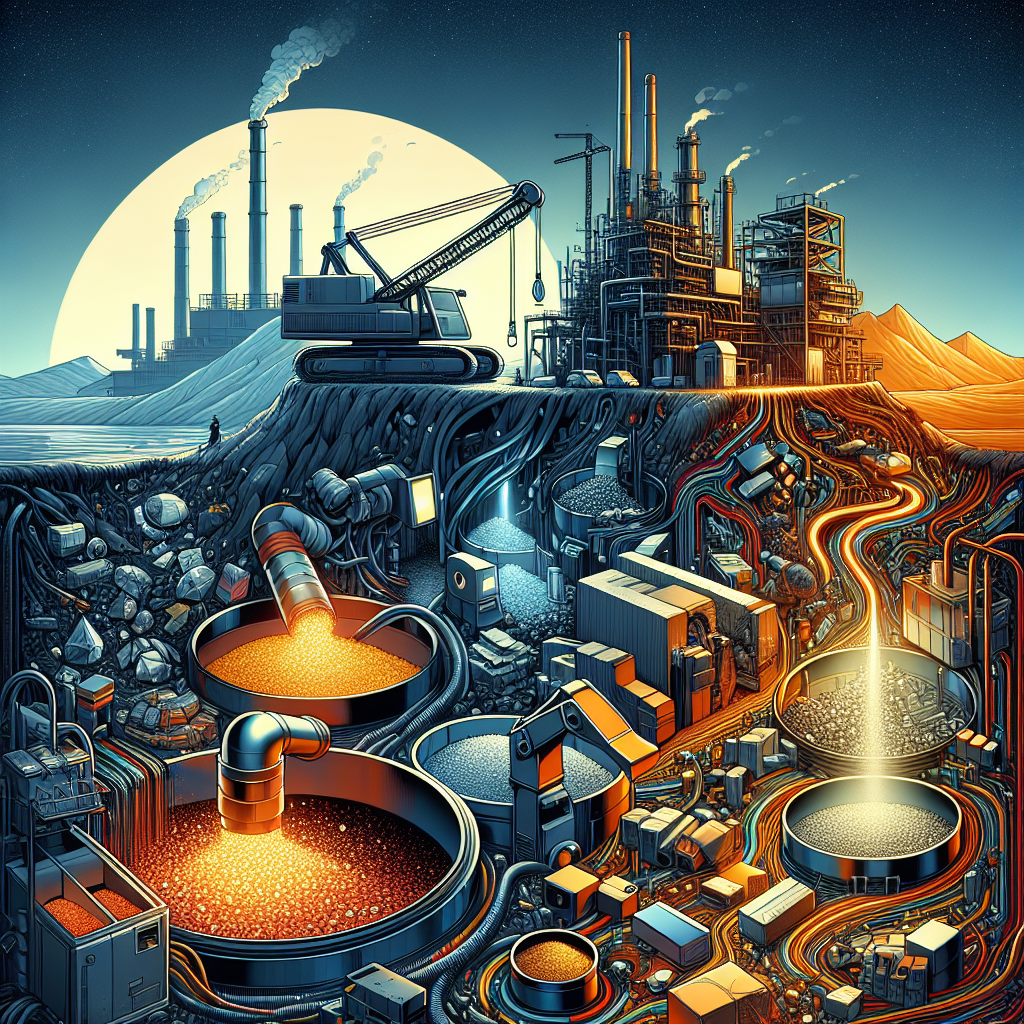
In order to weaken China’s dominance in the critical mineral production sector, the Western world may have found an unexpected method: extracting metals from oil wells, waste streams, and discarded electronics to expand domestic processing capabilities.
In practice, developing new mines takes years. Rather than passively waiting, a group of startups is turning to utilizing existing resources, reclaiming metal elements that have been controlled by Beijing for decades.
Eric Herrera, CEO of global digital marketing company MaverickX, recently revealed to The Epoch Times, “In fact, just Chevron’s oil wells in three counties in Texas could supply the world’s demand for rhodium.”
Rhodium, highly praised for its ability to neutralize toxic emissions, is one of the world’s most valuable precious metals.
The broader category to which rhodium belongs comprises essential components found in smartphones, electric vehicles, renewable energy sources, and even covert elements in weaponry.
Rare earth elements like neodymium and dysprosium are not actually rare. Their reserves are plentiful, but they are challenging to extract. Meanwhile, minerals like lithium, cobalt, and tungsten are considered “critical” because modern economies and defense systems are heavily dependent on them.
Currently, China controls about 90% of the world’s rare earth material processing, smelting, separation capabilities, and magnetic material manufacturing.
This monopoly’s impact on the global stage is well understood by Beijing. Therefore, in the most recent trade dispute with the United States this year, the Chinese Communist Party restricted exports of rare earths, germanium, and other critical materials.
As early as 2010, during a territorial dispute with Japan, China halted rare earth exports to Japan for about two months.
Facing threats from the CCP, Western companies are striving to compete against China’s processing advantages through rapid development.
To fully utilize the value of rocks and discarded electronic products, Herrera’s company is developing methods to recover more metals from existing ores and waste materials.
Herrera told The Epoch Times that he believes some solutions lie beneath the oil fields in the United States.
He mentioned, “With our process in place, not only can Chevron oil wells produce rhodium, but they can also generate titanium, nickel, vanadium, cobalt, copper, and various other metals.”
“The oil reserves in Texas are about 19,000 feet underground with approximately 110 drilling platforms,” he explained. “Each platform requires around 110,000 or 20,000 gallons of water, with the necessary permits obtained, equipment ready for use, and infrastructure fully deployed.”
“We just need to add chemical reagents to extract the metal components, then separate the chemical substances… This method is much faster and cost-effective,” he added.
Herrera emphasized that the speed in the oil industry surpasses traditional mining operations. For a large company, it takes at least five to ten years to apply a new technology to a mining site.
Moreover, this technology can make use of existing infrastructure. Additionally, unlike closing a copper mine, shutting down an oil well has less of an impact, he noted.
Herrera suggested that this pace might enable Western companies to gradually compete with China’s processing advantage in a more stable manner.
“I don’t think it’s going to happen overnight,” he said. “I believe it’s a step-by-step process, starting with a few oil wells, then more oil wells, moving on to oil fields, and ultimately entire oil fields must operate at full capacity to regain the processing advantage from the CCP.”
“We’re not there yet. I think we might be there in a few years. If we take action simultaneously, then yes, the CCP will definitely respond,” Herrera stated. He also pointed out that the same technology can be deployed in other major countries with rich metal geological reserves, including Kazakhstan and Saudi Arabia. It is widely known that shale in these countries contains extractable uranium.
James Tour, a chemist and nanotechnology expert at Rice University in Houston, has developed a fast method of extracting rare earth metals.
Tour has devised a technology capable of decomposing resources like electronic waste, ash, and tailings, swiftly reclaiming rare earth metals and other critical minerals with minimal environmental impact.
His method employs a Joule heat flash vaporization technique, a patented process that can raise material temperatures to thousands of degrees within milliseconds and extract rare earth elements from magnetic waste using chlorine gas in seconds, without the need for water or acid.
Tour mentioned that his venture Universal Matter, spun off from his laboratory experiments with graphene applications, has received commercial validation for the Joule heat flash vaporization technology. Graphene, a single atomic layer of carbon material, can enhance materials, improve battery performance, and enhance electronic device efficiency.
“People have just not known how to scale up, and we’ve come up with a process flow using Joule heat flash vaporization technology to achieve that,” Tour explained to The Epoch Times. “The company is up and running and producing one ton of graphene per day, and it has taken this technology into the concrete and asphalt industries.”
Following closely behind the rare earth recovery initiatives, a plant in Texas has already been authorized to employ metal reclamation methods.
Tour mentioned that the US subsidiary of Australian company Metallium, Flash Metals USA, aims to process one ton of printed circuit boards daily by January 2026 and increase the capacity to 20 tons per day by September 2026 to recover rare earth elements and critical metals embedded in them.
The metal concentration in electronic waste may be as much as a thousand times higher than that in natural ores.
“It’s much easier to process the stuff that we’ve already separated and that’s already in our existing electronics and magnets,” Tour stated. “What we’re throwing away is treasure, an absolute goldmine.”
Modern rare earth separation technology was developed by American nuclear physicist J. Robert Oppenheimer during the Manhattan Project in WWII. Later, the industry adopted solvent extraction to separate single rare earth elements.
In the 1960s and 70s, the United States dominated global rare earth production with the Mountain Pass Mine in California. However, after the mid-1980s, China expanded its mining and processing operations, and the US lost that position.
In 1995, General Motors sold its magnet subsidiary Magnequench, the last rare earth magnet producer in the US, to a Chinese-led consortium, marking a crucial turning point. The sale was approved by the Committee on Foreign Investment in the United States, transferring technological and business expertise in the field to China, ultimately ending America’s leading status in rare earth production.
Senator Jim Inhofe condemned the transaction in 2005, noting that under President Bill Clinton’s leadership, the United States lost its domestic supplier of neodymium magnets.
Tour pointed out that China’s monopoly has facilitated environmentally damaging refining methods.
“In China, this is an extremely dirty process that pollutes cities, rivers within the cities, and urban water supplies,” he remarked.
Today, there is a significant emphasis from the US government, led by President Donald Trump, on the rare earth processing issue.
“President Trump takes this very seriously because things like this can prevent wars,” Tour commented.
“But if we can’t get those elements, we will go to war. This is something that is fought for with wars.”
Tour mentioned that China artificially depresses prices, bankrupting Western projects through dumping low-cost materials into the market, rendering competitors unprofitable. With price protection, the US government can counter this strategy.
“The US government is going to back us and ensure that we are getting fair prices so that the CCP can’t artificially depress prices and push us out of the competition,” Tour remarked.
A former US Army officer viewed the rare earth issue as “a struggle between the free world and the unfree world.”
Jessica Lewis McFate, currently the Senior Director of Intelligence Solutions at Babel Street, a Virginia-based intelligence solutions firm, specializing in open-source intelligence and national security, indicated that access to rare earth resources has far-reaching impacts.
McFate explained to The Epoch Times that unlike shortages of high-performance chips used for high-intensity computing or RF applications – including weaponry and radar systems, the impact of a Fortune 500 company being unable to access rare earth-dependent components such as gallium within six months can have more profound consequences.
She highlighted the critical importance of gallium in medical technology, meaning any interruption in supply would have cascading effects on national security and civil sectors.
“It can affect our smartphones and even MRI machines,” she stated.
“Suddenly, top executives at major companies must seriously examine how much they really know and pose sharp questions to suppliers, like ‘Where do you source your circuit boards from?'”
“The perspective from the CCP is that they are waging a war,” McFate stated.
“I believe that engaging in a battle for our beliefs with non-lethal means would be much safer for humanity. So I think maintaining a high level of competitive awareness and even outsmarting in the competition for advantages is entirely justifiable.”
“The situation is clearly changing.”
Billions of dollars in federal funds are currently flowing into the rare earth development sector.
The Department of Energy has announced nearly $1 billion in investment to support critical minerals and rare earth supply chains, covering mining, processing, manufacturing, recycling, and byproduct recovery areas.
Under the leadership of the Trump administration, Washington now holds stakes in rare earth-related companies such as MP Materials, Vulcan Elements, ReElement Technologies, and Lithium Americas, as well as striking significant mineral deals with over a dozen nations.
Through the expansion of Lynas in Australia, Iluka’s Eneabba refinery, and Arafura’s Nolans Project, Australia is becoming the world’s second-largest rare earth processing hub, excluding China.
The Critical Raw Materials Act enforced by the European Union mandates that by 2030, the majority of strategic raw materials must be processed within the EU.
Valuation expert Sunil Kansal in London cautioned that rebuilding processing capabilities outside China is feasible, but the process might be slow.
“In the coming decade, the United States, the European Union, Australia, and some other countries may be able to meet a significant portion of their own needs, but may not be able to fully replace China, particularly in heavy rare earths,” Kansal told The Epoch Times via email.
“It is apparent that the momentum is shifting from policy visions to actual industrial construction.”
Some argue that even with the most promising technologies, complete independence from Chinese rare earth dependence cannot be achieved unless the US continues to approve and construct large traditional mines, eventually restoring the domestic mineral supply chain.
John Shively, Chairman and CEO of Pebble Limited Partnership headquartered in Alaska, noted that the stagnation of Alaska projects points to the challenges of doing so. The Pebble Project in the Bristol Bay area of Alaska is one of the world’s largest undeveloped gold-copper deposits. However, for decades, this project has remained idle.
“When I was young, in the 1960s and 70s, projects like Pebble would have been warmly welcomed in America,” Shively remarked. “And now, due to the permitting process and litigation, it’s nearly impossible to get a project like Pebble off the ground.”
“Pebble mineralization was first discovered in 1988, and real exploration started in 2000-2001, so it’s been 25 years since then,” he noted.
He mentioned that China is “basically processing fine ore for free”, forcing America to compete with a non-market economy.
“It perhaps doesn’t economically make sense, but it’s something we must do,” Shively stated.
He shared that the Pebble company is exploring constructing a processing plant in Alaska, avoiding traditional smelting methods in favor of new techniques related to pressure and liquids to extract metals from ore in an environmentally friendly manner.
“The technology is there,” he said. “It just hasn’t been fully utilized.”
From a “national security” perspective, maintaining mining and processing operations domestically is crucial, Shively emphasized.
“If we can do that, it’s an absolute advantage,” he added.
Diana Rasner, head of materials and chemicals, waste, and recycling at the California-based Cleantech Group, warned that without addressing regulatory issues, Western economies will continue to be constrained by China’s rare earth dominance in the foreseeable future.
“While the US obtained a one-year reprieve on rare earth export restrictions in April, the timeline is negligible compared to the time needed to establish and expand processing or manufacturing capabilities in Western countries,” she told The Epoch Times via email.
“Therefore, the window for action is incredibly short.”
She stated that the US’s efforts to rebuild rare earth processing capacity are “a step in the right direction.”
“But if we underestimate the timelines required for these facilities to be fully operational, particularly in Western countries, we are being shortsighted,” she remarked.
For several decades, China has been significantly enhancing its rare earth production capabilities while streamlining its national approval processes for increased efficiency.
Rasner explained that Western countries do not possess such processes.
“Think about things like permitting, waste management, engineering and feasibility studies, local regulations/environmental laws, on-site construction… All of these procedures must be completed before we produce our first batch of rare earth metals and oxides,” she stated.
“And that’s not including the production processes of end products like permanent magnets.”
Major players in the rare earth industry suggest that technology is a piece in reconstructing the supply chain puzzle.
Pini Althaus, Founder of USA Rare Earth and Chairman of Cove Capital, argued that China’s dominance in critical minerals has been established over “decades” through coordinated investment, all-encompassing subsidies, and overlooking environmental costs.
“Over 90% of the processing capacity is for critical minerals,” he noted.
Althaus highlighted that the United States should not replicate China’s model but establish a parallel, independent supply chain.
“Trying to compete with China is the wrong path because we cannot compete with it,” he stated. “It will take at least 15 to 20 years before we can reach China’s level of competition.”
“The focus should not be on competing with China. I believe the focus should be on building our independent supply chain, ensuring that we have sufficient critical mineral resources. And this goal is gradually being achieved.”
The immediate opportunity seen is in magnet recycling, termed by Althaus as the “main event” in short-term supply.
Through his company REEMAG, Althaus employs a hydrocarbon-free decomposition process, avoiding the use of any chemical reagents, and only requires a small amount of electricity to break down magnets.
Althaus believes that Central Asia, especially Kazakhstan, is a promising quick source of key mineral resources outside the US.
He noted that large deposits have been found from Soviet-era drilling, including tungsten resources. These resources can meet the US military-industrial complex’s demands for “almost all” needs for decades.
Althaus emphasized the long-term reliance of the US military-industrial complex on strategic non-aligned ally countries, especially China, for supplies, a situation he deemed “absurd.”
“I believe in the next five years, there will be significant changes in the landscape,” Althaus predicted, anticipating the emergence of more initiatives to weaken China’s dominant position in the rare earth field.
“So, it’s like pulling out an arrow from the CCP’s quiver.”
Reporters Eva Fu and Jan Jekielek from The Epoch Times contributed to this article.