
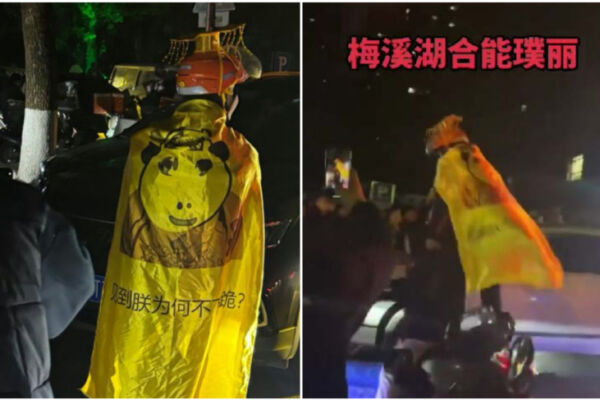
In Changsha, a group of food delivery drivers staged a protest against discrimination by the property management of a residential community, which escalated into a festive imitation of a “rebellion,” with one rider being “crowned” in a yellow robe. Authorities urgently dispatched a large number of public security special police to the scene. Some commentators pointed out that the protest by the Changsha food delivery drivers has evolved from sporadic “bandit-style” resistance to a collective action resembling the “Yellow Turban Rebellion.”
The expression “crowned in yellow” refers to the time in history when Zhao Kuangyin, later known as Emperor Taizong of the Song Dynasty, was crowned by his subordinates with a yellow robe during a military rebellion at Chenqiao, symbolizing a successful coup.
On December 22, the Hetian Puli residential community in Changsha demanded that food delivery drivers could only enter the community on foot while pushing carts. However, the drivers discovered that property owners were allowed to enter on electric bikes, leading to disputes with security guards and residents. As the news spread, hundreds of food delivery drivers rushed to the scene to protest against the “discrimination,” surrounding the community gate.
On that evening, one food delivery driver wearing a crown and a yellow robe bearing the words “Why not kneel when you see me” stood on the back of another driver’s bicycle, circling the protest site, seemingly imitating the historical “crowning in yellow” and “parade on horseback.” Nearby drivers cheered in response.
A food delivery rider from the post-2000 generation who was present at the scene on December 23 told Dajiyuan that most of those who participated in the protest were young riders in their twenties. Due to the disrespectful language used by the property management staff, they went to express their protest and demand an apology. Over a hundred police officers arrived at the scene initially just observing but failing to address the situation, leading the riders to start causing disturbances. Some riders donned “crowns” and “dragon robes,” symbolizing a rebellion.
Video footage on social media showed more food delivery drivers forming teams to rush to the scene, with subtitles adding “rebellion” to the videos.
According to sources, police began forcibly dispersing the crowd and arrested three riders after 1 a.m.
The prolonged economic downturn is impacting the stability of the Chinese Communist Party’s rule, with food delivery drivers at the grassroots level facing multiple challenges. In a viral video, a food delivery rider angrily criticized the authorities for seizing their livelihood tools – electric bicycles – under the pretext of vehicle safety and compliance.
He said, “When I’m unemployed, no one cares. When I have nowhere to live, no one cares. When I have no money for healthcare, no one cares. I work late until 2 a.m. delivering food on an electric bike. You don’t care if I can eat every day, but you care if I get hit by a car on the road. Pension, medical care, education – aren’t they more important than electric bicycles? Why are you so fixated on electric bikes? They may mean nothing to you, but to us, they are tools for survival and the driving force to move forward, do you understand? The probability of me being hit by a car is one percent, but without it, the chance of me starving to death is 100%.”
On December 23, a commentator named “Xin Gaodi” posted on a platform stating that the protest by food delivery drivers in Changsha’s Hetian Puli residential community was like a powder keg that had been ignited, quickly attracting public attention. With 14 million food delivery drivers in China, their networked organization and rapid responsiveness have evolved from sporadic “bandit-style” resistance to collective actions resembling the “Yellow Turban Rebellion.”
Recently, more and more netizens on Chinese social media platforms, especially Douyin, have been semi-publicly criticizing the CCP’s tyranny, denouncing party leaders, and expressing their hopes for a “change of dynasty.” It seems that the CCP’s online censorship has fallen behind, with public opinion showing signs of slipping out of control.
On November 14 last year, officials from the Chinese Ministry of Public Security warned at a press conference that “many people on the internet illegally disseminate information on making firearms and explosives, illegally trade gun parts and explosive materials,” and those found violating the law would face criminal prosecution.
The news of the aforementioned incident on Douyin sparked a flood of comments from netizens, with remarks like “They are warning you about the power of guns,” “If I can master it, I will start mass production, but unfortunately, I’m clueless,” “Bro, they may not be agile, but they can do real big things, like police stations, courts, hospitals, etc.,” “They have become timid birds after all!,” “Everyone has a weapon in their hands, yet they still dare to bite?,” “When a bun costs 50 yuan each, I will take the stage to lecture,” “Water can carry a boat and overturn it.”
Some also said, “It’s time to ring the bell when the day breaks,” “Where can I buy ready-made products? I urgently need them,” “Historically, things managed by yamen runners don’t matter much. Li Zicheng entered Beijing, the Qing entered the pass. Without mentioning yamen runners, even the Jin Yiwei and Dongchang ran away.”
Lai Rongwei, executive director of the Taiwan Inspiration Association (TIA), recently told Dajiyuan that in the face of strengthened internet control by the authorities, ordinary people are also wise and often express their dissatisfaction in a satirical manner. With the Chinese Communist Party’s high-pressure and persistently unstable governance, as the economy continues to decline and unemployment rises, an atmosphere conducive to popular uprisings is taking shape.
Resistance against the CCP is spreading from online platforms to offline activities. On December 17, during Shanghai’s petitioning day, numerous petitioners in Shanghai gathered in People’s Park behind the petition office, holding up signs and legal documents protesting injustice while chanting slogans. Shanghai University retired professor and rights activist Guo Guoping informed Dajiyuan that the petitioners simultaneously shouted “injustice,” “down with the government,” “down with the Communist Party,” “freedom belongs to the people,” creating a spectacular scene. Dozens of police officers forcefully took away three petitioners.
Recently, a video circulated online showing a woman on a Shanghai subway carriage shouting “down with the Communist Party.”