
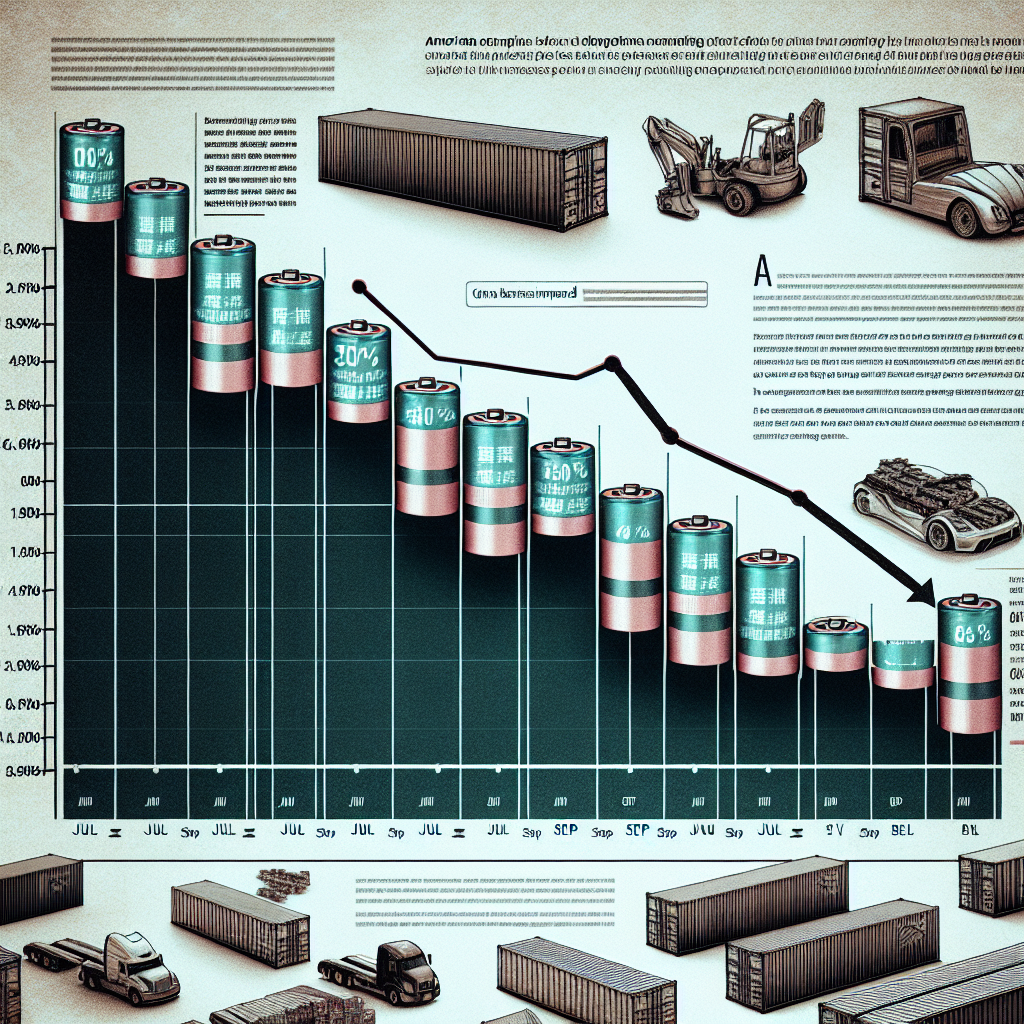
According to the data from the U.S. Customs, the quantity of batteries imported from China to the United States saw a significant decline from July to September this year, indicating that American companies are taking a cautious approach towards using Chinese-made batteries before the relevant new regulations are enacted.
Analysis of the U.S. Customs data by the Nikkei Asia reveals that from July to September, the import volume of batteries in the U.S. plunged by 36.2% compared to the previous quarter, amounting to 304,269 metric tons. In September, the import volume of Chinese-made batteries dropped by 58% from August. In contrast, the import volume of batteries from South Korea increased by 151% in the quarter.
With the passing of the One Big Beautiful Bill in July, starting next year, U.S. companies using batteries or solar panels manufactured in China will gradually be excluded from federal tax credits. Companies that have more than 25% ownership held by Chinese entities or have associations with companies linked to the Chinese military will also lose tax credit eligibility in clean energy investments, clean fuel production, and manufacturing.
Despite the decrease in import volume, China’s dominant position in the U.S. battery market remains firm. During the third quarter, China accounted for 80.7% of the total lithium battery imports in the U.S., higher than the 77% in the same period last year. Batteries produced by South Korean companies LG Energy Solution and SK Innovation accounted for 6.3%, while Japan accounted for 4.5%.
In terms of overall demand, the U.S. still shows a strong demand for batteries used in energy storage systems and other applications. The cumulative battery imports in the U.S. exceeded 1.1 million metric tons in the first nine months of this year, marking a 46.6% increase from the same period last year.
However, the import volume of lithium batteries for electric vehicles decreased by 12% to 27,220 metric tons, reaching the lowest quarterly level in nearly three years. Following the cancellation of electric vehicle tax incentives by the Trump administration, some manufacturers adjusted their product strategies and halted the production of pure electric vehicles, leading to a decline in lithium battery imports.
Currently, the momentum of lithium battery imports in the U.S. mainly stems from energy storage projects. With the expansion of artificial intelligence and data centers, the electricity demand in the U.S. is soaring. Consulting firm ICF predicts that U.S. energy demand will increase by 25% by 2030 and 78% by 2050.
Data from BloombergNEF shows that in 2025, the U.S. is projected to add a record 42.4 gigawatt-hours of energy storage capacity, an 8% increase from the previous year.
However, due to President Trump’s imposition and subsequent delay of tariffs on Asian trading partners, battery importers are facing significant trade fluctuations. China is the world’s largest battery producer and the largest supplier of energy storage batteries to the U.S. Besides other tariffs, China also faces up to a 47.5% “equivalent tariff,” significantly raising the import costs.
For the past five years, Japanese and South Korean battery manufacturers have been steadily increasing their factory capacities in the U.S., enhancing the country’s clean energy manufacturing capabilities. However, it is widely expected that imports will continue to dominate in the short term, even though the tariff on lithium batteries for non-electric vehicles imported from China may increase to 25% next year.
Isshu Kikuma, an energy storage analyst at BloombergNEF, expects that “most of the batteries used in energy storage projects that commence operation in 2026 will still rely on imports, primarily from China. Currently, domestic production capacity in the U.S. remains limited.”
Nevertheless, as U.S. production capacity gradually increases, he anticipates that by 2028, most projects in the U.S. will use batteries not made in China to qualify for tax credits.
Currently, Chinese battery and solar panel manufacturers are striving to remain in the U.S. market through various means and ensure that their projects meet the eligibility criteria for U.S. tax credits to enhance the financial viability of the projects.