
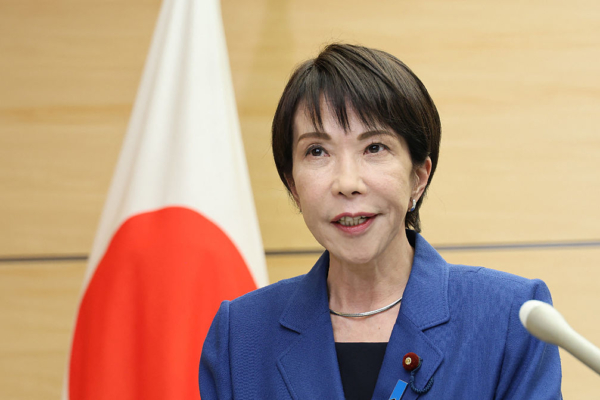
Japanese Prime Minister Sanae Takichi recently made her first public response to the travel restrictions imposed by Beijing on Japan, emphasizing the importance of domestic tourism and highlighting the government’s efforts to diversify the tourism market to enhance industry resilience. She also stated that Japan will remain calm and continue necessary diplomatic communication.
The cooling of relations between Japan and China this time stemmed from Takichi’s clear statement on November 7 in parliament that “any issue involving Taiwan could constitute a survival crisis for Japan.” This statement provoked a strong reaction from Beijing, leading to countermeasures such as discouraging Chinese citizens from traveling to Japan, seen as a form of pressure on Japan.
During a press conference at the Prime Minister’s Office on Wednesday, December 17, Takichi was asked whether the decrease in Chinese tourists was impacting the Japanese tourism industry. She responded with a smile, pointing out that many Japanese people have chosen to travel domestically at the end of the year, stating that “Japanese traveling to various parts of Japan is also very important.” She also mentioned that the government will continue efforts to attract tourists from various countries and regions to avoid over-reliance on a single market in the tourism industry.
Her remarks sparked enthusiastic responses in Japanese online communities. Many netizens commented, saying, “Finally, we can go to Kyoto,” “She is absolutely right,” and “No need to endure unchecked pressure from inbound tourism anymore.” Accommodation providers also revealed that local Japanese customers have significantly increased recently, and “overall etiquette and order have improved, reducing on-site workload.”
Regarding the need for a direct meeting with the Chinese Communist Party leader Xi Jinping to break the current deadlock, Takichi stated that Japan maintains communication channels at all levels, including leadership levels, and is willing to continue dialogue. She also mentioned that Japan will carefully evaluate the actual impact of relevant Chinese measures on the Japanese economy and industry and make necessary responses.
The wariness of the Japanese political circles towards the “economization” of China is not a recent development. Following the 2010 collision between Chinese and Japanese ships, China once restricted rare earth exports to Japan, causing substantial impact on the Japanese manufacturing industry and becoming a crucial turning point for Tokyo to reassess the risks of relying on China.
Subsequently, with the escalation of Hong Kong and Xinjiang issues, worsening security situation in the Taiwan Strait, and disruptions in the supply chain during the pandemic, a consensus gradually formed among Japan’s ruling and opposition parties: dependence on China is not just an economic issue but also involves national security and institutional resilience.
During the 2021 Liberal Democratic Party presidential election, major candidates such as Fumio Kishida, Sanae Takichi, and Taro Kono clearly emphasized taking a confrontational stance against China in foreign affairs and security policies, advocating close coordination with allies like the United States to respond to China’s military expansion, regional security, and values.
Among them, Takichi’s stance on China is the most robust and concrete. She advocates comprehensive strengthening of economic security to prevent the influence of China in key technologies and supply chains, while explicitly supporting Japan’s possession and rapid utilization of the “enemy base attack capability” as a key element in future security competition.
Despite the uncertainty surrounding Chinese tourists, the latest data released by the Japan Tourism Agency on December 17 showed that the total number of foreign visitors to Japan continues to break historical records. In November this year, there were 3.518 million visitors to Japan, a 10.4% increase compared to the same period last year. The cumulative total from January to November reached 39.06 million visitors, surpassing the total for the entire year of 2024.
The data indicates significant growth in markets such as South Korea, Taiwan, Malaysia, Indonesia, the United States, and Canada. Among them, 19 markets including South Korea, the United States, and Taiwan set new highs for November in recent years. The number of American visitors to Japan surpassed 3 million for the first time, becoming the fourth source market to achieve this scale after China, South Korea, and Taiwan.
Since 2023, the Japanese government has been promoting the “Fourth Tourism Nation Promotion Basic Plan,” focusing on sustainable tourism, raising consumption levels, and enhancing local attraction capabilities as core objectives, while continuously adjusting overseas marketing and market deployment to diversify risks and enhance industry resilience.
In contrast to Japan, South Korea has recently seen widespread anti-China demonstrations in various Seoul districts due to the temporary visa waiver policy for Chinese group tourists implemented by the government in late September. Protesters in busy areas shouted “China Out,” protesting against a large influx of Chinese tourists in a short period.
Data from the Chinese travel platform, where to go, also shows that during the weekend of November 15-16, South Korea surpassed Japan to become the most popular overseas destination for Chinese tourists, ranking first in both flight search volume and booking volume.
Some South Korean citizens openly expressed their “envy for Japan” on social media, praising the Japanese government for its “clear” stance on China. On the other hand, Taiwanese tourists began wearing identification badges with the word “Taiwan” to avoid being mistaken for mainland Chinese tourists.