
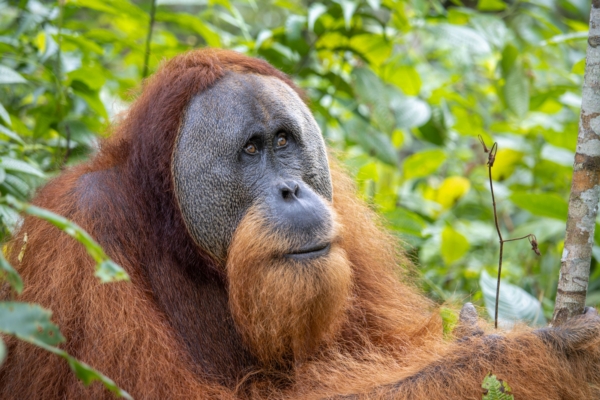
Recently, the Indonesian island of Sumatra has been hit by consecutive heavy rains, triggering disastrous floods and large-scale landslides, claiming the lives of over a thousand people and causing unprecedented havoc on the local ecosystem. Animal protection groups have issued warnings that the world’s most critically endangered orangutan species, the Tapanuli orangutan, may be on the brink of extinction.
The Tapanuli orangutan was officially recognized as a new species by the scientific community in 2017. With a wild population of less than 800 individuals, it is currently the most endangered group of orangutans on Earth, only found in the Batang Toru forest in the northern part of Sumatra, Indonesia. This species is believed to be one of the oldest lineages of existing orangutans, with a history spanning over 3 million years.
Satellite images combined with knowledge of the Tapanuli orangutan’s habitat range indicate that the extreme rainfall in late November caused floods and landslides, not only destroying the forest structure in the Batang Toru region but potentially delivering a devastating blow to the wildlife in the area.
In a village in northern Sumatra, residents discovered the body of a Tapanuli orangutan among mud and debris, with its facial skin torn apart, a heartbreaking sight.
Researchers focused on the western region of Batang Toru, where the most concentrated population of approximately 581 Tapanuli orangutans resides and estimated that 6% to 11% of them may have perished in the recent flooding.
Erik Meijaard, a renowned biologist engaged in orangutan conservation, emphasized that given the orangutans’ breeding frequency of every 6 to 9 years, along with their already sparse population and limited habitat, losing even 1% of the adult individuals annually could drive this species towards extinction.
Panut Hadisiswoyo, founder and chairman of the Indonesian Orangutan Information Center, echoed a similar sentiment, stating that the loss of even a single orangutan would be a devastating blow to the survival of the species.
Meijaard pointed out that satellite images revealed multiple massive cracks in the Batang Toru mountain area, with some cracks extending over a kilometer and nearly 100 meters wide. The mudslides carrying vast amounts of debris, trees, and floodwaters cascaded down the mountainside, engulfing almost everything in its path, including other large wildlife such as elephants.
These experts expressed concerns that even if surviving Tapanuli orangutans escaped direct impact, their crucial food sources and living spaces have been severely depleted. Initial estimates suggest that over 9% of the critical habitats in the western region may have been destroyed, with lasting repercussions expected to persist for years.
They urge the Indonesian government to immediately halt all development projects that could further damage the Batang Toru ecosystem, expand protection areas, and conduct comprehensive investigations and rehabilitation efforts for the affected regions and orangutan populations. Otherwise, this species, which humanity has only recently come to know, may vanish from the Earth in a short period of time.