
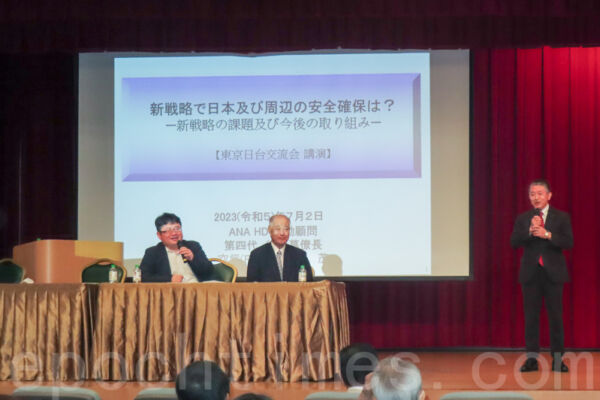
On December 15th, the Chinese Communist Party announced sanctions against Shigeru Iwasaki, the former Chief of Staff of the Japan Self-Defense Forces, on the grounds of “colluding with Taiwan independence.” Analysts believe that this move by the CCP aims to hinder cooperation between Japan and Taiwan, but its effectiveness is limited. Meanwhile, the CCP’s arrogance is likely to drive more Japanese businesses and investments away from China.
Shigeru Iwasaki, now 72 years old, is a retired four-star Air Force General in Japan, who served as the Chief of Staff of the Japan Self-Defense Forces from 2012 to 2014 (equivalent to the “Chairman of the Joint Chiefs of Staff”). He was also an ally of the late former Japanese Prime Minister Shinzo Abe.
In March of this year, Shigeru Iwasaki was appointed as a political advisor to the Taiwan Executive Yuan for a one-year term. At the time, the Japanese newspaper “Sankei Shimbun” analyzed that this move was part of Taiwan’s efforts to strengthen security cooperation and communication with Japan in response to military pressure from the CCP.
The Chinese Ministry of Foreign Affairs stated on December 15th that they “firmly oppose” Shigeru Iwasaki serving as an advisor to Taiwan, accusing him of colluding with Taiwan independence forces, interfering in China’s internal affairs, and undermining China’s sovereignty and territorial integrity.
The statement also announced sanctions against Shigeru Iwasaki, including freezing any assets he may have in China, prohibiting transactions and cooperation with organizations and individuals in China, and banning him from entering China (including Hong Kong and Macau).
Shen Mingshi, a researcher at the Taiwan Institute for National Defense and Security Studies, told Epoch Times that when Shigeru Iwasaki agreed to serve as a political advisor to Taiwan, he had already given it careful thought, so the sanctions “should not have a significant impact on him personally.”
He believed that China’s sanctions against Shigeru Iwasaki may be an attempt to prevent closer ties between Taiwan and Japan. By seeing high-ranking Japanese officials coming to Taiwan as advisors, the CCP wants to “block” this momentum.
He also suggested that these sanctions are unlikely to create a “chilling effect” within Japan but instead might reinforce cooperation with Taiwan and the United States based on Japan’s security interests and geostrategic considerations.
Yao Yuan, a professor at the University of St. Thomas in the United States, told Epoch Times that the CCP aims to make Japanese individuals act more cautiously and fearfully when cooperating with Taiwan. The exchanges between Taiwan and Japan are frequent, both at official and unofficial levels, making it difficult for the CCP to curb such cooperation effectively.
On December 15th, the spokesperson for the Taiwan Ministry of Foreign Affairs, Xavier Chang, strongly condemned Beijing’s sanctions against Shigeru Iwasaki. He viewed it as part of the CCP’s actions involving cross-border interference, extraterritorial jurisdiction, or transnational oppression of foreign nationals.
The sanctioning of Shigeru Iwasaki by the CCP marks the first instance since the deterioration of Sino-Japanese relations in early November. Following the remarks by the newly appointed Japanese Prime Minister Takashi Hayashi regarding Taiwan, the CCP has been consistently implementing various retaliatory measures.
Yao Yuan stated that the CCP’s actions serve both its domestic and international propaganda, as the CCP regime operates like a “gangster regime,” believing that it dictates everything.
Shen Mingshi emphasized that the CCP’s sanctions highlight its totalitarian and arbitrary nature, which may provoke more backlash from Japanese individuals and businesses. Prime Minister Takashi Hayashi’s firm stance against the CCP has garnered strong support within Japan.
Regarding the impact of the CCP’s sanctions on Japanese companies in China, Shen Mingshi mentioned that foreign investors increasingly feel insecure about their investments, leading to more Japanese companies and individuals withdrawing from China. In fact, many Japanese companies have already left China due to understanding the dynamics there.
Yao Yuan pointed out that in China’s environment where “rule of man, not rule of law” prevails, investments lack protection. While previously the benefits outweighed the risks, the situation has now shifted towards risks outweighing benefits, prompting more people to choose to withdraw from China.
He suggested that by avoiding any entanglements with the CCP, one can sidestep concerns about sanctions. “The simplest way is to not engage with it, and then it won’t be able to control you.”
“The CCP’s actions are essentially a subtle way of gradually pushing out more foreign individuals who may have opportunities for cooperation and exchanges with China, making the CCP more closed and isolationist,” he said.