
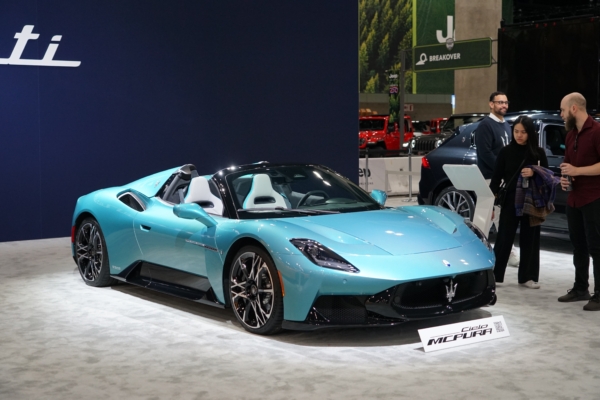
According to a report from the WeChat public account “Daily People” under Boya Tianxia, as the Chinese economy continues to decline, foreign luxury cars in the Chinese market are facing a “cold winter” in terms of sales performance. The price of the Maserati pure electric version has dropped from 890,000 yuan to 350,000 yuan.
Maserati, which reached its sales peak in China in 2017, has seen a sharp decline in sales in just 8 years, going from selling over 10,000 vehicles annually to now selling less than 100 vehicles per month, landing in the “marginal zone”.
Financial reports from Stellantis Group, the parent company of Maserati, show a continuous decline in Maserati’s sales in the Chinese market from 2022 to 2024. In 2024, they only managed to sell 1,209 vehicles throughout the year.
Data from the China Passenger Car Association indicates that as of the first quarter of 2025, Maserati’s domestic sales volume was only 277 vehicles, a 32% decrease compared to the previous year, marking a near-record low in recent years.
Former CEO of Stellantis Group, Tang Weishi, publicly acknowledged that the Maserati brand is facing financial difficulties and is currently in a state of losses.
In an effort to boost sales in the Chinese market, Maserati made a significant price cut for the Grecale model in June and July of this year.
One salesperson, Kong Xi, from a Maserati store in Chongqing, revealed that the on-the-road price of the 2023 Grecale (fuel version) was generally over 700,000 yuan, and at that time the store could only sell five to six units per month. The recent price cuts almost halved the prices compared to the previous year.
Salesman Fan Wei in Shanghai also mentioned that upon receiving instructions from the manufacturer to clear out the 2023 Grecale inventory, he promptly posted discount posters on social media.
A fan named Su Qiu expressed her surprise upon seeing the Maserati price reduction information on social media, stating that “Maserati has always been a super luxury brand in my heart, and I never thought I would be able to afford one someday.”
Finally, Su Qiu compared prices at multiple 4S stores in Foshan, Shanghai, and other locations, ultimately placing an order at a store in Shijiazhuang, Hebei, where the base price was 360,000 yuan, with additional accessories costing over 30,000 yuan, and including insurance, the total cost came to around 410,000 yuan.
Surprisingly, in November, Maserati initiated a new round of price reductions. A sales post from a dealer in Shenyang indicated that the Grecale pure electric version had been reduced in price. It was reported that Maserati officially began its electrification transformation in 2020, and the Grecale pure electric version, as a key model in its electrification strategy, was introduced to the Chinese market in 2024.
Liu Jun, a salesperson at a Maserati 4S store in Shandong, revealed that the official guide price for the pure electric Grecale version was 898,800 yuan, but following the price reduction, the base price dropped to just 358,800 yuan – a staggering decrease of 540,000 yuan, making it even cheaper than the second-hand market. However, with less than 100 units available nationwide, they quickly sold out.
Liu Jun further admitted that in reality, Maserati only produced this batch of pure electric Grecale versions, as they had been unable to sell the existing stock, and it is highly unlikely that they will produce more in the future.
Maserati’s struggle represents a microcosm of the challenges faced by super luxury brands in the Chinese market, including Bentley, Lamborghini, and even Porsche, all of which are experiencing unprecedented cooling in the Chinese market.
Data from the China Passenger Car Association indicates that traditional luxury brands saw a cumulative 10.9% decrease in sales volume in the first three quarters of this year compared to the previous year, reaching a market share low of 10.5%. Porsche’s sales in the Chinese market decreased by 26%, and the BBA (Benz, BMW, and Audi) trio, which once held almost 80% of the luxury car market share, has now shrunk to less than 40%.