
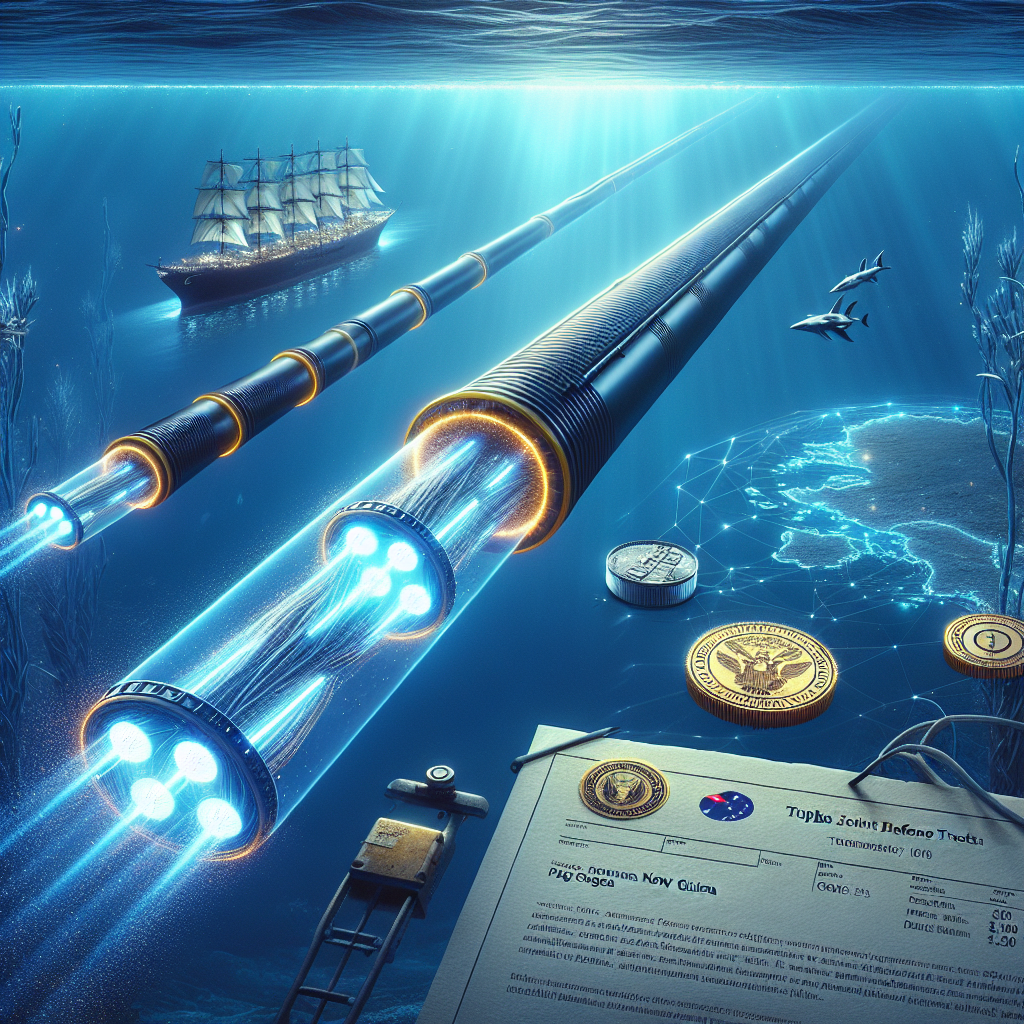
Papua New Guinea (PNG) announced on Friday, December 12, that Google, a subsidiary of Alphabet, will be constructing three new high-capacity undersea cables for the country. This $120 million project will be fully funded by Australia and is based on the “Pukpuk Joint Defense Treaty” signed by the two nations in October.
Strategists from Australia and the United States consider this move as a crucial upgrade to PNG’s digital infrastructure, given its strategic importance, with the primary goal being to enhance regional network security and digital resilience amid China’s increasing penetration in the Pacific region.
PNG, rich in resources but largely untapped, is located to the north of Australia, holding a valuable strategic position.
This infrastructure investment is clearly placed within the context of geopolitical competition. PNG’s Minister for Information and Communication Technology, Peter Tsiamalili Jr., emphasized in a statement that the project reflects both countries’ commitment to advancing digital security, regional stability, and national development.
According to Nikkei Asia, the region is facing increasingly complex cyber threats, particularly from Chinese hackers.
Tupou’tuah Baravilala, Director of Digital Government Transformation in Fiji, expressed in an interview with Nikkei, “Threats that would have never stepped into the Pacific before are now definitely prevalent. We are also very concerned about the geopolitical environment we find ourselves in.”
Earlier this year, Samoa confirmed that a Chinese state-sponsored network group, APT40, conducted malicious cyber operations against the Samoan government and critical infrastructure. Additionally, the President of Palau publicly stated that severe cyber attacks on the country’s financial system can be traced back to China.
Steven Matainaho, Secretary of the Department of Information and Communication Technology in PNG, told Nikkei that network incidents in the country have surged by 400% in the past 12 months, including ransomware attacks on key infrastructure like the tax office and national bank.
Australia’s full funding of the project aims to counter these network threats. The text of the “Pukpuk Defense Treaty” indicates that the agreement will allow Australian defense personnel to access PNG’s communication systems, including satellite stations and cables.
Tsiamalili stated in his announcement that the $120 million project will connect the northern, southern, and Bougainville autonomous region of PNG through high-capacity cables.
Matainaho informed Nikkei that the defense treaty will support network defense, strengthen critical infrastructure, and adopt national defense methods in cybersecurity. He emphasized, “Ultimately, sharing is important because you cannot protect yourself in isolation.”
These three new international-grade undersea cables will bring substantial technological and economic benefits.
The new cables will operate parallel to the existing two cables, enhancing network redundancy by establishing alternative routes. Matainaho explained that this is crucial for earthquake-prone PNG to avoid relying on higher-latency satellite systems due to disruptions in a single cable.
He told Nikkei that the three new cables will reduce network costs by 10 times and enable PNG to attract investments from global tech giants like Google and Oracle for data center infrastructure.
Earlier reports by Reuters mentioned Google’s plans to construct a data center on Christmas Island in Australia’s Indian Ocean frontier, another strategic defense location.
Google plans to connect the two new cables eastward to cities in Australia that host critical defense bases (also used by the U.S. military).
Google confirmed the Christmas Island data center plan last month and stated that the two additional cable systems will connect westward to Africa and Asia to “deepen the resilience of the network infrastructure.”
The United States is also strengthening military ties with PNG and signed a defense cooperation agreement in 2023.