
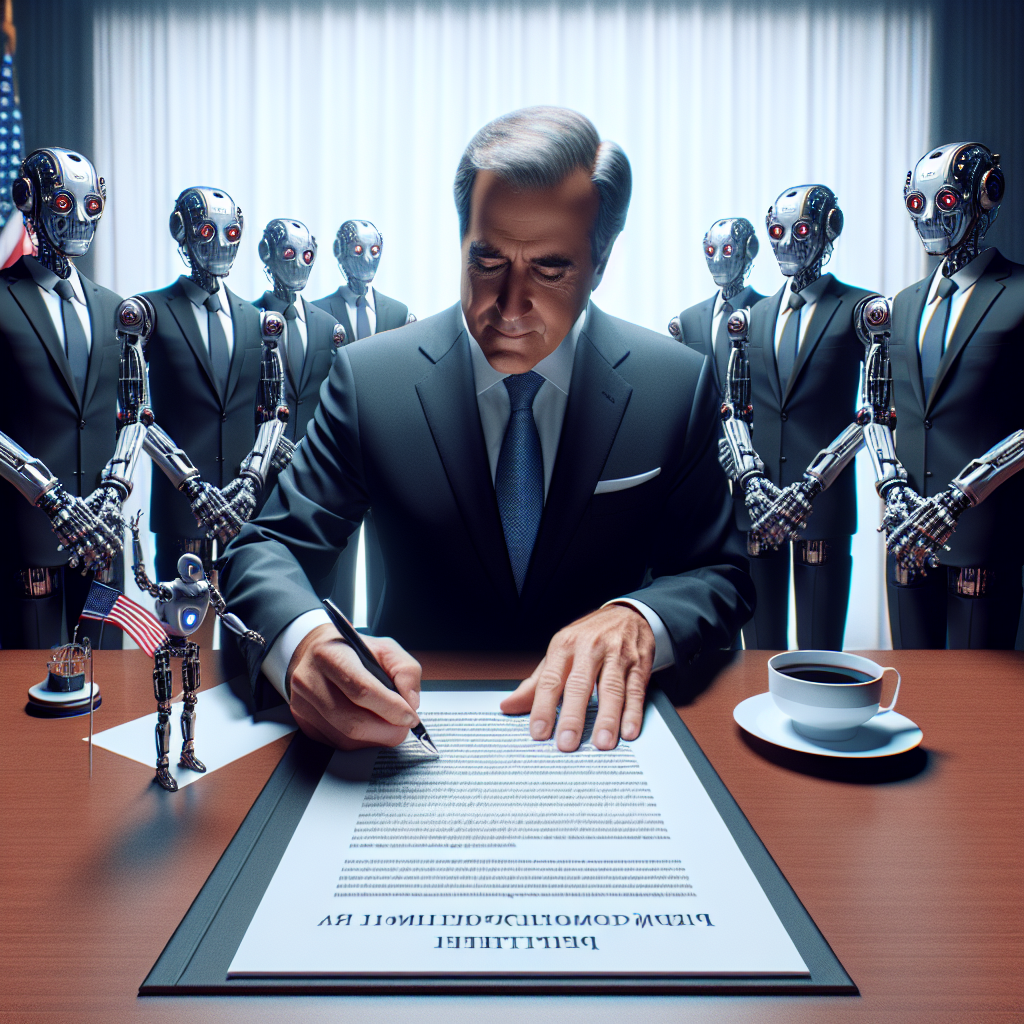
The United States President Donald Trump signed an executive order on Thursday (December 11th) aimed at establishing a set of federal standards for regulating artificial intelligence (AI) companies and preventing states from imposing restrictions on this thriving industry.
The executive order, named “Ensuring a National Policy Framework for Artificial Intelligence,” is intended to create national AI regulatory standards that will prohibit any state laws from exceeding this framework, and will challenge any state law in violation through the Department of Justice.
During the signing ceremony held at the White House, Trump stated: “There must be a centralized approval window. When companies need approval, they can only come to this one window, they cannot be running to California, New York, or Illinois separately. These companies have invested huge sums of money, which is a crucial part of the economy.”
Since Trump took office in January, state-level AI regulation has garnered bipartisan support, with multiple Republican-led states such as Arkansas, Florida, Alabama, and North Dakota having passed legislation to strengthen restrictions on the industry. Particularly after some parents sued companies like OpenAI, accusing chatbots of inducing their children to commit suicide, there has been more active legislative action.
Trump emphasized the importance of protecting this emerging industry. Treasury Secretary Scott Bessent hinted that if the federal government allows states to set their own rules, China will surpass the United States in the field of innovation.
The executive order specifies that the national AI regulatory standards should focus on protecting children, preventing speech censorship and copyright infringement, and ensuring community safety.
In the order, Trump wrote: “A carefully crafted national framework will ensure that the United States wins this AI race, and we must be determined to do so.”
The order instructs Attorney General Pam Bondi to establish a dedicated team within 30 days to target and challenge any state AI laws that conflict with the order. The goal of the order is to maintain the United States’ global leadership in the AI industry through a “minimally burdensome” national policy framework.
Commerce Secretary Howard Lutnick and other senior officials are tasked with consolidating any “onerous” state-level AI regulations that hinder the government’s national policy framework, and determining whether states that have regulations conflicting with the executive order should lose eligibility for the “Broadband Equity Access and Deployment (BEAD) Plan” funds.
Trump also directed other federal agencies to consider whether state AI laws violate the federal government’s policy goals when issuing grant funding.
Additionally, the order calls for the preparation of recommendations to Congress to establish a “unified federal AI policy framework to replace state AI laws that conflict with the policies set forth in this order.”
However, the proposal allows states to retain certain legislative powers, including those related to child safety protection, AI data center infrastructure and licensing reform, state government use and procurement of the technology, and other pending issues.
Florida Governor Ron DeSantis, an important Republican ally of Trump and a staunch supporter of state-level AI regulation, stated on December 8th that the executive order “cannot and will not” strip states of the authority to enact AI laws, but theoretically, Congress could do so.
The executive order claims that a system composed of “50 different regulatory regimes” hinders AI innovation and makes compliance for businesses excessively difficult.
The non-profit organization, the National Center on Sexual Exploitation, committed to combating pornography and sexual exploitation. Its public policy analyst Megan Griffin expressed that allowing states to regulate AI would suffocate innovation is simply “nonsense”.
She told Epoch Times: “Insurance companies, those nationwide large insurance companies, operate smoothly every day in varying state regulatory laws.”
Griffin opposes federal regulation of AI instead of states. She pointed out that American children committing suicide due to the content they encounter on social media platforms is the real “serious harm to human prosperity.”
She said: “If we let this situation proliferate, let young girls become victims of deep-faked pornography on campuses, let chatbots lure our children, that is the real threat. That is the obstacle to innovation.”