
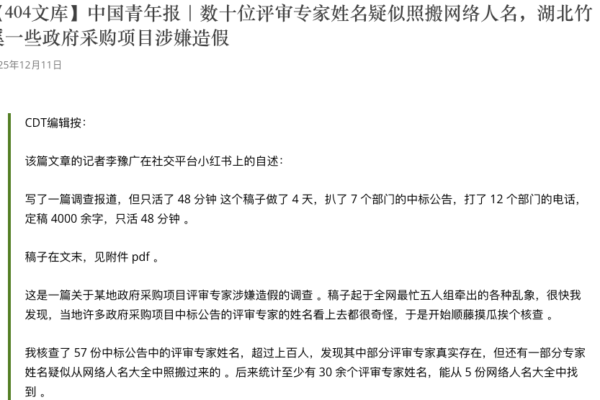
On December 11, the Central Youth Online published an investigation report, verifying 57 local government bidding documents. The article was taken down 48 minutes after being online but was promptly archived by China Digital Era. Investigative journalist Li Yuguang, in a post on Xiaohongshu, stated that this article took 4 days to complete, involved checking bidding announcements from 7 departments, making calls to 12 departments, finalizing a draft of over 4000 words, but was taken offline within 48 minutes of publication.
China Digital Era website reported that on December 3, the China Government Procurement Network announced a winning bid notice for the leasing of mechanical equipment by the Housing and Urban-Rural Development Bureau of Zhuxi County, Hubei Province. The names of 5 expert reviewers were found to match the beginning portion of an online list of names. The announcement was issued by Hubei Runtu Tendering Agency Co., Ltd. The following day, the company posted a notice terminating the procurement process, citing irregularities in the bidding procedures.
Previously, discrepancies were found in multiple areas such as government procurement, project evaluations, education projects, and industry subsidy applications where expert reviewer names or project lists were found to be duplicated in large numbers, some even being completely identical. Journalists at Central Youth Online also discovered similar issues in their investigation.
A veteran journalist from Hubei Daily, Mr. Chen, revealed that local procurement notices often do not attract much attention. He mentioned that when addressing complaints, he has repeatedly come across instances where winning bid notices were forged by agent organizations.
Regarding the investigation, Li Yuguang explained on the Xiaohongshu platform that starting from December 8th, he verified a total of 57 winning bid announcements from various government departments in Zhuxi County. Some expert reviewer names were found to be identical to several online lists of names, appearing in the same order. The departments involved included the Housing and Urban-Rural Development Bureau, City Management Bureau, Cultural Tourism Bureau, Data Bureau, Agriculture and Rural Affairs Bureau, and the Water Resources and Lakes Bureau, with many projects exceeding 30 million RMB.
He wrote, “I verified the expert reviewer names in the 57 winning bid announcements, totaling over a hundred individuals, finding that some were real experts, but others seemed to have been copied directly from online name lists. I identified at least 30 expert names that could be found in 5 online name lists.”
A senior editor from Inner Mongolia, Gao Peng, who has long been following procurement systems, mentioned that the emergence of fixed lists in local procurement data has only recently been exposed. If these lists overlap with online data, it suggests the presence of significant insider trading in the bidding process. He added that in the past, investigative journalists who discovered such issues would question the local government, but often faced requests not to report on the matter or offers for non-reporting in exchange for advertisements.
Gao Peng pointed out that there have been several loopholes in government and enterprise procurement notices, stating that both journalists and the government are aware, leaving ordinary citizens unaware of the realities.
Journalists from Central Youth Online tried to inquire about the bidding processes from several departments including the Housing and Urban-Rural Development Bureau and the Data Bureau of Zhuxi, but did not receive positive responses. A staff member from the Procurement Office of Zhuxi County’s Finance Bureau confirmed that some expert reviewer names were not accurate. They mentioned that a joint investigation team from the City and County Commission for Discipline Inspection and Supervision was conducting a thorough check on all aspects of the data.
A news editor from Beijing, Mr. Zhao, explained that the completeness of the procurement process should be judged based on the bidding announcement, the bid opening records, and the evaluation documents. Without these key documents, the authenticity of the projects cannot be confirmed by external parties. He believed that this incident has led more readers to pay attention to the transparency of procurement data.
On December 11, Central Youth Online officially released the aforementioned investigation report, revealing concerns about fictitious expert reviewer lists, the affiliations between the tendering agency and the supervisory department, as well as incomplete bidding data. The report highlighted that Runtu Agency is fully owned by the Natural Resources and Planning Bureau of Zhuxi County, indicating a hierarchy between the agency and the local administrative body, with the evaluation venue being consistent with the location of the bureau. Most of the winning bidders were local companies, some of which had incomplete business data. Calls made to the responsible individuals went unanswered.
The reporter attempted to contact the Natural Resources and Planning Bureau of Zhuxi County to further inquire about the progress of the investigation but received no response.
The report indicated that several government department officials in Zhuxi County confirmed to Central Youth Online journalists that they are currently undergoing a joint investigation. The Housing and Urban-Rural Development Bureau, Data Bureau, and other departments stated that the investigation team had initiated a thorough review, examining the procurement process, the data of the tendering agency, and past projects. A representative from the City Management Bureau mentioned that they had initiated an internal review post-incident. An employee from the Cultural Tourism Bureau clarified that the project in question was not procured by their department but rather by a local cultural and tourist investment company.
In recent years, incomplete government procurement procedures, missing expert reviewer lists, and undisclosed bidding announcements have been reported in various regions of China. The Central Audit Department and disciplinary bodies have been promoting data supplementation and reverse checking of bidding processes in many areas. China Digital Era continues to archive deleted procurement and investigation reports in their 404 library to maintain public records.