
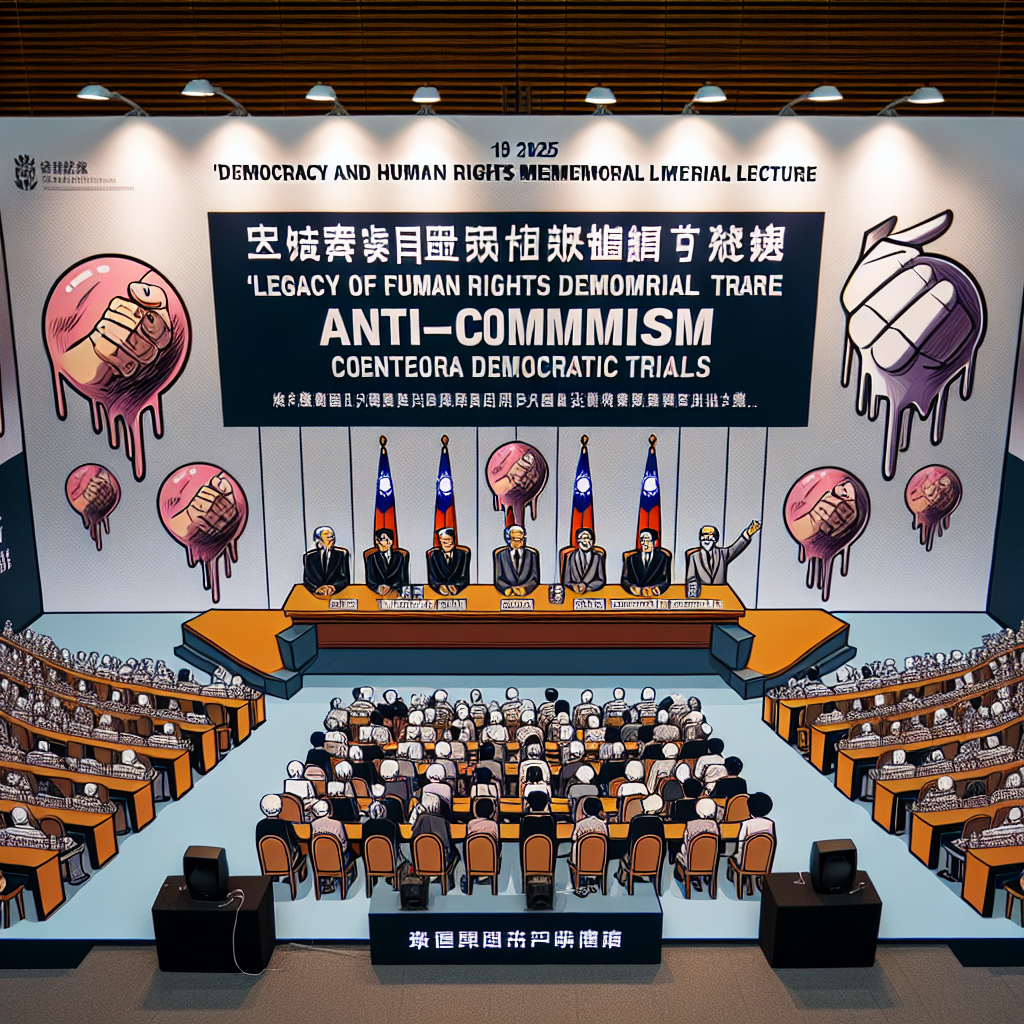
In Taiwan, the “Lei Chen Democracy and Human Rights Memorial Lecture” was recently held at National Taiwan University for the 2025 annual forum on “Legacy of Free China and Contemporary Democratic Trials.” Experts cautioned that anti-communism should not just be a slogan but must be based on a correct understanding of authoritarianism to help Taiwan face aggression and unite common will.
Organizers noted that in Taiwan’s politically repressive 1950s, the three freedom and democracy pioneers Lei Chen, Yin Haiguang, and Fu Zheng harshly criticized communist authoritarianism, advocating that genuine anti-communism must be based on freedom and rule of law to sow seeds of thought for democratizing Taiwan. Seven decades later, as China continues to pressure Taiwan, anti-communist discourse resurfaces.
Taiwan President Lai Ching-te, in his opening speech, mentioned that Lei Chen, Yin Haiguang, and Fu Zheng were all born and raised in China. Lei Chen founded the “Free China” magazine, promoting democracy, freedom, and rule of law in Taiwan, raising the banner of democracy against communism. Lei Chen advocated changing the country’s name to “Democratic State of China-Taiwan,” but the Democratic Progressive Party retained the name “Republic of China” believing it helps unite Taiwanese society as it is written in the constitution and Taiwan is effectively an independent sovereign state without the need to declare independence separately, aiming to unite Taiwan.
President Lai stressed the importance of this forum, highlighting how understanding the anti-communist rhetoric and strategies of past figures profoundly impacts Taiwan’s democracy in defending democracy, anti-communism, and national interests as crucial, urging Taiwan to unite regardless of party lines and work together.
The forum featured two sessions. The first session focused on “Reconsidering Anti-Communism: The Nature of Communist China and the Anti-Communism Issue.” It was moderated by attorney Xue Qinfeng, convener of the Lei Chen Democracy and Human Rights Fund consultation committee, with Chen Ruoshui, chairman of the Yin Haiguang Academic Fund, speaking. The event also included discussions by Lin Baohua, consultant for the Lei Chen Democracy and Human Rights Fund, and Huang Zhaonian, Associate Professor and Director of the Institute of National Development Studies at National Chengchi University.
Chen Ruoshui emphasized that Taiwan is currently facing a serious threat from the Chinese Communist regime and must rethink the meaning and foundation of anti-communism. He warned that the CCP is not just an authoritarian state but a totalitarian system with complete control and mental domination characteristics, posing a potential catastrophic threat extending beyond mere national competition.
Chen Ruoshui pointed out that the CCP has evolved from revolutionary violence and social transformation to today’s digital authoritarianism, emphasizing power, manipulating nationalism, employing flexible means without scruples. The current Chinese nationalism promoted by the CCP has become core to its expansion and rule legitimacy.
He reiterated that anti-communism cannot be merely a slogan but must be based on a precise understanding of authoritarianism to help Taiwan face aggression and unify common will, urging Taiwanese society to maintain clear awareness at strategic levels to defend their homeland and safeguard freedom.
Lin Baohua stressed that the essence of the CCP lies in pragmatism as a means and core of power and violence, expanding influence through deception and interest exchanges, discarding policies once they serve their purpose. He cautioned against the CCP’s comprehensive control and plunder based on manipulating human nature.
In the face of the CCP’s threats, Lin used the recent ban on the use of small red books following a crackdown on fraud in Taiwan as an example to illustrate the need for the government to communicate extensively with the younger generation and raise awareness of the dangers of communism. He also emphasized that Taiwanese society must recognize the essence of the CCP, avoid exploitation of human weakness, and maintain inclusiveness and unity internally to jointly resist the CCP’s united front and threats.
Huang Zhaonian, from a political science perspective, analyzed different periods of the CCP, noting that although their ultimate goal was to maintain the legitimacy of rule, leadership, party-state relations, and social control measures varied. For instance, during Mao’s era, there was extreme centralization of power, with the CCP using communism to legitimize their rule. In Xi Jinping’s era, they returned to extreme centralization with even more comprehensive state and societal control, emphasizing ideology more strongly.
Huang further examined how the CCP regime uses soft power (culture, ideology) and hard power (coercion, economic control) to lead to authoritarian overflow and expansion. He believed that Taiwan still faces internal contradictions and unfinished transitional justice, requiring further deepening of democratic culture and reinforcing Taiwan’s overall consensus on democratic values.
The second session of the forum, titled “Freedom of Speech of the Enemies of Freedom,” was hosted by Professor Chen Junhong, Director of the Fu Zheng Democratic Research Center at Dongwu University. The event featured discussions by Associate Professor Su Huijie from the Law School of National Taiwan University, former Justice of the Judicial Yuan and Adjunct Professor at the Law School of National Taiwan University Lin Ziyi, and former President of the Judicial Yuan and Honorary Professor at the Law School of National Taiwan University Xu Zhongli.
Su Huijie focused on the tension between constitutional protection and democratic defense concerning “enemy of freedom and democracy” speech. She reviewed U.S. constitutional practices, existing judicial opinions in Taiwan, and introduced the “defensive democracy” system formed in post-authoritarian history in Germany on preventing the system from being legally overthrown through mechanisms such as party prohibitions and deprivation of basic rights.
Su stressed the high reference value of the judgments by the European Union and the European Court of Human Rights following Russia’s aggression against Ukraine, showing how advocating war and propaganda speech that harms national security and public order are considered threats to democracy and are subject to restrictions. She suggested that Taiwan should consider the threshold of speech restrictions based on the harm to national security and public order.
Given the reality of Taiwan Strait tensions, societal divisions, and regulatory vacuums on online platforms, Su believed Taiwan needs to find an appropriate balance between upholding core democratic values and ensuring freedom of speech, with civil society continually investing in turning constitutional values into action.
Xu Zhongli said that the basic concept of a defensive democracy in a tolerant society is the right to reject intolerance towards intolerant individuals in the name of tolerance to prevent extreme political forces from using democracy to destroy democracy. He outlined the four characteristics of defensive democracy: first, value constraint; second, used to counter internal forces; third, taking defensive measures primarily through political means; fourth, must be preventive.
Analyzing Taiwan’s democratic defense model, Xu mentioned that Constitutional Interpretation No. 499 has revealed the priority of liberal democratic constitutionalism. However, Constitutional Interpretation No. 445 continues to use the U.S. “clear and present danger” standard concerning freedom, which he deemed unfortunate from the defense of democracy perspective. Specifically regarding Taiwan’s unique geopolitical situation compared to the U.S., how can Taiwan correct its mistakes? For instance, Taiwan’s courts demand “clearly imminent” and “specifically dangerous” behavior before punishing activities supporting the CCP’s organized crime development.
Xu emphasized the need for Taiwan to actively enhance its defense mechanisms for democracy. He proposed changing the “clear and present danger” standard to a “real and urgent danger” standard and considering formulating relevant regulations on anti-democratic speech beyond the Assembly and Parade Law while ensuring the principle of proportionality.
Drawing upon U.S. cases, Lin Ziyi highlighted that the assessment of “clear and present danger” varies in each case, incorporating considerations of the harmfulness and seriousness of threats to freedom of speech.