
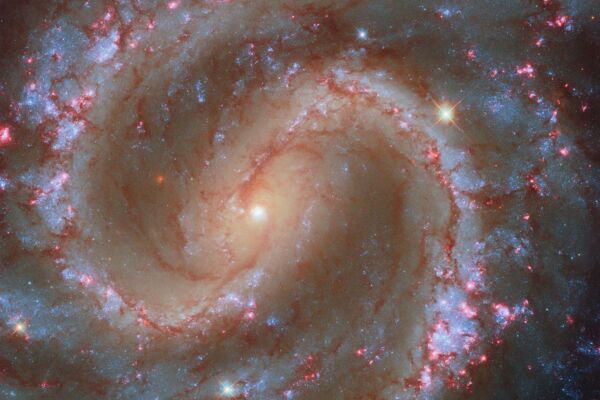
The Hubble Space Telescope (Hubble Space Telescope) of the National Aeronautics and Space Administration (NASA) has captured a spiral galaxy named NGC 4535. When observed through a small telescope, this galaxy appears extremely faint, hence it is called the “Lost Galaxy”.
NASA released the image of NGC 4535 taken by the Hubble Space Telescope on December 3. The agency points out that this galaxy is located in the constellation Virgo, approximately 50 million light-years away from Earth.
Despite being very faint, the Hubble Space Telescope with a mirror diameter of about 2.4 meters and located outside Earth’s atmosphere can easily observe galaxies like NGC 4535 and identify its prominent spiral arms and central bar structure.
The highlight of this image is the young star clusters dotted along the spiral arms of NGC 4535. Many bright blue star clusters are surrounded by glowing pink nebulae.
These nebulae, known as H II regions (or H-2 regions), indicate the presence of particularly young, hot, and massive stars in the galaxy, emitting high-energy radiation. These massive stars heat up the clouds in which they were born through powerful stellar winds, stirring the surrounding environment, eventually leading to supernova explosions.
This image combines data from an observational project aimed at cataloging approximately 50,000 H II regions in nearby star-forming galaxies like NGC 4535.
The Hubble Space Telescope previously released an image of NGC 4535 in 2021. The new image captures the radiant red light emitted by nebulae surrounding massive stars in their initial few million years of life, providing us with a new dimension of understanding NGC 4535.
Furthermore, on December 5, NASA also released an image of another spiral galaxy, NGC 1792, captured by the Hubble Space Telescope.
NGC 1792 is an active galaxy located in the constellation Columba, more than 50 million light-years away from Earth. The galaxy’s shimmering fuzzy spiral arms accentuate the bright glow at its center.
The charm of NGC 1792, as reflected in its seemingly chaotic appearance, captivates astronomers. It is classified as a starburst galaxy, an area of active star formation with stellar nurseries scattered throughout its spiral arms. In fact, its brightness is astonishing given its mass.
NGC 1792 is positioned near a larger neighboring galaxy, NGC 1808. Astronomers believe that the strong gravitational interaction between these two galaxies has disrupted the gas reservoirs within NGC 1792. As a result, the star formation activity in NGC 1792 surges like a tide, concentrating on the side near NGC 1808 due to the stronger gravitational influence there.
Thus, NGC 1792 serves as an ideal target for astronomers to study the complex interactions between gas, star clusters, and supernovae within galaxies.
The Hubble Space Telescope has previously observed NGC 1792 and released its image in 2021. This new image incorporates additional data collected throughout 2025, allowing us to delve deeper into the intense activities within the galaxy.