
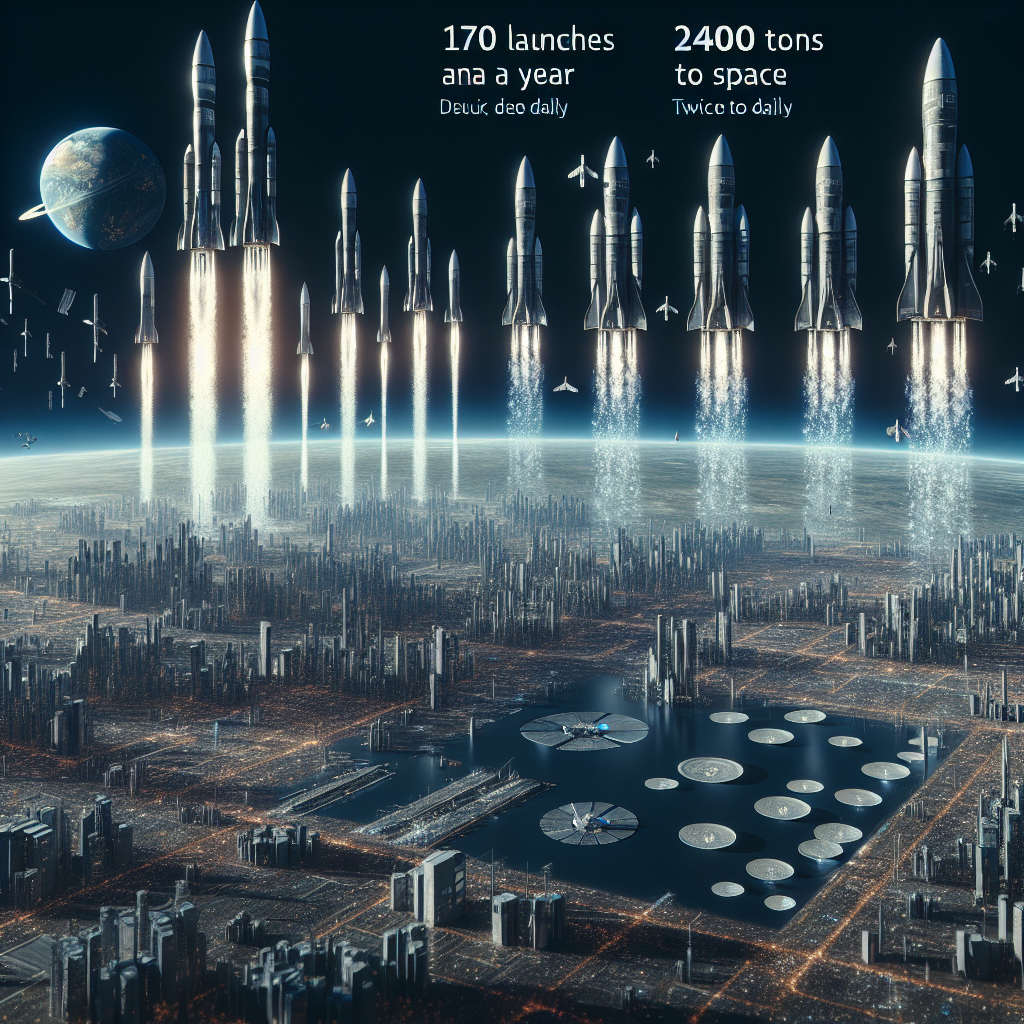
In December 2025, while the world marveled at how many rockets were launched in a year, SpaceX had already made “twice a day” launches a routine, marking “170 launches a year, 2400 tons to space” on the calendar. The company established an unprecedented economic system in low Earth orbit: over 9100 Starlink satellites orbiting the Earth, the single-use first-stage rocket flying 30 times, delivering 1001 satellites into orbit, and reducing the launch cost to $2720 per kilogram. What’s even more astonishing is that all this is just a transition: the construction of a new East Coast base for Starships has started, heralding the era of “space airports.”
On December 2, SpaceX launched two Falcon 9 rockets within a day from space launch sites in California and Florida, sending a total of 56 new-generation Starlink satellites into orbit.
By conducting satellite launches continuously from both the East and West Coasts of the United States, SpaceX can deploy satellites into multiple orbits in a single day, significantly reducing the time needed to achieve high-density coverage of satellite networks in priority areas, thereby quickly improving Starlink signals and network speed in certain key regions.
Independent tracking data shows that this launch increased the number of satellites in the Starlink constellation to over 9100, all of which are currently operating in low Earth orbit.
This new batch of Starlink V2Mini satellites from SpaceX is larger and heavier than earlier V1 and V1.5 versions, with each satellite weighing around 750 kilograms, more than twice the weight of the previous versions, and offering 3 to 4 times the network capacity of a single satellite.
These new-generation Starlink satellites feature many new technologies and were originally intended to be launched using the Starship rocket. The complete V2 version of the Starlink satellite weighs 1.2 tons, with a network capacity ten times that of the V1 version. However, as Starship is still in testing, SpaceX began deploying the Mini version of the V2 satellites using the Falcon 9 rocket since February 2023.
To date, SpaceX has conducted over 150 launches of Falcon 9 rockets this year, with over 60 launches in California and over 90 in Florida, surpassing past records in rocket launches.
The intense launch schedule this week is particularly noteworthy: within a few days, SpaceX has arranged multiple launches of Starlink satellites from both the East and West Coasts of the United States. Such speed was unimaginable in the early stages of orbital rocket development.
At the same time, US officials have approved the construction of a new Starship launch pad for SpaceX at Cape Canaveral in Florida. The US Space Force has approved the modification of historic Launch Complex 37 at Cape Canaveral for Starship’s Super Heavy rockets’ launch and landing operations. Under this authorization, SpaceX can conduct up to 76 Starship launches and 152 landings at this new site each year.
This marks a significant step in deploying Starship at the Eastern Space Launch Complex. SpaceX has already launched Falcon 9 rockets at Cape Canaveral’s launch site. Starship is SpaceX’s fully reusable heavy-lift rocket critical for NASA’s Artemis Moon program and future national security missions.
On December 1, SpaceX announced on social media that the development of a Starship operation at Cape Canaveral Space Force Station had officially begun through the “Development of Launch Complex 37 for Starship operation.”
SpaceX stated in the post, “With three launch pads in Florida, Starship is always ready to support US national security and Artemis Moon landing goals. As the world’s premier spaceport, Cape Canaveral continues to evolve towards operating like an airport.”
SpaceX’s Starship enables full reuse of rockets and spacecraft, allowing them to refuel after each launch and return to flight, similar to commercial aircraft.
The development of rocket and spacecraft reuse technology at SpaceX has progressed through three stages: spacecraft reusability, first-stage rocket recovery and reuse, and full-scale reusable rocket and spacecraft systems (Starship).
The most challenging part has been the recovery and reuse of the first-stage rocket, a pioneering achievement in the history of rocket launches.
On November 28, Falcon 9 first-stage rocket B1071, after completing a launch mission, successfully completed its 30th reflight, setting a record as the second Falcon rocket in SpaceX’s history to achieve 30 flights. This milestone demonstrates SpaceX’s matured rocket recovery technology, with B1071 setting another record by launching a total of 1001 satellites in its 30 flight missions, making it the rocket with the highest number of satellite launches. This reuse technology significantly reduces Falcon 9’s rocket launch costs.
The Falcon 9 rocket consists of two stages, with the first stage being reusable and the second stage burning up upon completing satellite deployment in orbit. Both cargo and crew spacecraft are currently reusable.
The Starship rocket is a new generation large-scale launcher system based on the abovementioned rocket and spacecraft recovery technologies. Starship comprises only two parts: the reusable first-stage rocket and the Starship spacecraft on top, without a second stage. Starship can achieve full retrieval and reuse of the entire rocket and spacecraft system, truly allowing space rockets to operate like commercial aircraft with free takeoff and landing.
Starship’s low Earth orbit carrying capacity reaches between 150 to 200 tons, capable of launching hundreds of large satellites at once. Starship will be used for launching SpaceX’s new full-scale V2 Starlink satellites and missions to the Moon and Mars, serving as the cornerstone of SpaceX’s deep space exploration plans.
Starship has undergone 11 tests, with 5 flight tests conducted this year, the most recent being a successful suborbital flight on October 13, verifying key technologies such as heat shields, engine restarts, and landing maneuvers, serving as the culmination of Starship testing for the year.
Currently, SpaceX is not only delivering more satellites into orbit but also laying the foundation for the next phase of Starship missions, which may alter the frequency and cost of human space travel.
Although the reuse and landing of SpaceX’s Falcon rockets have become commonplace now, the technology was not initially welcomed by many. Industry veterans once questioned the potential cost savings and reliability of reusable rockets, often citing the Space Shuttle program as reference and doubting the possibility of reusable rockets compared to reusable spaceplanes.
In 2016, Ben Goldberg of Orbital ATK pointed out in a group discussion that even if rockets could be reused, the significance might be limited. Research suggested that utilizing reusable rockets could only reduce the cost of near-Earth orbit missions by up to 30%.
Former NASA official Dan Dumbacher, who previously led the Space Launch System (SLS), expressed similar doubts in 2014, implying that if NASA itself could not achieve full rocket reusability, private companies like SpaceX would face significant challenges.
On December 22, 2015, Falcon 9’s first-stage rocket was successfully recovered and vertically landed at a ground recovery site, marking the first complete recovery and vertical landing of an orbital-class rocket in human spaceflight history.
Thanks to reusability and high-frequency launches, as of December 2025, the standard commercial launch price of Falcon 9 is approximately $69.85 million, and the cost per kilogram of payload to low Earth orbit is only about $2720, far below that of competitors.
At a space economy summit on November 5, SpaceX’s Vice President of Launch Kiko Dontchev stated that Falcon 9 was expected to complete 170 launches this year.
Dontchev told attendees, “In summary, we are achieving a payload capacity of 2400 or 2200 tons this year, which is simply incredible.”
From a historical standpoint, this capacity is close to the global record for all companies and countries launching payloads into space. According to Jonathan McDowell, in his “Jonathan’s Space Report,” it is estimated that about 2500 tons of effective space payloads were launched globally in 2024.
This means that this year, SpaceX alone has launched nearly the sum of last year’s global total payloads into space. This highlights SpaceX’s dominant position in the global aerospace realm.
Dontchev stated, “While this is not yet enough to land on Mars, it is undoubtedly a step towards it, with the giant Starship design being the core of the Mars plan.” He also pointed out that Falcon 9 remains SpaceX’s primary rocket today, with reusability being key to achieving such large-scale launches, allowing the entire economic system to be established in low Earth orbit.
Currently, Falcon 9 rockets can only be partially reused, as SpaceX has to construct a new second stage for each launch. For Starship rockets, SpaceX plans to create the first fully reusable rocket.
Dontchev mentioned that the upper stage of the third version of Starship is already in production: “I am very hopeful that we will conduct flight tests early next year, possibly as early as January.”
On June 3, SpaceX CEO Elon Musk announced that SpaceX’s revenue for the year would reach around $15.5 billion, a significant leap compared to the previous estimate of $11 billion to $13 billion.
Musk published SpaceX’s revenue forecast on the X platform and pointed out a “perhaps interesting milestone”: by 2026, SpaceX’s commercial spaceflight revenue is expected to exceed the entire budget of the US National Aeronautics and Space Administration, NASA.
As one of the world’s most valuable private companies, SpaceX’s revenue primarily comes from two business segments: launch services and the global satellite internet division Starlink. In February this year, Starlink announced that its global user base had exceeded 5 million. Musk has stated that once cash flow becomes more predictable, Starlink will go public, but he has not provided a specific timeline.
In 2024, SpaceX completed 134 launches and aims to achieve up to 170 launches in 2025. This launch frequency surpasses that of any other company or government space agency. Most of these missions are conducted using Falcon 9 rockets, which are widely employed for launching commercial satellites, government payloads, and transporting NASA cargo.
The reusability of rockets has provided SpaceX with a significant advantage, while frequent launches have helped the company capture a larger market share globally.
Most of SpaceX’s revenue is directly invested in the company’s Starship project, deemed critical by Musk for interstellar expansion, especially in achieving his grand goal of colonizing Mars. Currently, the cost of each Starship launch is approximately $100 million, and Musk’s aim is to reduce this cost to around $10 million.
As 2026 approaches, along with new flight plans for Starship, the era of human “space airport” may be on the horizon.