
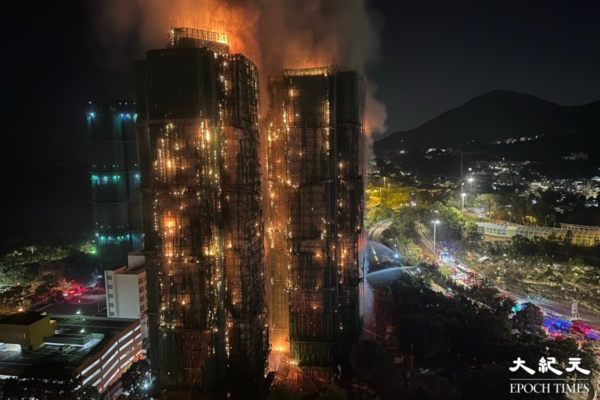
In recent days, a century-old fire occurred at the Grand Wealth Garden in Tai Po, Hong Kong, with the number of casualties continuing to rise. The SAR government announced on the afternoon of December 3 that as of 2 p.m. on that day, the disaster had claimed the lives of 159 people, and the internal search work in seven buildings has been completed.
This century-old tragedy not only shocked Hong Kong but also sparked a deep reflection on the current governance system. Hong Kong media personalities and columnists, who have been seen as pro-government and pro-establishment, including Eugenia Yau Wing, posted an article on her personal Facebook page on December 2 titled “Cure the Rot that Attracts Flies First.” Her sharp criticism directly pointed out that the core of the Grand Wealth Garden fire was “man-made disaster,” citing a movie dialogue: “Man-made disasters are sometimes more terrifying than natural disasters!”
Yau Wing’s article targeted the social abnormalities in Hong Kong over the past few years. The original article described how citizens often “report to ‘East Week’” when faced with issues. She pointed out that officials and politicians often say “people’s livelihood matters,” but when many citizens encounter problems such as building repairs and poor management, their final resort is a television program called “East Week, West Week.”
She noted that this phenomenon signifies the “failure and ineffectiveness” of government departments, legislators, political parties, and traditional media, with the unspoken message from citizens being “no one to complain to.” Yau mentioned that the large-scale maintenance issues at Grand Wealth Garden were reported on “East Week, West Week” a year ago, representing the last resort for residents when complaints seemed to fall on deaf ears. This illustrates how small societal issues escalate into significant problems due to the lack of attention.
The article stated that Yau Wing herself has received requests for help from citizens regarding building maintenance issues in recent years, and despite seeking assistance from legislators and the media, the problems have not been resolved, leaving “helpless” ordinary citizens.
A section of the original article published on the Facebook page of the “Ta Kung Pao” was also deleted, highlighting that in the past few years, Hong Kong has used the wrong methods to address issues. It emphasized the need to focus on people’s livelihoods, reform bureaucratic structures, and not just prioritize political loyalty. The article suggested that the lack of criticism from legislators and media, as well as their constrained monitoring roles, inevitably lead to major incidents, albeit unexpectedly costing hundreds of lives and affecting thousands of families.
Yau Wing’s article concluded by quoting a classic line from actor Andy Lau in the movie “City on Fire,” stating, “Man-made disasters are sometimes more terrifying than natural disasters,” urging a focus on solving root causes.
She called on for the central government’s emphasis on “governance first, betterment later” not to remain just a political catchphrase but to become “a thorough change.” This change should be profound enough to shake up the entrenched bureaucratic system and prevent tragedies from recurring.
The article ended by expressing the hope that “this fire can awaken some people and illuminate our future path.”
From the perspective of a pro-establishment media figure, this commentary issued an extremely grave warning about the governance and bureaucratic system in Hong Kong, defining the disaster at Grand Wealth Garden as an unavoidable “man-made disaster” caused by long-standing faults, resonating with many.