
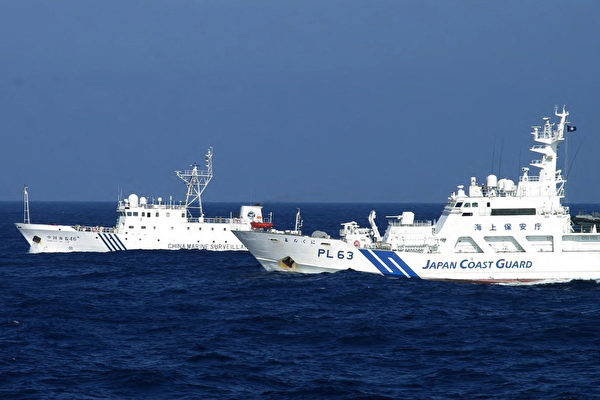
Tensions between China and Japan continued to escalate on Tuesday, December 2nd, as both countries’ coast guard authorities reported another standoff between their ships near the disputed islands.
Since Japan’s new Prime Minister, Kanichi Takai, made remarks on November 7th regarding Taiwan, the relationship between China and Japan has been under intense strain.
The Japan Coast Guard stated that two Chinese coast guard vessels entered Japanese territorial waters near the Diaoyu Islands in the East China Sea early on Tuesday and left several hours later.
The Diaoyu Islands (known as the Senkaku Islands in Japan) are under Japanese control, but Beijing claims them as its own territory. The waters around these islands have been a hotspot in China-Japan relations for decades.
In its statement, the Japan Coast Guard mentioned that one of the Chinese coast guard ships approached a Japanese fishing vessel, prompting the Japanese coast guard ships to request its departure from the area. The statement asserted, “The behavior of the Chinese coast guard ship sailing in Japanese territorial waters near the Diaoyu Islands and asserting its sovereignty claims fundamentally violates international law.”
The Japanese statement further specified that these two Chinese vessels, along with others, were still active in the nearby waters.
On the other hand, Liu Dejun, a spokesperson for the Chinese Coast Guard, claimed that a Japanese fishing vessel had “illegally entered Chinese territorial waters.” Liu stated on the official WeChat account of the Chinese Coast Guard, “The Chinese coast guard took necessary control measures and issued warnings to drive it away.”
This incident marks the second clash between Chinese and Japanese ships near the Diaoyu Islands since Takai’s remarks about Taiwan. On the morning of November 16th, four Chinese coast guard ships successively entered the waters near the Diaoyu Islands, stayed for about an hour and a half, and then withdrew from Japanese territorial waters. The Japan Coast Guard continued to issue warnings and closely monitor the Chinese ships to prevent them from entering Japanese waters again.
Recently, Kanichi Takai became the first Japanese leader in decades to openly connect a Taiwan Strait crisis with the potential deployment of Japanese troops. During a parliamentary session on November 7th, she stated that a conflict in the Taiwan Strait could be considered a “threat to Japan’s survival.” This stance by Takai could provide a legal basis for Japan to exercise its right to collective self-defense and intervene in the event of a Taiwan Strait conflict. In response, China reacted strongly and implemented a series of retaliatory measures, including warning Chinese tourists against traveling to Japan, suspending the resumption of importing Japanese seafood, and halting the approval of new Japanese films.
Despite the backlash, Takai has refused to retract her statements, emphasizing that the Japanese government’s position remains unwavering.
“In the face of a situation that threatens Japan’s survival, the government will make a comprehensive judgment based on all available information and the specific circumstances that arise,” she stated.
There seems to be little willingness within Japan to make concessions to China. Yasuhide Nakayama, a member of the ruling party and former Assistant Defense Minister, expressed that discussing security realities truthfully is not provocative but a right of every sovereign country.
Taiwan is only 110 kilometers (68.35 miles) away from Japanese territory. The concept that “a crisis in Taiwan is a crisis for Japan” was first introduced by the late former Japanese Prime Minister Shinzo Abe in 2021.