
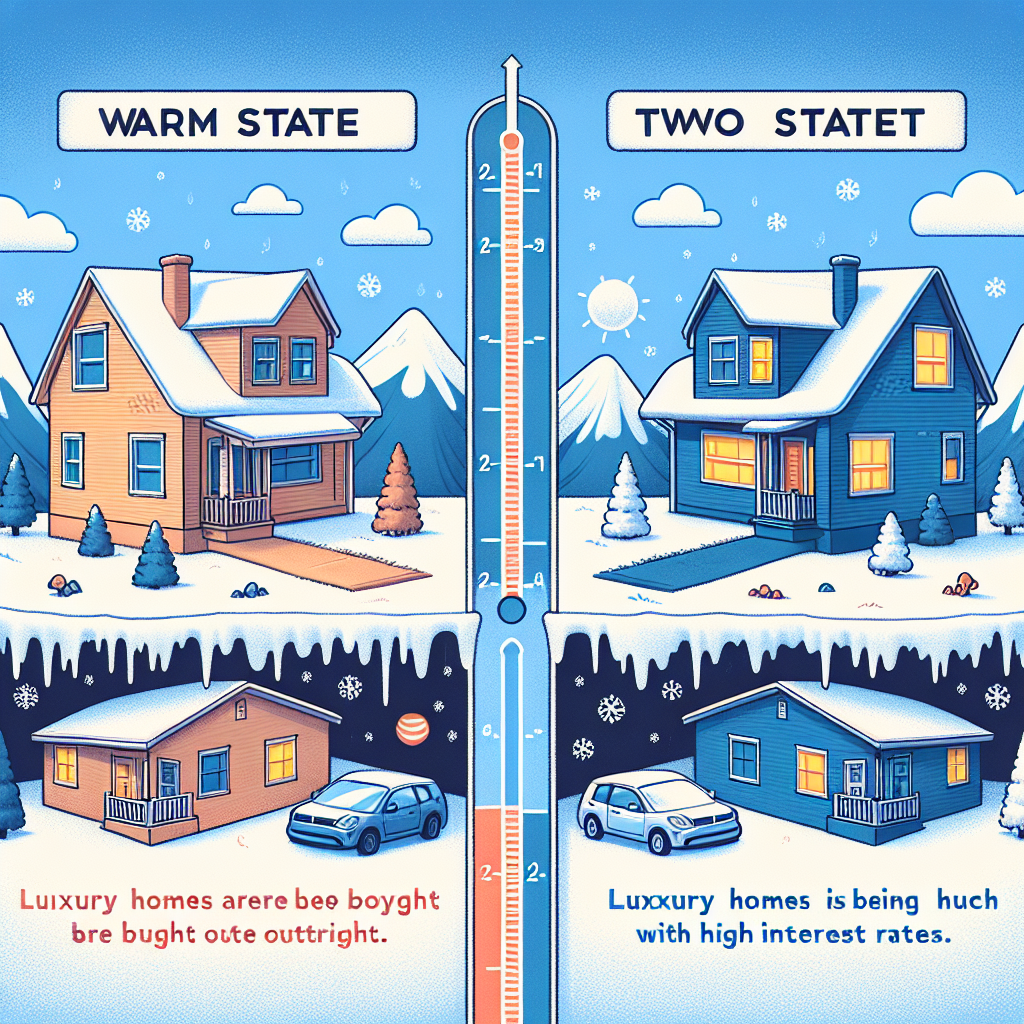
Why do we see “two housing markets in the United States” this winter? In the same United States, there are two completely different housing market perceptions: on one side, there is the high-end market, warm states, cash buyers who almost ignore high interest rates; on the other side, there is a slowdown in transactions, buyers and sellers at a standstill, and a conservative atmosphere in the regular owner-occupied housing market.
Winter is traditionally the off-season for the US housing market, and the real “differences” and “turns” are most obvious in winter, especially this year.
The key forces contributing to the “two housing markets” are high-income groups, international funds, and those with tax migration purposes on one side; and high interest rates, low inventory, and homeowners locked into low rates who are unwilling to sell on the other.
The appearance of the regions in the first housing market: ordinary households under high interest rates are unable to buy or sell. Buyers are worried about the sharp increase in monthly mortgage burdens, while old homeowners are “locked” by old rates of 2%-3% and unwilling to move.
The seasonal and psychological factors of winter mean cold weather in northern cities, fewer home viewings, and extended listing times. Additionally, family buyers tend to wait for spring break or summer break to move, leading to a general cautious approach during winter.
The winter image of school district housing remains robust, but there is slightly more room for bargaining for buyers. Parents are concerned about whether they can move in before the next school year and complete the enrollment schedule.
Therefore, the basic mindset of buyers in the first housing market is mainly focused on “monthly cash flow,” feeling pressure from high-interest monthly payments and uncertainty about future interest rate drops.
In fact, the first housing market encompasses several types, with one type being cold winter areas with many middle-class families relying on loans and being “frozen by high interest rates.” This includes suburban school districts in the Boston metropolitan area, commuting school district towns in New York and New Jersey, and good school district areas in the Chicago metropolitan area.
First, these places have cold winters, prone to heavy snow, resulting in a significant weakening of market momentum. In addition, in places like the Boston school district or suburbs, many homeowners have old rates around 3% and are unwilling to sell or upgrade their homes.
In school districts in New York and New Jersey, homebuyers are mostly professionals, with many Chinese parents feeling the overall pressure of “monthly payments + tuition + tutoring.” Although the school district supports prices, transaction volumes are noticeably subdued. As for Chicago, prices are relatively moderate compared to the East and West Coasts, but local incomes are not as high, and high interest rates significantly compress purchasing power.
The second type is the “non-premium” owner-occupied areas in the major coastal metropolitan areas of the West, including the San Francisco Bay Area: non-pyramid-top primary city, middle-class owner-occupied areas of Los Angeles and Orange County, suburban commuting areas in the Seattle metropolitan area.
In the San Francisco Bay Area, neighborhoods like San Jose, Santa Clara, and Milpitas in the South; communities like Fremont, Union City, Dublin, and Pleasanton in the East Bay.
Many buyers in these areas are from the high-tech industry or general white-collar workers, needing loans of 70%-80%. With low winter transaction volumes and extended listing times for homeowners, prices may not drop significantly, but the market remains “sticky.”
In Southern California, areas like West San Fernando Valley and Pasadena in the Los Angeles suburbs; as well as some communities outside Irvine in Orange County, such as Tustin, Lake Forest, and Mission Viejo, fall into the first housing market type.
Why is the U.S. housing market divided in half this winter? From New York to Florida, from the middle class to the wealthy, who is feeling the cold under high interest rates and who is still house-hunting? #USRealEstateHotspots 11/29/2025
The third type is suburban good areas for owner-occupied houses in the inland major metropolitan areas, including areas where prices are not as exaggerated as the coastal ones but where local salaries are also not as high. For example, suburban areas of mountain cities like Denver and Salt Lake City, and suburbs of northern metropolitan areas like Minneapolis and Detroit.
The fourth type is the family market in the southern and sunny regions that have not been inflated by out-of-state funds. In many of these areas, there are middle-income, ordinary regions dependent on local income, such as the outer areas of Houston, Texas, and surroundings; or non-short-term rental communities outside Orlando in Florida, suburbs of Tampa without coastal views.
These regions represent the “general household market primarily for primary residences, relying on salaries to pay mortgages, and particularly sensitive to high interest rates during the winter.”
Next, let’s take a look at the areas that fall into the second housing market: first, the first one must be the cash luxury home belt in South Florida, including Miami Beach, Brickell, Sunny Isles Beach, Palm Beach, and Fort Lauderdale.
The characteristics of the second housing market can be seen from the high cash ratio of buyers: in 2024, nearly 40% of all real estate transactions in South Florida were cash, with rates around 38.9% in Fort Lauderdale and 38.1% in Miami. Furthermore, in 2024, 67% of foreign luxury home buyers in South Florida paid fully in cash, much higher than the national average.
Additionally, there has been a continuous influx of high net worth individuals into Miami and Palm Beach, with cumulative price increases from 2020 to 2025 leading them to be at the forefront of the luxury home market in the U.S., with Palm Beach seeing an increase of around 117% and Miami around 84%. Even as prices have cooled from “crazed” to “steady,” transactions for million-dollar-plus luxury homes remain high, indicating that cash buyers are almost unaffected by high interest rates.
The second area is the luxury home triangle in Texas: Dallas, Austin, and Houston’s high-end segment. In 2024, the volume of million-dollar-plus home transactions in Dallas increased by about 28% over the previous year, but when excluding million-dollar homes, transactions in other price ranges saw almost zero growth, typical of “two parallel worlds in the same realm.” Representative areas include Park Cities and northern suburban areas in Dallas.
Furthermore, there are the lake and mountain view luxury home circles for tech nouveau riche individuals in Austin, and old money luxury home circles like River Oaks and Memorial Villages in Houston, but the general primary market within the same state has been noticeably underwhelming.
The third area is Scottsdale and Paradise Valley desert luxury homes in Arizona. Scottsdale features upscale golf communities and vacation villas, with transactions for million-dollar-plus homes surging by 57.7% in early 2025 compared to the same period the previous year, while transactions for ultra-luxury homes of five million or more have even skyrocketed by 157%. Paradise Valley has also seen transactions in the $29-$33 million range, setting new state records.
The fourth area is the coastal region of Southern California: the west side of Los Angeles and the cash luxury home belt along the Orange County coast. Areas like Beverly Hills and Bel Air on the westside of Los Angeles; and coastal areas like Malibu, Pacific Palisades, and Santa Monica are mentioned.
Some may wonder, did the wildfires in early 2025 not deter these buyers? Indeed, during the initial fires, transaction volume in Malibu halved in the first half of 2025, but many new owners chose to take over burned land and ruin, with land often priced at over a million and even over two million finding buyers. Hence, it was the “existing homeowners living there” who were deterred, and not the “cash buyers acquiring the properties.”
In the coastal areas of Orange County like Newport, Laguna, and Newport Coast, recognized as one of the hot markets for ultra-luxury homes nationwide, median listing prices for luxury homes can exceed four million, with prices continuing to hit new highs in recent years.
The fifth region is in the desert area, Las Vegas and Henderson. This area features upscale golf communities and mountain-view luxury homes with median listing prices around two million or higher, often listed between three million to thirty million. About 28% of transactions in Las Vegas in 2024 were in cash, notably higher compared to many other inland states.
Although the Las Vegas market saw a bit of “rising inventory and slowed pace” in 2025, cash and investor buyers remain key forces in high-end communities.
Finally, for buyers looking to complete transactions during the winter, while there may be less competition and opportunities for bargains, the lower listing and transaction volumes during winter, especially from December to February, can lead to distorted price signals due to insufficient references. A few “cheap” transactions may mistakenly make you think that a certain area is weakening across the board.
Conversely, if there are several high-priced transactions (such as rare properties in good school districts), it may lead to an overestimation of the market’s support strength. For a more accurate market analysis, it’s best to consider “seasonal adjustments” and look at data from the previous and following seasons together to avoid misjudging the situation! ◇