
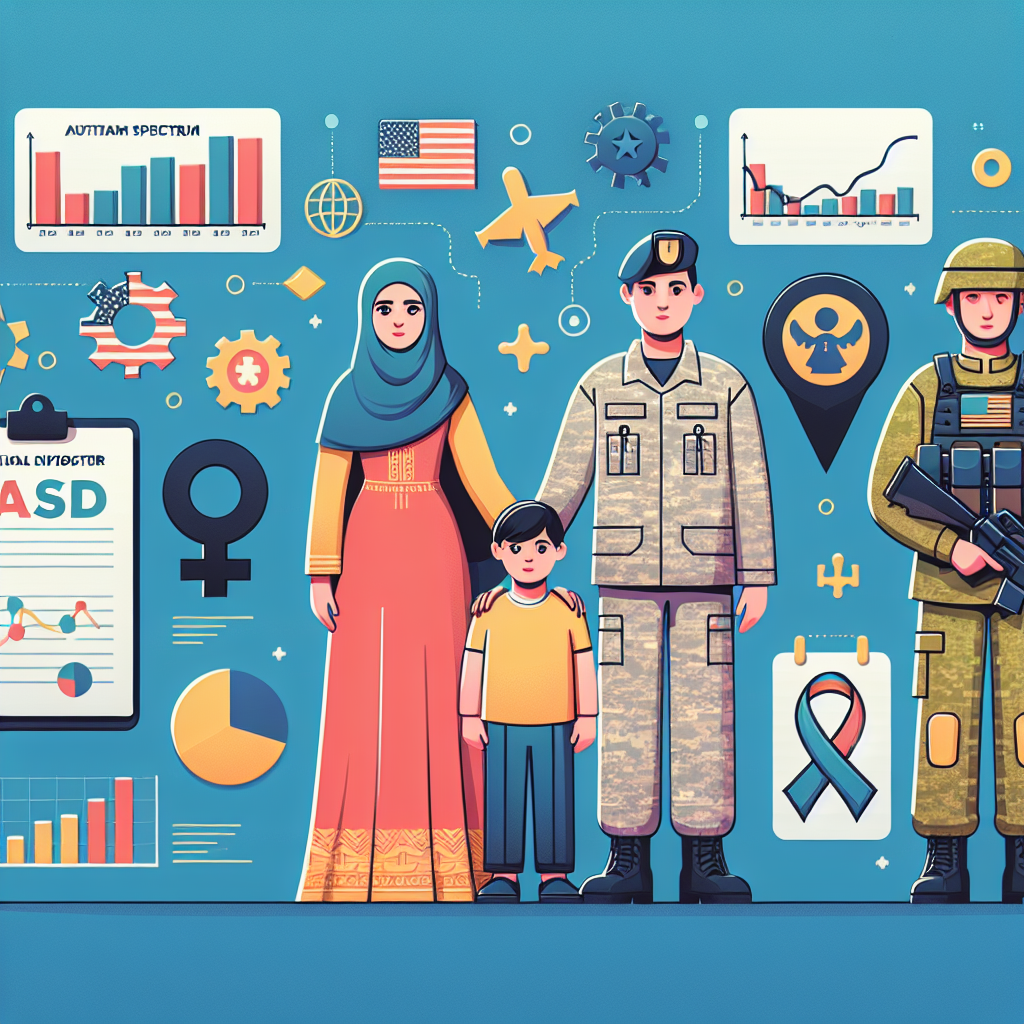
According to a report by the Children’s Health Defense (CHD), a federal health survey data analysis found that children of military families in the United States are diagnosed with Autism Spectrum Disorder (ASD) at a higher rate compared to children of civilian families. Some scientists believe that the issue of children being directly or indirectly exposed to toxins through contact with parents cannot be ignored.
CHD scientists Karl Jablonowski and Dr. Brian Hooker analyzed data from the National Survey of Child Health conducted by the U.S. Census Bureau over the past eight years. Jablonowski stated, “For years, more information on children of military personnel diagnosed with autism has not been discovered by the Census Bureau. Our male and female soldiers deserve better treatment. Serving in the military may bring various risks to individuals, and the research found that their children also face unknown neurological health risks.”
Researchers analyzed over 330,000 children’s health records collected between 2016 and 2023, revealing that 3.19% of children covered by civilian insurance and 4.12% covered by military medical insurance were diagnosed with ASD.
After statistical adjustments, the data showed that children covered by military insurance had a 30.73% higher likelihood of being diagnosed with autism compared to children covered by civilian insurance. In any given year, children of military personnel had a higher likelihood of being diagnosed with autism than civilian children.
The study also found that children whose mothers had served in the military had a 46.19% higher likelihood of being diagnosed with autism compared to those whose mothers had not served, while children whose fathers had served had a 42.71% higher likelihood compared to those whose fathers had not served.
In comparison to children of non-military fathers, children from military families also displayed significant differences in the severity of autism. The likelihood of children from military families being diagnosed with mild ASD was 37.37% higher, moderate ASD was 45.64% higher, and severe ASD was 82.73% higher. Researchers noted a clear gradient: children of non-military fathers had the lowest rate of illness, while children of currently deployed or active-duty military fathers had the highest rate of illness.
The scientists pointed out that on one hand, this could be related to exposure to toxins in the military environment or due to occupational reasons, such as exposure to perfluoroalkyl and polyfluoroalkyl substances (PFAS) related to firefighting foams, unique medical exposures in deployment environments, or other industrial and environmental toxins typically associated with military operations. On the other hand, vaccination rates in military families were relatively high.
The researchers also suggested that there may be biases in the investigation data, such as children of military parents with autism being more inclined to complete national child health surveys, or differences in diagnosis between the military and civilian medical systems that could lead to higher detection rates.
Despite the various possible interpretations of these analytical results, the risk of children becoming ill through direct contact with toxins or indirect exposure through parents cannot be overlooked, and further investigations must be carried out promptly, the study concluded.
On November 19, the U.S. Centers for Disease Control and Prevention (CDC) website revised its information about autism, stating that there is “lack of evidence” to support vaccines causing autism. In 2022, approximately 1 in 31 children were diagnosed with ASD, meaning that there could be 1 child with autism among every 31 children, compared to the ratio of 1 in 36 two years ago, indicating a significant increase in the incidence of autism in children.
Editor: Fang Ping