
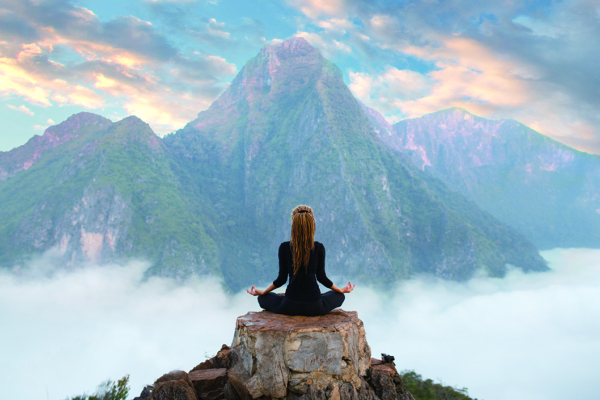
Meditation/Sitting is becoming a daily habit for many successful business people. Many business leaders and billionaires, including Apple co-founder Steve Jobs and Twitter co-founder Jack Dorsey, openly recommend meditation and share the positive impact it has on their lives and work.
Passionate about Zen meditation, Jobs once traveled to India, delving deep into the study of Buddhism. During his trip, he noticed that people in Indian villages relied more on intuition than rational thinking. He realized that intuition is a very powerful force that had a profound impact on his work.
In an interview, he said, “I began to realize that intuitive understanding is more important than abstract thinking and intellectual logical analysis.”
Therefore, he persisted in sitting to awaken his intuition. He said, “If you just sit and observe, you will notice how restless your thoughts are. If you try to calm them, you will make it worse, but over time, it will calm down. When it does, you can hear more subtle sounds – that’s when your intuition starts to blossom, you begin to see things more clearly, and live in the present.”
Walter Isaacson, who wrote Jobs’ biography, stated that during this process, Jobs “learned to focus and avoid distractions, traits that helped him build Apple and Pixar into industry giants.”
According to Honehealth website, Twitter co-founder Dorsey sits for an hour both in the morning and evening, a practice that has led to clearer thinking over the past 20 years. While operating Twitter and Square concurrently, Dorsey found meditation crucial to maintaining clarity under immense pressure, enabling him to not be consumed by setbacks at work.
Ray Dalio, founder of the world’s largest hedge fund Bridgewater Associates and a billionaire, directly stated: “Meditation is the most critical reason I have achieved all my accomplishments.”
In his book “Principles,” Dalio wrote: “I encountered meditation during a period of extreme work stress and personal life pressure, and it alleviated much of my pain. Meditation profoundly changed my outlook on life. I’ve persisted with meditation… and have seen exponential returns. The more you do, the greater the reward. This effect far surpasses linear growth.”
Authors Elizabeth Novogratz and Sukey Novogratz, of the book “Just Sit: A Meditation Guidebook for People Who Know They Should But Don’t,” said in an interview with Forbes: “Meditation can increase the thickness of the hippocampus, responsible for memory and the ability to learn new things.”
“Meditation aids long-term memory, helping you in tasks like giving speeches, closing deals, or remembering your boss’s husband’s birthday. This part of the brain is also an area affected by Alzheimer’s disease, thus daily meditation can extend its benefits beyond the workplace.”
“The amygdala is an area of the brain responsible for fear, telling us how to deal with anything we find scary, such as dealing with bosses, asking for a raise, public speaking, firing employees, or leading a team.”
“Compared to non-meditators, meditators have less gray matter in the amygdala. When the gray matter in the amygdala decreases, the prefrontal cortex thickens – responsible for consciousness and decision-making. Long-term meditators are not only braver but also have a longer response time in emotionally stirring situations because they have time to respond to the situation rather than react. They are better and more efficient decision-makers.”
According to Yahoo News, a group of entrepreneurs who founded companies or developed applications to popularize meditation among the masses stated that meditation can help in various ways for your career, ultimately aiding in wealth accumulation.
Former ABC News anchor, bestselling author on meditation, and developer of meditation applications Dan Harris said, “Unless you are enlightened or dead, you can’t turn off the voices in your head.”
However, he emphasized that the key is not to take the voices in your head too seriously. “Understand that not all thoughts are relevant to reality. The voices in your head won’t disappear, but you will develop a different relationship with them, learning to respond to things wisely rather than react blindly. It’s a superpower that makes you more efficient, easier to deal with, and enhances your competitiveness in a world where most people are completely blinded.”
Have you ever said something to your boss or colleague that you regret later? Experts suggest that meditation can help suppress the impulse to retaliate immediately after being provoked.
Yalof Schwartz, founder of the meditation company Unplug, said, “Instead of sending an email you’ll regret, meditation allows you to pause, stay mindful, and take initiative instead of a passive approach. A CEO just taking a deep breath for a second can save a million dollars.”
Harris stated that meditation helps cultivate mindfulness, a popular term he describes as “the ability to know what’s going on in your head at any given moment without being led around by it.”
He pointed out that cultivating mindfulness reduces emotional reactions instantly. You no longer instinctively see the inner cacophony as truth and learn to stay calm. This makes you more outstanding in your work, giving you at least 10% more time to keep calm when others are losing their minds.
Dina Kaplan, founder of The Path meditation events company, said, “What people don’t realize is that as you train your mind, the internal noise – the noise in your head – gradually subsides. You have more room to input new information.” This new information might mean coming up with new ideas at work or realizing you’re not happy with your current job and need a change.
Kaplan said, “When you start a meditation practice, the first thing you notice is that you begin to see more, smell more, hear more. You start picking up all the non-verbal signals others are giving you, which is incredibly helpful for business and life. This gives you the edge.”
If you take pride in your toughness, sitting/meditation won’t make you weak.
Harris said, “Sitting/Meditating isn’t a bubble bath leading you into a state of unflappable, perpetual relaxation. It’s more like exercising the brain, where you sit down and focus on one thing for a while – usually your breath. When you lose focus, you start over, again and again. It requires perseverance and persistence, qualities that are equally applicable in daily life.”
Many experts say “no time” is one of the excuses many people use to avoid sitting/meditation. However, Kaplan said, “Meditation gives you more time. On meditation days, my efficiency increased by 90%.”
Renowned American entrepreneur and investor Naval Ravikant is known for his spiritual and philosophical insights. His most crucial daily practice is sitting/meditation. In an interview with Joe Rogan, he mentioned that his sitting meditation doesn’t rely on any particular method or tool; he simply sits quietly, observing the thoughts flowing through his mind naturally.
He said, “It’s interesting; when I first started meditating, it was very difficult. I think many people have heard about meditation and its benefits, many have tried it, found it challenging, and ultimately gave up. It’s something everyone says they’ll do but no one actually does. Now it has become a bragging topic, where people discuss how long they meditate for. ‘How long did you meditate for?’ ‘I meditated for this long.’ ‘Oh, your meditation method is wrong, mine is right.’ However, meditation is simply the power of ‘doing nothing,’ but it’s crucial.”
“Because in the process of our growth, life becomes cluttered. Some things you are digesting, some you are absorbing, and some you should think about more but haven’t had the time, so they get buried. They become your preferences, views, and all unresolved problems. Like your email inbox, filled with many unreplied messages, some dating back 10, 20, 30, and 40 years. When you sit down to meditate, those messages come back to you. Hey, what about this issue? What about that one? Have you resolved this? Thought about that? Do you regret that?”
“It’s scary, people don’t want to face it. They say, ‘I can’t; I can’t clear my mind. I can’t continue.’ But, in reality, what you’re doing is self-healing; you’re not going to a psychologist, paying them to listen to you; you’re listening to yourself. You just sit there, let those messages pass through, deal with them one by one until your inbox reaches that magical state of ‘zero.'”
“Someday when you meditate sitting down, you’ll realize that the only thing on your mind is what happened yesterday because you’ve processed everything, even if it’s not resolved. At least you’ve heard your inner self. That’s when meditation truly begins. I believe it’s a profoundly impactful thing; everyone should experience it, then you’ll truly understand the beauty of ‘doing nothing.'”
“All meditation requires is sitting down, closing your eyes, finding a comfortable posture, letting everything naturally happen. If you want to think, think; if not, then don’t. Don’t deliberately do or not do anything; that’s all you need to do.”
That’s Naval’s art of “doing nothing.” Do you believe in the benefits of sitting/meditation now? Then give it a try. Remember: the art of non-action is the key to a fruitful life.