
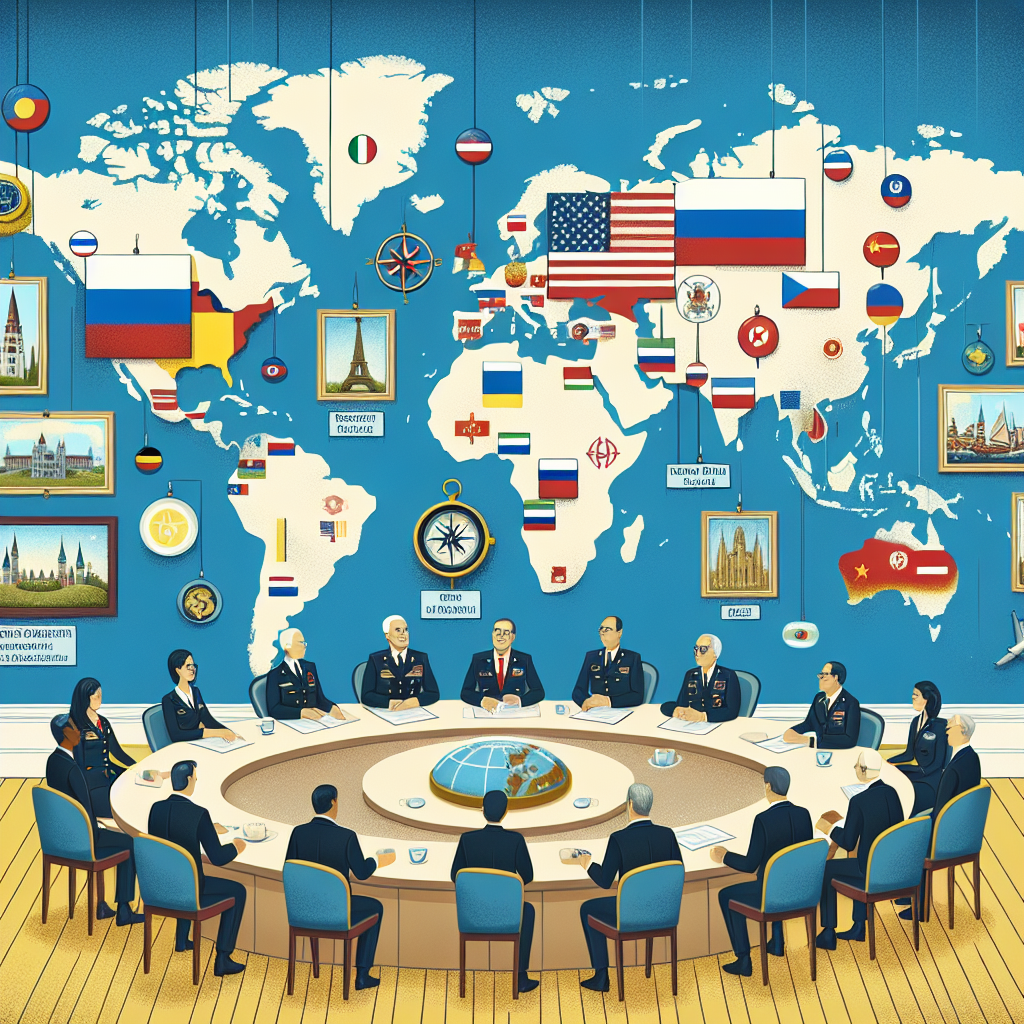
Senior security officials from multiple countries expressed on Sunday (June 1) at the Shangri-La Dialogue that the support of Russia and North Korea for Russia’s invasion of Ukraine exposes the fading boundaries of international security, emphasizing the need for global cooperation to promote defense strategies.
According to reports from Associated Press, Lithuanian Defense Minister Dovilė Šakalienė stated at the prestigious Shangri-La Dialogue that if Russia’s invasion of Ukraine succeeds and leads to its fall, it could trigger a chain reaction in Asia, potentially emboldening Beijing in its assertiveness towards Taiwan and the South China Sea.
“If Russia succeeds in Ukraine, it is not only about Europe, not just about one region, but it sends a very clear signal to small countries in the Indo-Pacific region: anyone can ignore their boundaries, use any concocted excuse to justify an invasion,” she said.
The 22nd Shangri-La Dialogue took place from May 30 to June 1, with over 600 representatives from 47 countries participating in the forum. The forum featured 6 plenary sessions focusing on topics such as the US’s new security ambitions in the Indo-Pacific, ensuring stability in a competitive world, controlling nuclear proliferation in the Asia-Pacific, addressing challenges in cyberspace, the seabed, and outer space, cross-regional security connections, and enhancing security cooperation for stability in the Asia-Pacific region.
On Saturday (May 29), US Defense Secretary Pete Hegseth suggested that European countries should prioritize defense in their region and leave more defense responsibilities in the Indo-Pacific to the US. However, Šakalienė pointed out that in reality, global security regions are evidently interconnected, and boundaries are becoming blurred.
She stated, “It is well known that the primary cyber security threats for Japan come from China (CCP), Russia, and North Korea; while the main cyber security threats for Lithuania come from Russia, China (CCP), and Belarus, where two of the main threats – China (CCP) and Russia – completely overlap.”
Recently, Moscow and Pyongyang have openly acknowledged North Korea’s deployment of troops and military equipment on the Russian-Ukrainian frontlines, with China providing economic and technological support to Moscow while opposing international sanctions against Russia. Iran has been a key supplier of attack drones in Russia’s war efforts.
Šakalienė emphasized, “In response to the increasing coordination and convergence between the authoritarian axis of Russia, China (CCP), Iran, and North Korea, the international community needs a unified response.”
She added, “Against this backdrop, it is reasonable and necessary for the US to strategically focus on the Indo-Pacific region, but this is not solely the responsibility of the US.”
Her comments echoed those of French President Emmanuel Macron at the opening ceremony on Friday (May 30), where Macron implied that Europe should play a more active role in the Indo-Pacific.
Macron openly warned China that if it does not take more steps to prevent North Korea from participating in the Russia-Ukraine war, NATO may increase its presence in Asia.
He also urged for a new alliance between Europe and Asia to counter the ambitions of major powers in the region seeking to establish a “zone of intimidation.” Macron highlighted that the alliance between Europe and Asia would be based on “shared norms and principles,” stating that “undoubtedly, the era of non-alignment is over.”
Australian Defense Minister Richard Marles, during the meeting, stated to reporters that a key conclusion drawn from the conference was the active participation of European countries in discussions, reflecting the interconnectedness between the Indo-Pacific and the North Atlantic.
Philippine Defense Minister Gilberto Teodoro Jr. dismissed China’s claim that the US is a hegemonic state. The Philippines is currently engaged in increasingly intense conflicts with China over the South China Sea dispute.
He remarked, “What China considers ‘fairness and justice’ may sharply contrast with the norms and values accepted by the rest of the world, especially smaller nations.”
Teodoro pointed out, “To imagine what an international order dominated by China (CCP) would look like, we need only look at how they treat smaller neighboring countries in the South China Sea.”
The Philippine Defense Minister also emphasized that the South China Sea is one of the “global economic lifelines” with several maritime routes, and the tense situation in the Indo-Pacific region will significantly impact the global trade flow, military deployments, and diplomatic stances.
He stated, “If any of these maritime passages get cut off, it will trigger a chain reaction across continents, affecting trade flows, military deployments, and diplomatic postures worldwide.”