
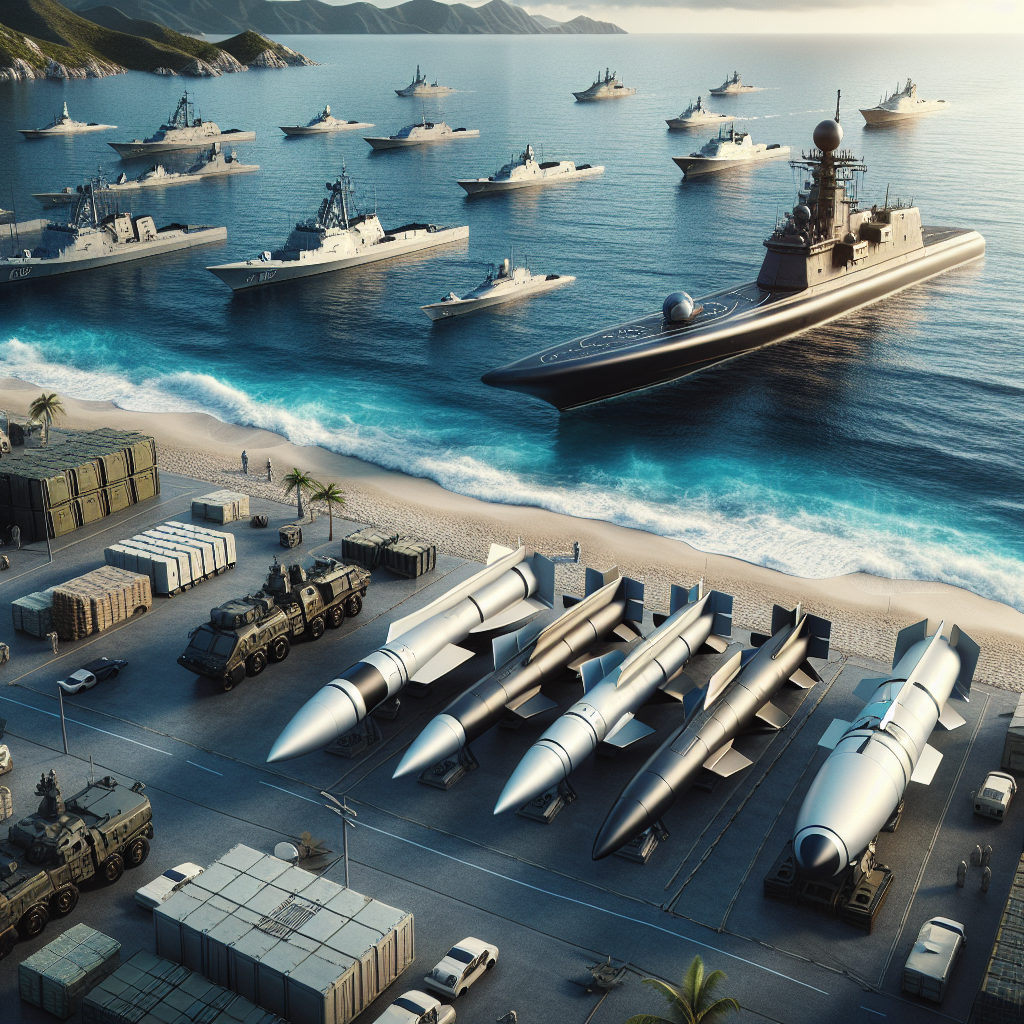
Amid the rapid expansion of the Chinese Communist navy, the United States has strengthened its military deployment around the region. In addition to deploying the “Typhoon” missile system in the Philippines earlier, the US military recently also deployed a nuclear-powered submarine equipped with over a hundred long-range missiles.
The photos released by the US Seventh Submarine Squadron on Tuesday (May 13) show that the USS Ohio missile submarine was deployed to the Guam Naval Base on April 23.
Guam houses multiple US military bases and is a crucial strategic area in countering China, located 1,800 miles (about 2,900 kilometers) away, forming a key part of the “containment strategy” under the Second Island Chain.
According to a report by “Newsweek” on May 14, the US Seventh Submarine Squadron headquarters stated that the deployment of the USS Ohio in the Western Pacific reflects America’s commitment to security in the Indo-Pacific region. The USS Ohio and its sister ships can provide “unprecedented strike and special operations capabilities” and are ready to carry out global operations at any time.
The headquarters is primarily responsible for submarine deployments in the Western Pacific, Indian Ocean, and Arabian Sea.
The USS Ohio is one of the four converted Ohio-class missile submarines of the US Navy. These submarines have transformed ballistic missile launch tubes into tomahawk cruise missile launch tubes, with each submarine capable of carrying 154 tomahawk missiles, accurately striking land targets from 1,600 kilometers away. They can also be used to support special operations, accommodating 66 personnel and their equipment.
Additionally, the deployment of the “Typhoon” missile system by the US in the Philippines has made China feel uneasy.
In its first national security white paper released this week, China referred to the deployment of “intermediate-range missile systems” in the region as a sign of “geopolitical escalation.”
Although Beijing did not specifically name the countries involved, it is well known that the US deployed the “Typhoon” missile launcher in the Philippines during the annual joint exercises under the “US-Philippines Mutual Defense Treaty” last year.
China also reiterated in the white paper its so-called “peaceful reunification” with Taiwan and support for the completion of the Code of Conduct in the South China Sea.
Julio Amador III, founder of the geopolitical risk company Amador Research, warned in an interview with “Defense News” that China has always opposed “foreign intervention from extra-regional powers” and sees itself as an alternative partner for regional security.
He cautioned that the international community should “pay attention to China’s consistent inconsistency in actions and be prepared to deal with any potential actions from China.”