
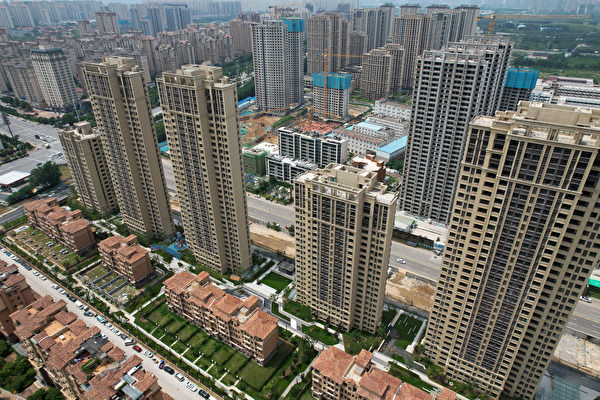
In recent years, the collapse of the real estate market in China has had a significant impact on the financial industry. At least 337 small and medium-sized banks, including those in Henan province, are on the brink of a financial crisis. Zhengzhou Bank, as a government-controlled urban commercial bank, has been deeply entangled in the wave of loan defaults by local real estate firms in Henan.
According to reports from the Financial Times and China Interview Network supervised by Shenzhen Media, Zhengzhou Bank recently issued a public announcement regarding the progress of litigation matters. The bank pursued the local real estate firm Kangqiao Group and its affiliated enterprises for debt collection, won the lawsuit, but may not be able to recover the loans.
The Zhengzhou Intermediate People’s Court stated in a recent execution ruling issued to Zhengzhou Bank that no other executable assets of the debtor were found, thus ending the execution procedure for this case.
The amount involved in the case includes a loan principal of 660 million yuan and interest. This loan was issued by Zhengzhou Bank’s Changchun Road branch to Kangqiao Real Estate Company at the end of December 2019. Despite extensions, Kangqiao Real Estate still could not repay the loan. Consequently, Zhengzhou Bank filed a lawsuit against Kangqiao Real Estate and numerous guarantors. However, with Kangqiao Real Estate and many guarantor companies now classified as “discredited persons subject to enforcement,” the difficulty of recovering the loans is extremely high.
Public records show that the defendant behind Zhengzhou Kangqiao Real Estate is the well-established Kangqiao Group based in Henan, with founder Song Gewei being a prominent figure in the Henan real estate sector. Song was not only recognized as one of the “Top Ten Leaders in Central Plains Real Estate,” but also has a listed company under his name – Kangqiao Enjoy Life.
In 2020, Kangqiao Real Estate’s sales once exceeded 50 billion yuan, ranking 63rd on the real estate sales list. However, in less than three years, Kangqiao Real Estate not only disappeared from major sales rankings but also became a “discredited company,” with Song Gewei himself restricted from high consumption.
Apart from Kangqiao Real Estate, Zhengzhou Bank is also pursuing debts from local real estate companies such as Meijing Xinrui Real Estate and Xinyuan Group.
Meijing Xinrui Real Estate has since become a state-controlled enterprise, but was previously under Song Gewei’s companies. Zhengzhou Bank provided a loan of 450 million yuan to Meijing Xinrui Real Estate in October 2021, with a term of 2 years and guarantees from Beijing Kangqiao, Song Gewei, Zhengzhou Ruitu, Henan Kangqiao, among others. Due to Meijing Xinrui’s failure to repay the loan and the guarantors not fulfilling related agreements, Zhengzhou Bank initiated legal proceedings.
Xinyuan Group, another well-known local real estate enterprise in Henan, was recognized as one of the “Top 100 Comprehensive Strengths of Chinese Real Estate Companies” in 2020. The company’s founder, Zhang Yong, has been awarded titles such as “Top Ten Influential Figures in Chinese Real Estate” and “60 Outstanding Entrepreneurs in Chinese Real Estate Industry.”
However, similar to Kangqiao Real Estate, Xinyuan Group is now deeply embroiled in disputes and debt quagmire. Even before being pursued by Zhengzhou Bank for debts, Xinyuan Group and its affiliated companies had already become “discredited persons subject to enforcement,” including listed entity Xinyuan Real Estate, with Zhang Yong himself being restricted from high consumption by the court multiple times, involving an amount exceeding 1.6 billion yuan. The 1.1 billion yuan loan extended by Zhengzhou Bank to Xinyuan Group also faces difficulties in recovery.
During the booming years of the Zhengzhou real estate market, Zhengzhou Bank significantly increased its loans to the real estate industry. In its first year of listing in 2018, the bank’s real estate industry loan scale surged by 81% from the previous year-end to 1.8098 billion yuan, accounting for 11.34% compared to the previous year’s 7.78%. By 2021, Zhengzhou Bank’s loans to the public real estate sector reached 34.438 billion yuan.
With the real estate market cooling off, Zhengzhou Bank’s non-performing loans have been prominently exposed. Particularly, enterprises engaged in illegal loan acquisitions have become the main source of non-performing loans, highlighting deficiencies in Zhengzhou Bank’s internal controls.
In November 2024, the former chairman of Zhengzhou Bank was officially dismissed from the Party and removed from office. The investigation revealed that Wang Tianyu had engaged in significant corruption during his leadership at Zhengzhou Bank, providing assistance in loan financing and other illicit activities, the extent of which directed toward the real estate sector remains unknown.
Public records indicate that Zhengzhou Bank is a city commercial bank controlled by provincial and municipal governments, established in 1996 and renamed Zhengzhou Bank in 2009. In 2015, the bank went public on the Main Board of the Hong Kong Stock Exchange; in 2018, it was also listed on the Shenzhen Stock Exchange.
Zhengzhou Bank operates 132 branches and holds a 51% stake in Henan Jiuding Financial Leasing Co., Ltd. It has also established six village banks – Xinzheng Zhengyin Village Bank, Zhongmu Zhengyin Village Bank, Xinmi Zhengyin Village Bank, Fugou Zhengyin Village Bank, Xinzheng Jingu Village Bank, Yanling Zhengyin Village Bank.
It is noteworthy that in March 2022, multiple real estate enterprises in China announced defaults on debts, marking the first debt peak period for real estate companies in the year. Subsequently, deposit freezing incidents without prior warning occurred at several village banks in Henan since April, affecting depositors from various provinces including Hubei, Guangdong, Shandong, Anhui, among others.
According to reports from mainland media, the village banks implicated in the deposit freezing incidents in Henan province include at least four village banks in Henan and two in Anhui, involving deposits exceeding 39.7 billion yuan.
As per the China Financial Stability Report 2023 issued by the Central Bank of the Communist Party of China, there are 337 “high risk” banks in China, all of which are small and medium-sized banks. These include 14 city commercial banks, 191 rural financial institutions, and 132 village banks, primarily located in the northeastern provinces, Gansu, Inner Mongolia, Shanxi, Henan, and other regions.