
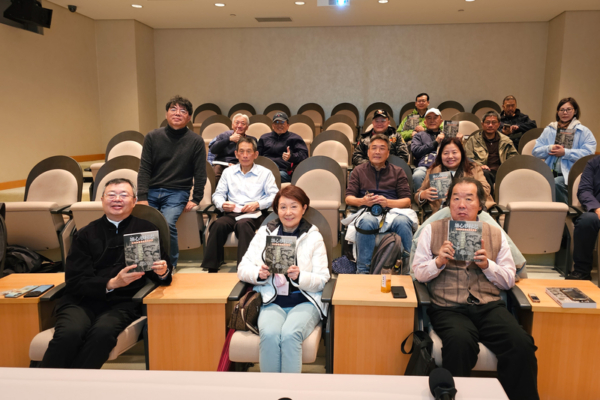
【Epoch Times December 19, 2024】Taiwanese culture publisher “Jiang Tai Wen Culture” released the new book “Puxin Military Dependent Village Chronicles: From Defending the Taiwan Strait to Standby for Counterattack,” which mentions that in Puxin, Taoyuan, Taiwan, there are 9 military officers from the Army in the past who sacrificed and dedicated themselves to defending the Taiwan Strait. During Chiang Kai-shek’s plan to counterattack the mainland, they were on standby for the counterattack, and the legendary “Wild Horse Plan” and “Guoguang Plan” were all part of their story.
The co-authors of the new book are Jiang Zhongxing, chairman of the Taoyuan Military Dependents’ Village Cultural Association and curator of the Puxin Military Dependents village Story Hall, as well as Chen Jinchang, the chief editor of Jiang Tai Wen Culture. The new book mentions that General Hu Lian once boldly proclaimed, “Where there are the 12 corps (later reorganized as the Kinmen Defense Command), there is Taiwan, and where there is Taiwan, there is the Republic of China.” Guests attending the book launch included Hu Lian’s grandson Hu Minyue, director of the Hu Lian Memorial Museum and Research Center, Gui Tian, executive director Hu Huixia, and others.
In the book’s preface titled “To Clean Up the Old Rivers and Mountains,” Jiang Zhongxing mentioned that his mother witnessed the persecution and death of relatives by the Communist Party at a young age, forcing her to dress as a boy at the age of 12. With the protection of his grandmother, he endured the seven and a half years of Japanese oppression. In 1949, amidst the pursuit of Communist forces, his parents and several villagers escaped from Jiangxi to Shantou, Guangdong, and finally landed in Keelung, Taiwan in October. After 10 relocations, they settled in Puxin Military Dependents Village in 1958, where they spent a relatively stable 30 years.
During the period from 1949 to 1958, Jiang Zhongxing stated that without the courage and fierce fighting of the elders in the Puxin Military Dependents Village during battles in Kinmen and the Zhoushan Islands, Taiwan would not have enjoyed decades of stability, let alone economic development. He mentioned that the victories at Guningtou and Dabu Island stopped the surging Communist forces at that time. At least a hundred elders from Puxin Military Dependents Village participated in these two battles. Later, the Kinmen Defense Command became a fortress against the Communists, launching assaults on Nanri Island, Meizhou Island, Dongshan Island, the 93 Artillery Battle, and the 823 Artillery Battle; the elders of Puxin Military Dependents Village successively took over the defense of Kinmen, ensuring Taiwan’s security.
The book “Puxin Military Dependent Village Chronicles: From Defending the Taiwan Strait to Standby for Counterattack” mentions Chiang Kai-shek’s plan to counterattack the mainland, including the legendary “Wild Horse Plan,” March 1 Training Class, Special Forces, Sino-American Joint Intelligence Center, “Wuhan Plan,” and “Guoguang Plan,” are all part of their story.
In the preface, Jiang Zhongxing says that in the 1950s, there was intensive planning for counterattack operations, guerrilla operations in the Yunnan-Burma border area and coastal regions of the mainland, defense of Taiwan and Penghu, the 1001st reconnaissance unit, Wild Horse Group, Special Forces Command, Special Operations First, Second, Third, and Fourth Regiments, Paratrooper Infantry Training Regiment; the first generation of elders from Puxin Military Dependents Village were all present, sacrificing and dedicating themselves in difficult times. This was a crucial period in the history of the Republic of China’s relocation to Taiwan, a life story that the elders of Puxin Military Dependents Village can be proud of.
Chief editor Chen Jinchang of Jiang Tai Wen Culture stated that before the President Chiang Kai-shek decided to move to Taiwan, many military dependents came to Taiwan, leading to severe accommodation problems. At that time, only a few military officers stepped forward to arrange accommodation, leaving many dependents homeless, scattered in schools, temples, factories, warehouses, and even cattle pens, or building makeshift shelters by themselves.
Chen Jinchang pointed out that the first phase of military dependent village construction in Taiwan was initiated by Generals Hu Lian and Liu Yuzhang when the government was not actively addressing the issue. They purchased land to build villages and then donated them to the state, such as Siwei New Village and Guanghua Second Village. The second phase involved building villages during military reorganization and construction in Taiwan, such as the Three Dragons New Village and Kinmen New Village built by the Republic of China Women’s Association (Women’s Association), as well as Success New Village and Wushou New Village established later for the counterattack against the mainland.
Chen Jinchang emphasized that many people thought that the Women’s Association started building military dependent villages as per the intention of its founder, Soong Mei-ling. However, she was the executor, and the actual directive to build military dependent villages came from President Chiang Kai-shek during the Women’s Association’s annual meeting in 1955. The government’s goal was to take care of military personnel’s dependents so that the soldiers could focus on fighting without the worries of their families being not taken care of.
He mentioned that President Chiang Kai-shek wanted to counterattack the mainland, leading Chiang Ching-kuo to establish the Special Operations First, Second, and Third Regiments successively sent to the Yunnan-Burma area for the planned counterattack. President Chiang Kai-shek spared no efforts in planning for the counterattack against the mainland, as evident in entries from his diary. Jiang Zhongxing shared that he and his father are grateful to President Chiang Kai-shek since it was the President who brought his father to Taiwan, allowing them to live a good life.
Jiang Zhongxing shared the origin of writing the book with Epoch Times, saying that his younger schoolmate collected a lot of information and encouraged him to start collecting data. When he visited the Yangmei Story Hall and consulted a lady, she encouraged him to gather more information, emphasizing the importance of having comprehensive data to publish a book or make a film later on. Jiang Zhongxing expressed, “I interviewed the elderly (retired soldiers), and at that time, there were very few people left who could tell these stories. However, they provided me with photos and documents. I realized how precious historical information is becoming scarcer, and I found that what I collected was the most complete.”
Jiang Zhongxing pointed out that General Hu Lian, a four-star general, started building military dependent villages even before national policies on the matter were fully implemented. He was one of the beneficiaries of Hu’s care, expressing his deep gratitude, “I had been a soldier in Kinmen. It was not easy to even have enough to eat back then. In such impoverished times, General Hu Lian could still raise funds to build military dependent villages. If it were any other general, they might have kept the funds for themselves. I have great respect for General Hu.”