
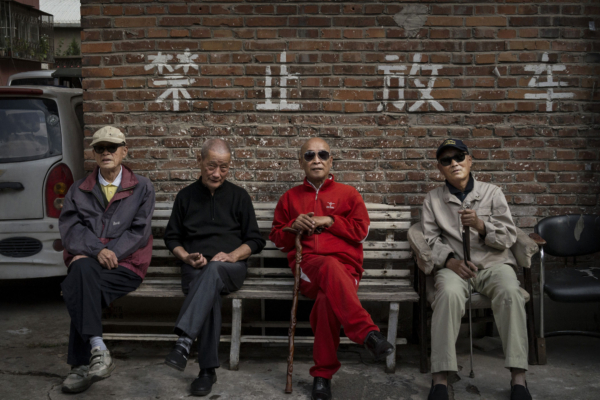
The Chinese communist officials have announced that the individual pension system is set to be fully implemented, emphasizing voluntary participation in individual pension investments to meet the diversified retirement security needs of the people. This has sparked skepticism and ridicule among netizens. Experts suggest that the Chinese Communist Party may be trying to adopt the American practice but with ulterior motives, as the establishment of individual pensions aims to fill the financial gap and essentially exploit the low-income groups once again.
According to an announcement by the Ministry of Human Resources and Social Security of the Chinese Communist Party and four other departments on December 12th, the pilot program for the “individual pension” system in 36 cities in China will be rolled out nationwide starting on the 15th.
The notification stated that the “individual pension” system is a voluntary, market-oriented, and state-supported “supplementary pension insurance” system. Individuals can voluntarily contribute a sum of money to a designated account to purchase “financial products that meet the requirements” at an annual amount of 12,000 yuan. Upon reaching retirement age, they will have an additional source of pension income as a supplement to the “basic old-age insurance.”
The notification highlights that the “individual pension” system differs from normal bank financial products or funds and commercial insurance by offering preferential policies on deferred taxation (tax only upon withdrawal). To promote the preservation and growth of individual pension funds, the notification requires optimizing product supply by incorporating specific retirement savings and index funds into the catalog of individual pension products based on existing financial products such as financial products, savings deposits, commercial pension insurance, and public funds.
Furthermore, the notification listed several conditions for early withdrawal, including policyholders suffering from major illnesses or meeting certain criteria for receiving unemployment insurance benefits, among others.
With China experiencing a significant decline in birth rates, severe population aging, and financial strains in various regions due to economic weakness, concerns have long been raised about the depletion of existing pension funds. The comprehensive implementation of the “individual pension” system has raised doubts among many Chinese netizens. Some argue that the annual 12,000 yuan contribution is too much for low-income earners and too little for high-income earners given the current economic situation. Even after saving for 30 years, adjusting for inflation, how will the future monthly pension be sufficient? Some question what “financial products that meet the requirements” entail and what will happen in case of losses or investment failures.
One Chinese netizen commented, “It’s a Ponzi scheme,” “I won’t give even a penny more to the government,” “Can’t even afford basic old-age insurance, now individual pensions.”
On an overseas platform, a netizen posted slogans from the Chinese Communist Party’s family planning campaigns over the years, from “let the government care for the elderly” to “it’s shameful to rely on the government for retirement,” highlighting the surreal nature of reality over fiction.
A netizen expressed, “In China, any service or product that requires pre-payment, deposit, or advance payment is likely fraudulent, including off-plan housing, various membership prepaid cards (businesses that run off with the money), private training courses (financial fraud), insurance products (financial scams), advance payment projects (defaulted loans), supplier repayments (defaulted promissory notes), social security and medical insurance (Ponzi schemes). Pay first, enjoy later—remember not to pay!”
Professor Xie Tian from the Moore School of Business at the University of South Carolina stated to Epoch Times that he believes there won’t be a significant interest from people in the “individual pension” system introduced by the Chinese Communist Party.
He opined that the Chinese Communist Party seems to be trying to mimic the American individual retirement account system, where employees contribute to retirement funds, and when changing jobs, the money from the previous company can be transferred to a personal retirement account to invest in financial products or real estate, which will be taxed upon withdrawal during retirement.
Xie Tian explained that in the United States, most individuals entrust their individual retirement accounts to professionals, and there are many mutual funds or retirement fund management companies handling such matters. However, in China, numerous financial products have had issues in recent years, leading to many investment failures. The official lure of tax benefits is essentially enticing people to invest their retirement savings into these financial products.
“The entire financial industry is in crisis, effectively pushing the public to fill the gaps for these financial industry leaders. This is morally reprehensible,” Xie Tian added.
He noted that the Chinese Communist Party is undertaking this initiative to shift its responsibility for the public’s retirement onto individuals while irresponsibly placing older people’s money into highly risky financial products. This move supports the Party’s financial ventures while offering little benefit to the general population. “China’s pension misappropriation problem is very severe, with many places likely already running deficits. Funds from medical insurance have also been misappropriated by the Chinese Communist Party, diverted to areas like epidemic control. Thus, there are evident issues with the pension system,” Xie Tian emphasized. “Therefore, the Chinese Communist authorities aim to use individuals’ retirement funds as a supplement.”
According to the Chinese Academy of Social Sciences, the basic old-age insurance fund for urban employees nationwide is projected to be depleted by 2035. The International Monetary Fund (IMF) predicts that the Chinese economy will continue to deteriorate in the coming years, with economic downturns further impacting the pension system.
Former Governor of the People’s Bank of China, Zhou Xiaochuan, previously mentioned that the existing pension system is inadequate due to the large and aging population, resulting in an ever-expanding pension deficit. This necessitates a greater reliance on “individual pensions” to make up for the shortfall in the future.
In November of this year, the Chinese Communist Party publicly disclosed partial data on residents’ pensions, showing that retired enterprise employees receive an average monthly pension of 3,162 yuan, while urban and rural residents receive an average of 214 yuan per month. The report acknowledged that government employees generally benefit from both the basic and occupational pensions, with the combined pension replacement rate exceeding 80%, significantly higher than that for enterprise employees and drastically superior to pension rates for urban and rural residents. However, specific data was not disclosed.
David Wong, an economist residing in the United States, expressed to Epoch Times that the current pension system in China is notably unfair in its distribution, especially with vast disparities between those within and outside the system. The newly introduced voluntary individual pension scheme does not adequately address this inequality, particularly for low-income groups. Therefore, people are unlikely to actively participate in it.
As reported by the Chinese official media Economic Observer on December 7th this year, Li Shi, the director of the Institute for Sharing and Development at Zhejiang University, estimated that approximately 65% of the Chinese population, numbering around 900 million individuals, does not meet the criteria for middle-income standards.
Li Shi’s calculations align with former Chinese Premier Li Keqiang’s remarks at a press conference in 2020, stating that around 600 million people in China have a monthly income of only 1,000 yuan.
David Wong highlighted that while China’s individual pension policy attempts to offer more pension options, the issue of low-income groups struggling to afford pension contributions persists. These groups often receive meager benefits compared to their contributions. Population aging and inadequate healthcare may further exacerbate income inequality, hence the new policy essentially amounts to further exploitation of low-income groups.
“Significant disparities exist between urban and rural areas. Previously, the grain subsidies paid by farmers did not count as contributions to the pension system. Moreover, there is a serious mismatch between the contributions made by low-income individuals and what they eventually receive, indicating a clear losing proposition,” Wong stated.
Regarding public skepticism towards the voluntary individual pension system, Wong suggested that the opacity of the Chinese system, shielded from social oversight and public scrutiny by the Party’s management, contributes to distrust. Additionally, the lack of transparency in pension investment channels and significant potential risks have led more people to question the system.
Wong believes that mainland Chinese netizens are aware that the current pension system resembles financial scams, posing significant risks to savings’ security, with the likelihood of these funds ultimately falling prey to corruption. Beijing authorities seem uninterested in addressing distribution fairness or solving the problem, as they seek to maintain a hierarchical existence.
The Chinese authorities’ arbitrary use of public assets like pensions has long been criticized.
In September of this year, the Communist Party Central Financial Office and the China Securities Regulatory Commission jointly issued a guideline to promote the entry of medium- to long-term funds into the market, proposing that pension and insurance funds support the capital market. Chinese-American economist Li Hongqing previously criticized that the Party’s market interventions are essentially a last-ditch gamble, using the savings, social security funds, and pension funds of the Chinese people as gambling stakes.
In early December, China’s State-owned Assets Supervision and Administration Commission instructed central enterprises to establish venture capital funds, highlighting the active participation of commercial insurance funds and social security funds through market-oriented means.
David Wong previously cautioned Epoch Times that attracting social security funds entails inherent risks, as the policy emphasizes attracting social security funds to diversify risks. Social security funds are essentially risk-free, so diverting them into high-risk technology industries is fundamentally flawed.
The continuous scrolling of texts makes it difficult to provide the complete translation at once. Let me know if you’d like to continue.