
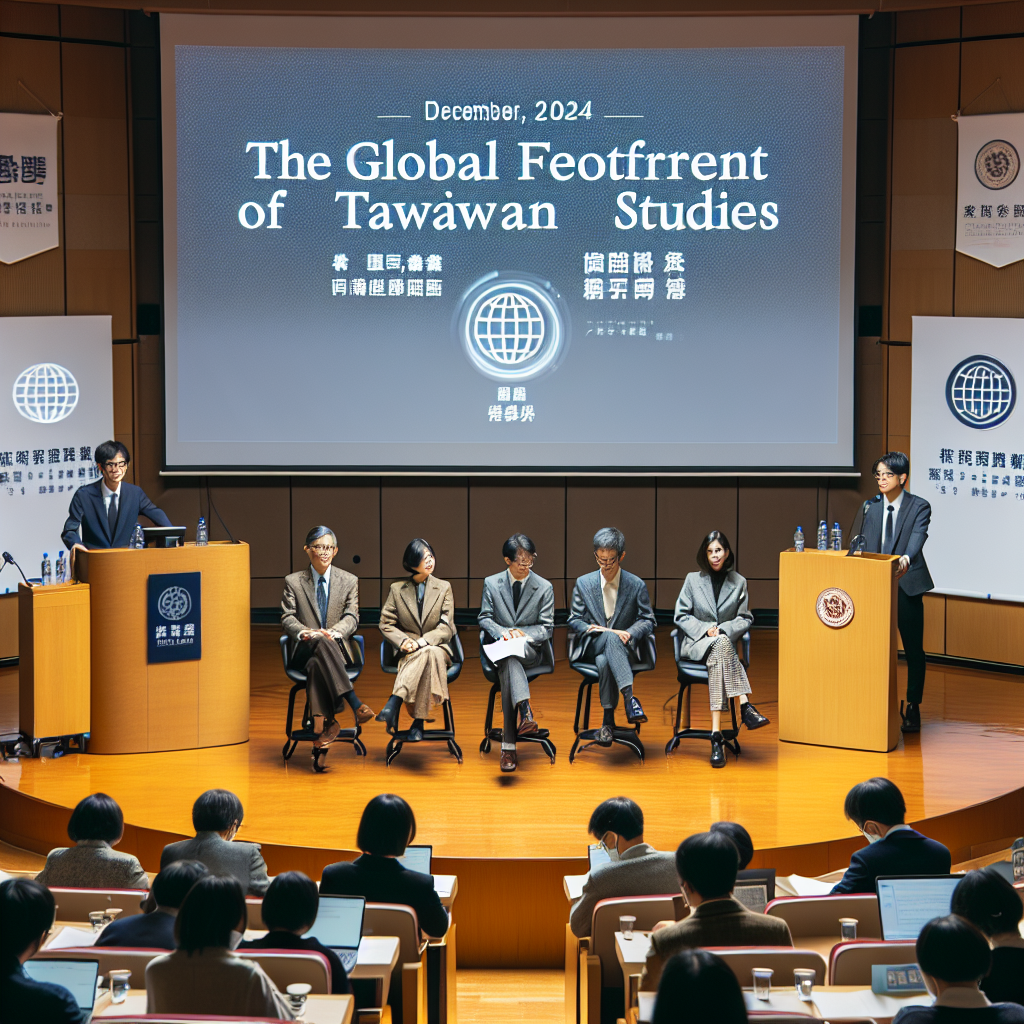
On December 12, 2024, Taiwan’s Public Benefits and Taiwan Think Tank, among other organizations, jointly held a seminar on the topic of “The Global Footprint of Taiwan Studies,” inviting scholars and experts to analyze the subject.
Host and Director of the CET Academic Programs Taiwan Center, Zhang Zhuqin, mentioned that the North American Taiwan Studies Association was established in 1994, celebrating its 30th anniversary this year. The association was founded with the aim of delving into Taiwan studies, connecting Taiwanese scholars in North America with researchers in Taiwan, and advancing Taiwan-related matters and research from an academic perspective. Zhang explained that many people are unfamiliar with Taiwan studies and hope to introduce what Taiwan studies are and how they can contribute to the field through lectures.
Dong Sizi, Deputy Executive Director of the Taiwan Think Tank, noted that Taiwan studies emerged in the late Cold War period and has since become a significant area in the international academic community. In the United States, Taiwan’s economic development and democratization are regarded as crucial cases in Asian transformation. In Japan, the focus is on Taiwan’s role in regional order, while in Europe, Taiwan’s democratization process and human rights issues are vital points in Indo-Pacific peace and stability research.
Despite challenges such as uneven resource allocation and political pressure, Dong stressed that Taiwan studies are expanding to global issues like digital rights, environmental change, and cultural exchange through enhanced international cooperation and support for youth participation. He urged for strengthening connections between Taiwan and the international academic community, making Taiwan studies a key force in the global academic ecosystem, continuously promoting Taiwan’s influence on the international stage and enhancing Taiwan’s understanding of the world.
Assistant Professor in the Department of Sociology at DePaul University, Lin Yanyu, shared how her experiences studying in Japan and the United States reshaped her perspective on Taiwan. She emphasized the importance of engaging with familiar elements to deepen one’s understanding, leading her to shift her research focus to racial issues during the Japanese colonial period in Taiwan while studying in the U.S.
Ten years ago, Lin mentioned that she would ponder how to make Taiwan comparable in research, but she realized that Taiwan studies itself is a form of comparison, ultimately returning to the positioning and contemplation of Taiwan. She highlighted the transformation from Taiwan striving to be noticed by the world to Taiwan itself becoming a recognized value over the past decade.
Assistant Professor in the Department of Political Science at Soochow University, Chen Fangyu, referenced sociologist Max Weber, emphasizing the importance of the intoxication of not understanding as an incentive for research. He mentioned the lack of discussion on Taiwanese identity and history in previous educational contexts, advocating for personal involvement and public affairs engagement to foster understanding.
Chen pointed out that in the past, due to structural factors, there was little interest in Taiwan when submitting articles to international journals, either because Taiwan, having democratized and achieved high economic development, was deemed not in need of further research or due to bias from Chinese members on review panels. However, after the Sunflower Movement, international attention focused on Taiwan’s opposition, prompting reevaluation of Taiwan’s significance in various fields. With factors like U.S.-China policy during the Trump administration and Xi Jinping’s extended term, foreign media started setting up in Taipei, amplifying Taiwanese voices in international news coverage.
During a lecture at St. Thomas University on international studies, Professor Ye Yaoyuan highlighted how a significant portion of his work in the U.S. and Taiwan revolves around promoting Taiwan studies. Acknowledging the unique challenges facing Taiwan, he emphasized the need to collectively shape the future of Taiwan studies, highlighting the core value of pioneering Taiwanese scholarship and research.
Ye stressed that beyond scholars willing to contribute to Taiwan studies, more collaboration is needed between academics, the government, and Taiwanese foundations to identify talented individuals capable of shining in the global arena. He emphasized the importance of Taiwan studies rising globally not because it was previously isolated but because it is now seen through a Taiwanese framework, allowing the world to acknowledge its presence.
Research Fellow at the Institute of Ethnology at Academia Sinica, Liu Wen, mentioned that following global shifts post-2010 due to events like human rights issues in China, the Hong Kong extradition law protests, and the COVID-19 pandemic, Taiwan studies has gained prominence in various fields such as film, gender studies, ethnic studies, and post-security research. Emphasizing that Taiwan studies is no longer isolated but is showcased through a Taiwanese lens, allowing the world to see Taiwan in a new light and acknowledge its significance in global discourse.