
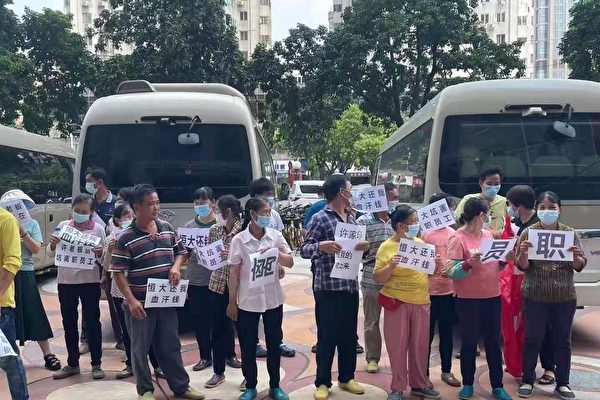
In a recent development following Evergrande’s bankruptcy liquidation, hundreds of investors who suffered losses initiated a three-day protest in Shenzhen, demanding the latest updates on the investigation into Evergrande by the Chinese Communist Party. This marks a significant protest event post-Evergrande crisis. Data shows that protest activities in China hit a record high in the third quarter of this year, with over three-fourths of the protest cases triggered by economic dissatisfaction.
According to Reuters, citing sources familiar with the matter, Evergrande investors participated in three separate protests in Shenzhen. These protests included visiting the investigation bureau in the area of Evergrande’s headquarters on Monday (November 25), the Economic Crime Investigation Bureau in Shenzhen on Tuesday, and the Intermediate People’s Court of Shenzhen on Wednesday.
“If we don’t speak up now, we will never have the chance,” a participating Evergrande investor told Reuters. Like others, this individual requested anonymity out of fear of retaliation from the Chinese authorities.
Evergrande’s wealth management company, Evergrande Financial Wealth Management (Shenzhen) Co., Ltd., was unable to meet its payment obligations and was placed under investigation by the authorities a year ago. Over the five years leading up to Evergrande’s bankruptcy, the project raised nearly $14 billion for the company.
Participants revealed that more than 500 investors took part in these three different actions. The purpose of this approach was to have investors visit these government departments one by one, avoiding overt protests to prevent police crackdown, as Reuters was unable to confirm the exact number of participants.
The joint action initiated by these investors this month aimed at pressuring the authorities to provide updates on the investigation initiated more than a year ago into Evergrande.
Evergrande’s debt exceeded $300 billion at the time of bankruptcy. From late 2021 to early 2022, following Evergrande’s default on payments to contractors and creditors, hundreds of investors staged consecutive protests outside Evergrande’s headquarters in Shenzhen, demanding loan repayment and redemption of overdue financial products.
Sources stated that the organized actions taken by Evergrande investors in Shenzhen over the past week marked the first significant protests since 2022. To avoid provoking the authorities, these actions adhered to official communication channels for expressing demands.
The timing and meeting locations for these actions were only disclosed on the day within the investors’ small groups. Over the past two years, Evergrande investors have maintained contact through small WeChat groups. “We need to keep a low profile, communicate one by one, or we will be stopped,” one participant said.
According to a report by Caixin on November 27, recent notifications have been sent to many current and former Evergrande employees, requiring them to complete the return of remittances by November 30. This round of returns primarily targets past commission income or referral commissions from Evergrande Wealth’s financial products, as well as partial salary bonuses for senior executives at Evergrande Group headquarters and regional companies.
On Tuesday, Evergrande Group announced that the Nansha District Court in Guangzhou issued a court order on November 14, stating that due to failure to fulfill payment obligations per the enforcement notice issued by the court, restrictions on consumer spending have been imposed on Evergrande Group and founder Xu Jiayin in non-essential consumption areas.
Notably, due to debt and ongoing operational pressures, China Evergrande Holdings subsidiary Evergrande Auto previously sought to introduce new strategic investors, but the capital introduction for Evergrande Auto came to a halt on October 25, marking the end of the initiative.
On January 29, the Hong Kong High Court issued a winding-up order against China Evergrande, which has debts totaling 2.39 trillion yuan (about $330 billion), appointing Middleton and Ms. Huang of Anmai Enterprise Consulting as the joint liquidators for the bankruptcy case.
The Chinese Communist Party has long regarded stability maintenance as the foundation of political security, but the number of protests and attacks triggered by economic issues is on the rise. In November, China witnessed at least three public attacks resulting in at least 43 deaths and over 60 injuries.
According to the CCP police, two separate attacks in Zhuhai and Wuxi were indiscriminate attacks carried out by perpetrators dissatisfied with the economic situation.
According to data from “China Dissent Monitor” under the human rights organization Freedom House, China saw 826 protest activities triggered by economic reasons in the third quarter, marking a historic high, with a 31% year-on-year increase. The second quarter saw an 18% increase in protest activities compared to the same period last year. At least three-quarters of the cases were due to economic dissatisfaction.
Commentator Wang Qingmin pointed out that while protesting and petitioning the government is commendable progress for society, a focus on addressing fundamental issues, such as salary arrears, incomplete projects, unfair law enforcement, employment challenges, high healthcare costs, education disparities, and poor pension security, is crucial. The power in the country does not truly belong to the people, leading to disconnect and opposition between those in power determining the country’s direction and policies and the people.
When rights advocates only speak up for themselves and narrow groups, even resorting to letting the authorities satisfy their own needs at the expense of others and public resources, effective changes for the majority cannot be achieved. Many neglected rights advocates are in the majority, and their struggles often fail due to lack of attention.
Addressing root issues through resistance is paramount for the Chinese people, as merely focusing on specific matters for rights protection merely scratches the surface and does not provide long-term solutions.