
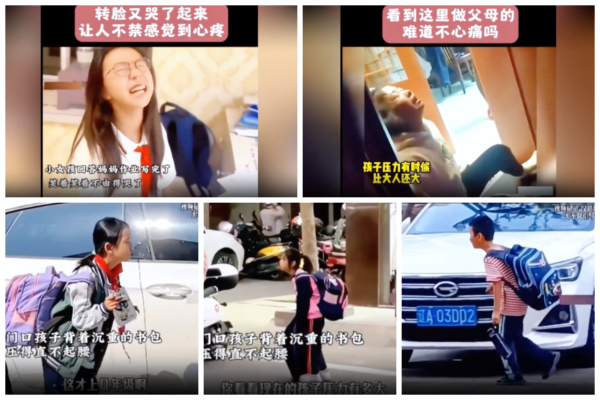
Middle school students have to complete 12 test papers in one night, with some crying after finishing late into the night… Despite the Chinese Communist Party calling for “reducing educational burdens” for many years, children’s school bags have become even heavier. Experts analyze that under the regime of the exam-oriented education system in China, the burden on students will only continue to increase.
Recently, on the internet, a 7th-grade student in Henan complained to parents about having to complete 12 test papers in one night, in addition to copying assignments and exercise books. In a video, a junior high school girl wearing a red scarf suddenly burst into laughter after finishing her homework in the early hours of the morning. When her mom asked her what happened, the girl replied, “Done,” and then burst into tears again. Another 8th-grade girl finished her homework at 3 am and cried heavily, feeling more pressure than an adult… There are videos showing children carrying heavy school bags, making it difficult for them to stand up straight.
On the popular social media platform, writing homework until the early hours of the morning is a hot topic. Many parents complain that 7th-grade students sleep at midnight every day, and even have to attend tutoring classes after school. 8th-grade students have to work on assignments until 12:30 am every day, sometimes even waking up at early as 5 am to work, resulting in severe sleep deprivation. Some children work on math homework during evening self-study, along with chemistry assignments, as well as Chinese, English, and physics assignments, sleeping at 11 pm or even 12:40 am, while some students work until 4 am.
According to a survey conducted online, 56% of children go to sleep after 11 pm, while 44% are able to sleep before that time.
In response to this, the self-media “Taoge Vision Review” believes that the nightmare of Chinese-style education is driving both children and parents crazy. “Why are our children so exhausted? After studying so much, it’s all useless in the end. Even after finishing university, they still can’t find a job? And they lack creativity. If this continues, then it’s better not to study.”
He emphasized that studying requires talent. Doing well in school doesn’t necessarily guarantee success in life. In society, it’s about adapting to the environment. “Only through experience can one endure hardships,” and it depends on who will have the last laugh. Poor academic performance in childhood doesn’t necessarily equate to poor future prospects or dissatisfaction in life. Many children end up being academic failures, striving for nothing. Parents spend their whole lives nurturing their children to no avail, and there are numerous examples like this.
The media figure also revealed that after releasing the video, several elementary and middle school teachers added him on social media, all complaining that under this educational system, not only are the children driven crazy but the parents and teachers as well.
In recent years, with the economic downturn in mainland China, youth unemployment rates are high, and the phenomenon of university graduates being unemployed right after graduation is severe. It is believed that this is not due to a lack of effort on the part of the Chinese people but rather a result of the system.
In July of this year, “Big Data China” conducted a nationwide survey titled “Is it me or the economic system’s fault? Changes in Chinese attitudes towards inequality” and found that 20 years ago, most Chinese people believed that social inequality was a reasonable outcome of the market economy, attributing failures to their own inadequacies. However, in recent times, most respondents now believe that structural factors are the most significant causes of poverty, such as unequal opportunities, education, and unfair economic structures. In terms of Chinese education, unequal opportunities are a root cause of enduring inequality.
Nevertheless, amid these circumstances, many parents still pressurize their children to succeed in the college entrance exams, and society, including the education sector, is filled with an atmosphere of “inspiration.” For example, some videos depict young people working on construction sites, covered in dirt and sweat, eating boxed meals on the roadside, juxtaposed with a group of sharply dressed female college students passing by… The authenticity of such videos has been questioned by viewers.
Another video circulating online shows three men hanging outside a high-rise building, cleaning windows, becoming “internet celebrities.” Someone shot a video in the office comparing them to white-collar workers inside the building, commenting, “Same height, different life.” A boy, who looks bright in the face, watches next to a construction site, envying the students next door: a place he once wanted to escape, but now can’t return to…
There is a widely shared composition by a primary school student titled “My School Bag.” He writes, “My school bag is very heavy, filled with my parents’ expectations, loaded with my teachers’ teachings, but can’t fit my love for playing basketball, nor my little wishes to play for a while. The school bag eats so much, does its stomach hurt?”
When teachers review such compositions, they feel the children’s helplessness and stress. However, the teachers still leave messages for the students, likening the beauty of a fountain to enduring stress, the grandeur of a waterfall to having no retreat, and the persistence of a dripping drop through a stone to unwavering determination.
Former professor Li Yuanhua from Capital Normal University expressed in an interview with Epoch Times that the Chinese Communist Party’s education system follows a single-track system, focused on the college entrance exam, providing limited choices for students. The society’s recognition and respect for vocational education in China are not as high as in free societies. Education is exam-oriented, with schools striving for recognition, and students striving for higher grades, leading to a rote learning approach.
He stated that in the so-called rote learning approach, students are given numerous exercises, extensive training, repeatedly working on all kinds of questions, to go through a rigorous process of practice to prepare for exams.
“The children’s youth is being stifled and killed prematurely. In this larger context, any ‘reduction of burden,’ any ‘quality education,’ can only be hollow slogans.”
He pointed out that despite increased investment in education by the Chinese Communist Party due to economic development, it still falls short of the global average. Selective investments in elite schools have resulted in a highly unequal distribution of education resources, leading to significant gaps in basic education.
He explained that for parents, the goal is to have their children admitted to a good school. This competition has extended from high school to starting as early as kindergarten. Everyone is focused on succeeding in the college entrance exam, selection processes for middle school, and emphasis on key elementary schools, increasing the competitive age range downwards. The pressure of competition forces everyone onto the same narrow path, the reality of China’s exam-oriented education system.
Li Yuanhua believes that the core of education is to nurture individuals with moral integrity and skills. However, within the corrupted moral environment of the Chinese Communist education system, education has strayed from its core purpose, becoming overly utilitarian. This education system lacks genuine moral values and serves primarily political interests.
“Of course, if you have connections or money, you can easily achieve success. For those from poor backgrounds, the only way is through studying. Chinese Communist schools compete for their own reputation, so they unreasonably burden children with unlimited amounts of exercises, problems, and assignments, to the point where the children are struggling to breathe.”