
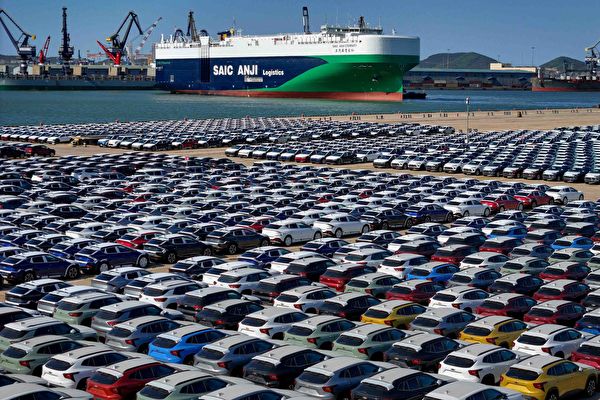
The Chinese Communist Party relies on investment in manufacturing to support China’s economy. Some American experts have raised questions about how long Beijing can maintain the current pace of investment in manufacturing.
Former U.S. Treasury and Commerce Department official Brad Setser, now a researcher at the Council on Foreign Relations in New York, has found through data analysis that except for BYD, China’s electric vehicle industry is nearly non-profitable. This profitability issue in the electric vehicle sector has led to contraction in the steel industry and oversupply in the solar photovoltaic (PV) industry.
According to official Chinese data, infrastructure investment (usually funded by local government financing platforms) has offset the decline in real estate investment, with the main investment growth concentrated in manufacturing, particularly in automotive.
On a monthly basis, China has added production capacity for around 40 million vehicles per year, while domestic demand for cars has remained at around 22 million, half of which are electric vehicles. As a result, it is challenging for electric vehicles to achieve growth by further encroaching on the market share of gasoline vehicles.
Faced with saturated domestic car demand, the remaining option of exporting also seems challenging. China’s car exports have recently surged, with passenger car exports exceeding 5 million for the first time. Setser estimates that China’s car exports will likely stabilize at around 1.5 million per quarter, or approximately 6 million per year.
Looking ahead, many capital-intensive Chinese manufacturing industries are being forced to transition in the hopes of significantly increasing production capacity and achieving profitability.
Beijing’s response to the weakened economy is to inject a boost into industries, mainly focusing on electric vehicles, but the cost may impact overseas job markets.
In an article on “Why Beijing is initiating a new round of trade war,” The Wall Street Journal mentions a bold yet risky calculation by the Chinese government: aiming to revitalize China’s economy by increasing investment in manufacturing to enhance industrial resilience without sparking too much international resistance.
Advisors to the Chinese government and business figures consulting for Chinese officials have pointed out the unusual economic slowdown in China due to the bursting of the real estate market bubble.
The Chinese leadership demands a push towards a nationally-driven manufacturing model.
The newspaper cited Chinese policy advisors, noting that under the leadership, two guiding principles have been set: to establish a comprehensive industrial supply chain and guard against sanctions from Western countries, as well as to fundamentally oppose American-style consumption. Beijing’s strategy focuses on stabilizing the sluggish economy, creating jobs, and compensating for domestic construction losses through investment in exports.
However, this new phase of Chinese manufacturing has encountered resistance and caution globally, as China’s manufacturing output now almost equals one-third of the global factory output. By expanding production capacity, China risks displacing the market shares of other countries.
The journal further reports that advisors and individuals in discussions with Chinese officials claim that officials are vehemently denying overcapacity issues in China, as Beijing aims to avoid giving U.S. and European countries reasons for imposing tariffs or taking retaliatory actions.
Despite this, some of Xi Jinping’s close associates have expressed concerns internally that government support may lead to severe overcapacity in sectors such as electric vehicles and batteries, reducing their commercial viability.
As Joerg Wuttke, former Chairman of the European Chamber of Commerce in China and current partner at the Washington consulting firm DGA Group, pointed out, “Everyone is producing in China, but nobody is making money.”