
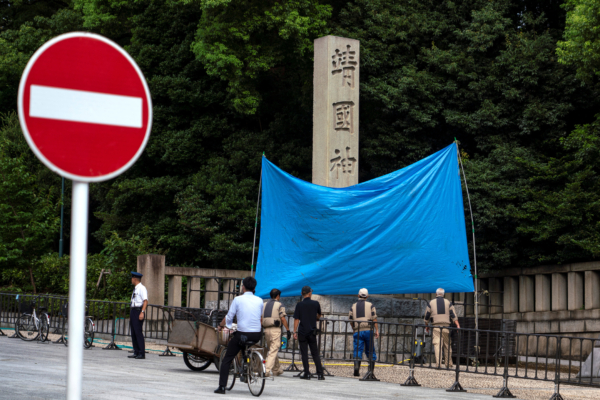
On the occasion of the 79th anniversary of the end of World War II in Japan, several Chinese individuals launched three “anti-Japanese” activities in Japan. On August 15, someone shouted anti-Japanese slogans at the Yasukuni Shrine; on the 18th, someone vandalized the pillar of the Yasukuni Shrine with insulting graffiti again; and on the same day, a Chinese NHK announcer deviated from the script during a live broadcast and shouted, “Diaoyu Islands belong to China.”
Around 3 a.m. local time on August 19, staff at the Yasukuni Shrine in Tokyo discovered black watercolor graffiti on a pillar near the shrine entrance with words like “toilet,” “dog poop,” and “down with militarism.” The staff immediately reported the incident to the Tokyo Metropolitan Police, who are investigating the case on suspicion of property damage.
After the suspect planned the act in advance, they returned to China on the morning of August 19. The person later recounted the graffiti process on social media, stating they had been waiting for the opportunity since 8 p.m. on the 18th, quickly vandalized the pillar when no one was around late at night, and then walked back to their hotel for hours before returning to China.
This is the second international illegal graffiti incident with similar content happening in the same location by a Chinese individual within two months, drawing significant attention from Japan and the international community.
In a separate incident on August 15, a Chinese man caused a scene at the Yasukuni Shrine by holding up a banner protesting Japanese invasion of China, shouting on a megaphone, “Do you think Chinese people are afraid of you?” and insulting a Japanese tourist. The video of this incident was uploaded to social media and garnered over 3.6 million views in less than a day.
Many Japanese netizens expressed strong dissatisfaction with the behavior of the Chinese individual, with comments such as, “Go back and never come to Japan again,” and “Deport him; it will only reinforce the negative image of Chinese people.”
Earlier on June 24, there was an incident of violence against Japanese schoolchildren in Suzhou.
Tsukasa Shibuya, President of the Asia-Pacific Exchange Association, stated in an interview with Epoch Times, “If China were a democratic government, such incidents would likely not occur. The root cause of these incidents is that these individuals have been brainwashed by the Chinese Communist Party.”
Akio Yaita, a veteran media personality, also interviewed by Epoch Times, while acknowledging that these individuals have been “brainwashed,” also expressed another perspective: “This is a commercial patriotism act. Currently, many Chinese ‘little pinks’ are using ‘patriotism’ to increase traffic and income.”
The incident of graffiti at Yasukuni Shrine, along with the outburst by the NHK Chinese announcer, stirred strong reactions in Japanese society.
On August 19, at 1 p.m., a Chinese NHK external announcer, during a broadcast of international news, deviated from the script and declared through radio broadcast that the Diaoyu Islands (known as the Senkaku Islands in Japan) are “Chinese territory.”
NHK President Nobuo Inaba reported the incident’s details at a meeting of the Liberal Democratic Party’s Information Warfare Strategic Investigation Committee on August 22 and subsequently disclosed the related information to the media.
Inaba apologized, stating, “This is a very serious violation of international broadcasting standards.” He announced the establishment of an investigative body led by the vice president to uncover the truth and hold those responsible accountable; NHK will urgently take measures to prevent similar incidents from happening again.
The male Chinese announcer in his forties, employed by NHK as an external Chinese announcer, went off-script in Chinese during an NHK shortwave and satellite broadcast of international news around 1 p.m. on the 19th. After reporting the graffiti incident at the Yasukuni Shrine that day, he “hijacked” the broadcast and delivered content not in the 20-second news script.
In English, he said, “Never forget the Nanjing Massacre, never forget comfort women; they were war sex slaves, never forget Unit 731.” In Chinese, he said, “The Diaoyu Islands and its affiliated islands have always been Chinese territory; protesting against NHK’s historical revisionism and unprofessional work.”
The incident sparked significant public outcry in Japan since it was a live broadcast and could not be stopped promptly. Masaji Matsuyama, Secretary-General of the Liberal Democratic Party in the House of Councillors, expressed regret, while Yuichiro Tamaki, representative of the National Democratic Party, called for a thorough investigation and stern action.
NHK terminated the employment contract of the Chinese announcer on the 21st and is considering seeking compensation for losses and criminal liability from the individual. The person involved stated that they would deal with the situation through a “representative.” The motive and intent of the individual are still unclear.
Yaita pointed out that these provocations against Japan have both national and personal dimensions. The Chinese Communist government has fueled these incidents by manipulating and creating confrontations with foreign countries to enhance its authority. Therefore, such incidents are unlikely to disappear in the future and are likely to escalate further.
Following the end of World War II, Japan, under the guidance and supervision of the international community led by the United States, amended its constitution, changed its political system, entered the ranks of free democratic countries, and rapidly became a world economic and technological powerhouse.
After the end of the Cultural Revolution in China (1966-1976), a crisis of faith in communism emerged. To maintain its rule, the Chinese Communist Party began implementing the policy of “reform and opening up.”
Influenced by traditional Chinese culture, the Japanese people have a close affinity for Chinese culture. From 1979 to 2018, the Japanese government provided Official Development Assistance (ODA) to China, including grants (157.6 billion yen), technical cooperation (185.8 billion yen), and yen loans (3.3165 trillion yen), primarily funded by Japanese taxpayer money. This financial assistance from Japan not only provided momentum for China’s “reform and opening up” initiative but also laid the foundation for steady economic development in the future.
Meanwhile, Japanese companies began investing in China, establishing branches and relocating production lines to China. According to statistics released by the Japanese government in October 2023, there are approximately 31,060 Japanese companies operating in China. These companies not only bring funds, technology, management experience, and modern corporate culture to China but also help in job creation, promoting economic growth, and improving the skills and qualities of employees.
On June 4, 1989, the Tiananmen incident occurred, plunging the Chinese Communist Party into another crisis of governance. After Jiang Zemin came to power, to maintain the Party’s rule and personal authority, he vigorously promoted the so-called “patriotic education,” using the CCP’s version of “revolutionary history,” Japanese aggression, and the war of resistance against Japan as crucial elements of the Party’s “patriotic education.” Since then, the relationship between China and Japan began deteriorating, and anti-Japanese sentiments among the public gradually intensified.
Yaita pointed out that the CCP has implemented the so-called “patriotic education” for many years, and Chinese film and television dramas are prohibited from criticizing the current social system. Instead, they repeatedly produce many “anti-Japanese dramas” about the wartime history, brainwashing young people with feelings of hatred, leading to these series of incidents.
From the era of Jiang Zemin’s “patriotic education” to the Xi Jinping era, the emphasis on “patriotism” has intensified. After being brainwashed by the CCP’s anti-Japanese propaganda, many Chinese harbor anti-Japanese sentiments. Yaita noted, “Ordinary Chinese viewers like to watch confrontational videos online. This is a characteristic of contemporary China.”
Yaita also pointed out a political atmosphere in China where all responsibilities are shifted to foreign countries. This very cheap form of “patriotism” and “patriotic behavior” can receive applause and approval domestically, turning those engaging in it into “heroes.”
As Japan-China relations worsen and tensions rise, the Chinese authorities are accelerating their military provocations against Taiwan. Starting from the era of Shinzo Abe, Japan strengthened cooperation with allies led by the United States and put forward the viewpoint of “when Taiwan is in trouble, it is Japan’s problem, which means the issue concerns Japan and the U.S. alliance.” The current Prime Minister Fumio Kishida has taken Abe’s diplomatic line to new heights, not only engaging in security cooperation with many countries but also enhancing Japan’s defense capabilities to exchange strength for peace and comprehensively contain China.
Tsukasa Shibuya stated, “Xi Jinping is striving to unify Taiwan by force, while Japan, together with the United States, is vigilant against any Chinese attack on Taiwan. Therefore, the Xi regime wants to restrain Japan. People hope Xi will step down soon, but even if someone else takes over, it will still be under CCP rule; as long as the current CCP system remains intact, peace in East Asia will not come.”
In the end, the text explores the historical context and the evolution of Sino-Japanese relations from post-World War II through various political and economic milestones, shedding light on the complex dynamics at play between the two nations.