
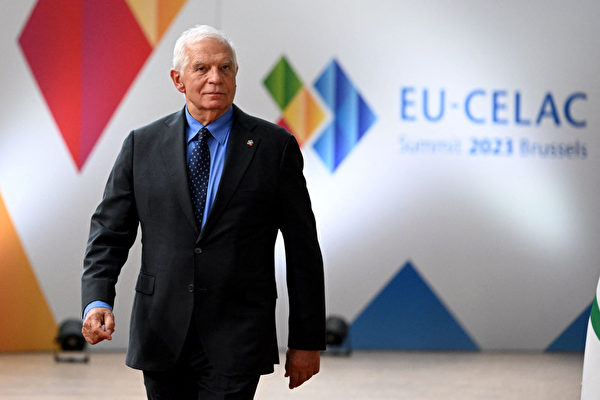
The European Union’s foreign policy chief, Josep Borrell, stated that the EU hopes to safeguard peace in the South China Sea and expressed willingness to assist Vietnam in enhancing its maritime and cybersecurity capabilities.
In a meeting with Vietnamese Foreign Minister Bui Thanh Son in Hanoi on Tuesday, Borrell, who is about to step down as the EU’s High Representative for Foreign Affairs, emphasized that the EU’s 27 member states have “direct interests” in maintaining peace and stability in the South China Sea, as over one-third of the EU’s imports and more than 20% of its exports pass through these waters.
Earlier on June 1st at the Shangri-La Dialogue, Borrell referred to the Indo-Pacific region as the “heart of the world” and highlighted that approximately 40% of EU trade traverses the South China Sea. He stressed the importance of avoiding tensions in the South China Sea or the Taiwan Strait and emphasized expanding security and defense partnerships in the Indo-Pacific region.
The South China Sea is a vital international shipping route, where Southeast Asian countries often have disputes with China over territorial claims. The Chinese government’s stance of almost entirely claiming the South China Sea has led to tensions with other countries in the region.
Borrell mentioned during a joint press conference with Bui Thanh Son that the EU could be a “wise promoter of peace and security” and offered to enhance Vietnam’s capabilities in cybersecurity, maritime security, and crisis management.
He underscored that Vietnam’s references to international law concerning the South China Sea issue should be applicable everywhere, including in Ukraine.
Despite Vietnam’s historical reliance on military equipment from Russia for decades, since 2022, Vietnam has openly expressed a desire to diversify its sources of security equipment and has been negotiating with various countries, including European nations, for potential defense supplies.
With a diplomatic approach known as “bamboo diplomacy” during the tenure of the late General Secretary of the Communist Party of Vietnam Nguyen Phu Trong, Vietnam has been effective in balancing relationships with major powers such as the United States, China, Russia, and India.
However, many EU countries perceive Hanoi’s neutral stance on Russia’s military actions in Ukraine as too close for comfort, indicating a potentially too cozy relationship with Moscow.
Apart from South China Sea security and cybersecurity issues, Borrell urged Vietnam to expedite the implementation of agreements reached with international donors, including the EU, in addressing climate issues and reducing reliance on coal. Progress on these agreements has been slow since late 2022.
To this end, Borrell encouraged Hanoi to swiftly identify priority projects that could be co-financed by international donors, such as renewable energy or grid upgrades.
The Vietnamese Foreign Minister welcomed the EU’s financial support, but noted that Vietnam’s recent extensive anti-corruption campaign has slowed down project approvals, resulting in the loss of billions of dollars in foreign aid. Additionally, most commitments from foreign donors for Vietnam’s coal transition have come in the form of costly loans rather than grants.
Borrell expressed hope that his visit could “serve as an opportunity to kickstart the process of upgrading bilateral relations.” He also highlighted the EU’s strong trade relationship with Vietnam and briefly touched upon human rights issues in the country.
In recent times, several major world powers, including the United States and Japan, have elevated their diplomatic relations with Vietnam to the highest levels, underscoring Vietnam’s increasing strategic importance. However, within the EU, different member states have shown varying stances on whether an immediate upgrade of relations with Vietnam is necessary.
(This article references Reuters’ reporting.)