
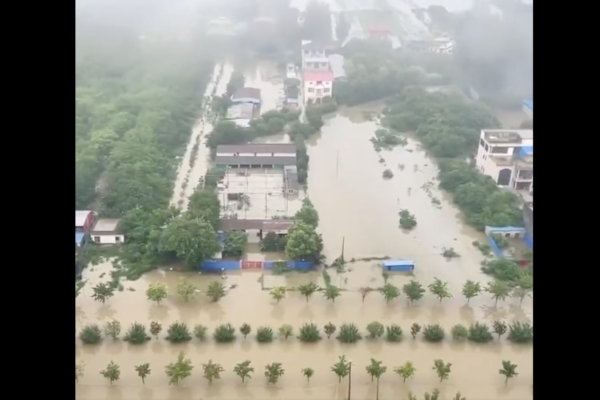
Recent days have seen extreme heavy rainfall in areas such as Henan and Shaanxi provinces in China, resulting in continuous flooding as reservoirs release water. As of 4 p.m. on July 17th, Henan officials reported that 33 large and medium-sized reservoirs in the province were releasing floodwaters due to exceeding the flood limit. Local residents have complained that the flood releases have worsened the disaster. Experts point out that controlled flood releases under the Chinese Communist regime are one of the significant contributing factors to flooding.
According to China Central Television news, the Henan Provincial Department of Water Resources stated that due to ongoing heavy rainfall, as of 4 p.m. on July 17th, 33 large and medium-sized reservoirs in Henan had surpassed their flood limit water levels, prompting ongoing joint scheduling for “ordered flood discharge.”
The official statement did not clarify what exactly constitutes an “ordered” discharge, nor did it specify whether warnings were issued to residents in advance for evacuation.
On July 17th, severe flash floods hit Nanyang in Henan and Baoji in Shaanxi, leading to flooding in houses, cars, and farmland, causing significant losses. Many local residents complained that the flood releases caused a sudden rise in river water levels overnight.
Reports from New Tang Dynasty Television yesterday highlighted complaints from residents in Tanghe County, Nanyang, who mentioned that due to severe drought in the area before, the Tang River bed was exposed, and crops required irrigation pumping. Starting from 7 p.m. on the 16th, continuous flood discharges from upstream for ten hours caused the Tang River to surge overnight, forcing riverside residents to evacuate due to rising water levels.
One resident in Tanghe County, Ms. Zheng, expressed, “Upstream in Sheqi and Fangcheng areas was submerged, and they released the water here. The flood discharge last night caused the Tang River to rise, flooding lower-lying areas, and villages on Guotan side were submerged. It’s been raining heavily. A few days ago, it was dry, and now the crops have been drowned. It’s really tough for the ordinary people.”
Mr. Yang, a resident of Nanyang, mentioned, “Many cars are submerged, farmland is flooded, people are trapped, and it’s quite deep under the culverts. Some underpasses in the city are deep, enough to submerge an adult. Also, the city’s drainage system is ineffective, leading to frequent blockages in case of heavy rain, indicating poor urban infrastructure planning.”
Furthermore, he criticized the lack of timely communication and action from authorities, pointing out the misuse of reservoirs for profit during dry seasons and their negligent warnings during rainy periods.
A resident of Zhengzhou mentioned concerns over internal flooding and improper urban drainage systems in the region, predicting potential flooding in low-lying areas post heavy rainfall due to inadequate drainage infrastructure.
In July 2021, Zhengzhou, the capital of Henan province, experienced a severe flood disaster, with pedestrians, vehicles, and metro tunnels inundated by floodwaters. Experts attributed the calamity to factors such as unannounced flood releases from reservoirs and inadequate urban infrastructure planning prioritizing real estate development over disaster prevention and management.
Experts criticized the authorities for artificially controlling floodwaters through dam gates under the guise of mitigating droughts and floods. They highlighted the lack of transparency in official flood discharges and the consequential threats to downstream populations, with casualties often underreported or entirely ignored for political reasons.
Recent heavy rainfall across multiple regions in China has led to continuous flood releases from major reservoirs, including the Three Gorges Dam releasing water through nine outlets, aggravating flood risks in the middle and lower reaches of the Yangtze River.
In Huangmei County, thousands of villagers were forced to evacuate after the embankment breach on July 5th, causing widespread inundation and temporary displacement. The official statement by Hunan authorities on the 16th indicated a resurgence in flood threats due to increased water discharge from the Three Gorges Reservoir, escalating flood control challenges in the region.
Experts warn that China’s dam management practices emphasize profit over public safety, transforming reservoirs into tools for economic gain rather than proactive flood control measures. Reports have emerged of authorities covertly releasing water without proper warning, shielding themselves from accountability by attributing disasters to natural calamities rather than human negligence.
Moreover, residents in other provinces such as Guangxi and Fujian have voiced protests against flood releases and their disastrous consequences caused by the authorities’ mismanagement.
In conclusion, the ongoing flood crisis in various regions across China highlights systemic issues in dam operations and urban planning, underscoring the urgent need for transparent and accountable flood control measures to protect vulnerable populations and mitigate future disasters effectively.