
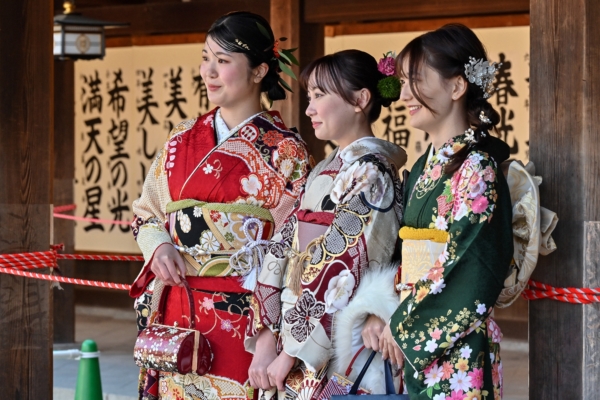
Amidst the Chinese Communist Party’s occasional incitement of anti-Japanese sentiment among the Chinese people, Japanese media has found that at a recent “Japan-China Friendship Adult Ceremony” event held in Shanghai, many Chinese students dressed in kimono attended, with a larger number of participating students compared to last year.
According to a report by the Japanese media Kyodo News on April 11th, on that day, students from Japan and China gathered to celebrate adulthood in the “Japan-China Friendship Adult Ceremony” held at a hotel in Shanghai, with approximately 50 students from each country in attendance, more than the roughly 70 students who participated last year.
As a representative of the Japanese side, Jin Takenouchi (20 years old), who is studying at the Shanghai International Studies University, gave a speech in which he shared his experiences of conversing with locals in Chinese on the streets. A 19-year-old Chinese boy expressed his desire to study at Nagoya University and is currently learning Japanese. He smiled and mentioned his wish to study culture and technology in Japan.
The report mentioned that many Chinese students in formal silk kimonos and Japanese students in traditional Chinese hanfu attended the event, enjoying performances of the traditional Japanese taiko drum and the ceremonial “kagami biraki,” the breaking of sake barrels. This event, initiated in 2012, is targeted at young people who have reached the legal age of 18 in both countries and is hosted by the Shanghai Association of Japanese Students.
On March 21st, at the Japan-China joint adult ceremony held in Beijing, Chinese universities pressured Chinese students, leading to the cancellation of attendance by many students before the event started.
In November last year, after Japanese Prime Minister Sanae Takayama made remarks concerning Taiwan that sparked strong backlash from the Chinese Communist Party, the Party once again fanned anti-Japanese sentiment among the Chinese public.
It is worth noting that the draft of Japan’s 2026 version of the “Diplomatic Bluebook” has removed the statement from the 2025 edition positioning Sino-Japanese relations as “one of the most important bilateral relationships,” now only describing China as an “important neighboring country” but retaining the term “strategic reciprocity.”