
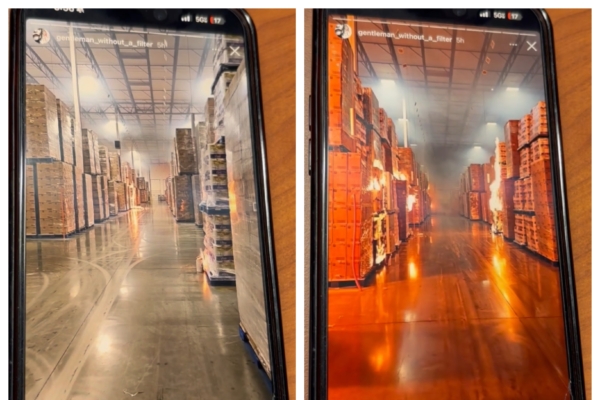
The suspect accused of setting fire to a massive warehouse in Ontario, Southern California, Chamel Abdulkarim, had his photo exposed. He is currently facing dual charges from California state and federal justice agencies. Prosecutors revealed on Friday that the suspect blatantly filmed the arson process, fueled by his hatred towards American capitalism and businesses.
On the early morning of April 7th, a raging fire engulfed a warehouse of approximately 1.2 million square feet in Ontario. This warehouse belonged to Kimberly-Clark, a global consumer paper products manufacturer. Their brand portfolio includes well-known names like Huggies, Kleenex, and Scott, widely used across the United States.
In this deliberate arson disaster, sanitary products valued at around 500 million US dollars were destroyed, leading to reports of panic-buying in supermarkets.
San Bernardino County District Attorney, Jason Anderson, announced during a press conference on Friday that the alleged arsonist was 29-year-old California resident Abdulkarim, an employee of NFI Industries, a third-party distributor for Kimberly-Clark. He was responsible for handling pallet goods at the facility.
Anderson disclosed that Abdulkarim faces one count of aggravated arson and six counts of arson as related to buildings, with a maximum sentence of life imprisonment. Meanwhile, the U.S. Department of Justice is also charging Abdulkarim with intentional arson, carrying a maximum penalty of 20 years in prison.
Bill Essayli, Chief Federal Prosecutor for the Central District of California, highlighted during the press conference that the suspect’s violent acts stemmed from his animosity towards capitalism and businesses. These so-called “political extremists” seem unashamed of their crimes, even reveling in them.
Essayli stated, “The investigation is ongoing, but we can confirm that the defendant boasted about his crimes multiple times and posted videos on Instagram showcasing himself igniting goods inside the warehouse.”
According to sworn testimony included in the federal criminal complaint, on the morning of the 7th, Abdulkarim ignited a fire inside the distribution center, rapidly consuming the entire building and causing an estimated 500 million dollars in goods loss, far exceeding that amount.
Footage released by the fire department showed thick smoke billowing and massive fireballs shooting into the night sky. Over 170 firefighters rushed to the scene for rescue efforts.
Due to the vast quantity of paper “fuel” stored in the warehouse, the fire became uncontrollable and escalated to a six-alarm blaze. Ultimately, the building, valued at over 156 million US dollars, was completely engulfed and the roof collapsed.
The Justice Department indicated that Abdulkarim later posted videos of the arson on social media. Additionally, he boasted and articulated his motives for the arson through phone calls and messages, including phrases like “I just made these (expletive) lose billions” and “That 1% (raise) is a joke.”
Although the videos and messages suggest a tragedy stemming from wage and work condition disputes, investigators have not formally confirmed the complete motive behind the crime.
At the time of the incident, around 20 employees were inside the warehouse, all safely evacuated with no reports of casualties.
Essayli emphasized that the United States is built on a foundation of free enterprise and capitalism, warning against the alarming trend of resorting to violence to convey political or economic grievances, which is unacceptable.
The suspect remains in custody without bail. As the investigation is ongoing, prosecutors have not disclosed more personal information or details about the suspect. From the surname’s origins pointing to Arabic, it is typically used by Muslim males.
Investigators are still reviewing and verifying the authenticity of numerous online claims. The current criminal complaint represents charges related to the suspected criminal behavior and is not evidence of conviction.