
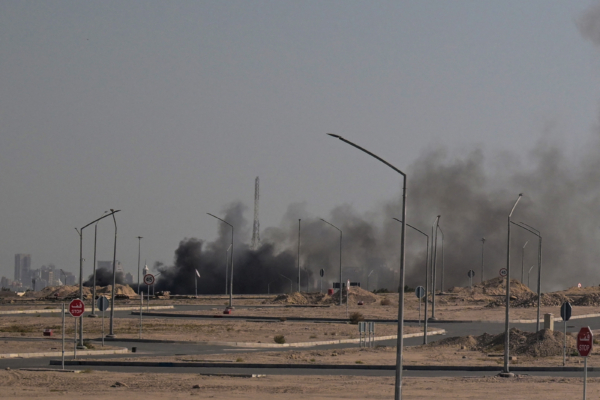
On Thursday night, the Kuwaiti Ministry of Foreign Affairs issued a statement strongly condemning the hostile armed drones attacking key facilities within the country. They stated that such acts blatantly violate Kuwait’s sovereignty and airspace.
Earlier that day, Kuwait’s state news agency (KUNA) reported that a spokesperson for the Kuwait National Guard, Major General Jad’an Fadel, stated that a National Guard post had been attacked by drones, resulting in significant property damage but fortunately no casualties.
This incident marks the first wave of attacks reported in the Persian Gulf region following a two-week ceasefire agreement between the United States and Iran. Kuwaiti officials noted that immediate “necessary security and on-site control measures” were taken to address this unexpected event.
Kuwaiti authorities indicated that these attacks undermine the recent ceasefire agreement between the United States and Iran and emphasized their commitment to resorting to all necessary means to defend national sovereignty and stability.
On the morning of April 10, the Kuwaiti military cited a statement from the Ministry of Defense spokesperson on social media platform X, saying, “The armed forces’ air defense systems are currently fully engaged in responding to hostile drones invading our airspace, targeting several key infrastructure facilities.”
Subsequently, Iran’s Islamic Revolutionary Guard Corps denied through national media any attacks on Persian Gulf countries during the ceasefire period. The organization also claimed that if Iran were to undertake any military action, it would be publicly announced through official statements.
However, Iran’s denial has been met with skepticism by many. This is due to Iran’s history of using missiles and drones to attack infrastructure facilities of neighboring Persian Gulf countries since the United States and Israel launched military operations against Iran, prompting strong protests from surrounding countries that view the current Iranian regime as an “enemy.”