
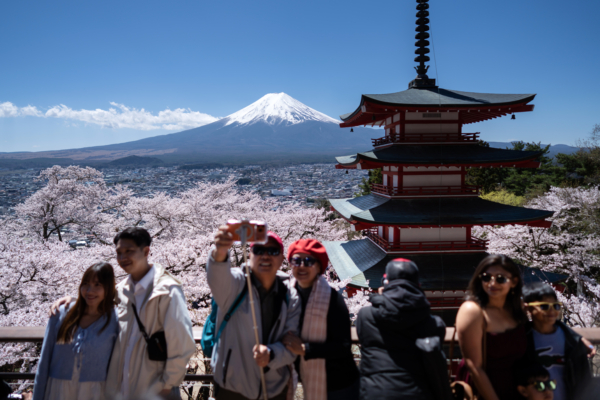
On April 10, 2026, the stunningly white Mount Fuji stands tall behind the red pagoda, with a sea of people in front of it eagerly capturing the pink cherry blossoms resembling clouds and haze. Every spring, social media is flooded with this classic scene.
This year, tourists eager to capture this beautiful sight quickly crowded the tranquil town of Fujiyoshida at the foot of the mountain. However, local complaints soon followed: never-ending traffic jams, littering, impolite foreign visitors knocking on the doors of private residences to borrow toilets, and even some tourists openly relieving themselves in residents’ front yards.
As the situation worsened, officials in Fujiyoshida announced in February the cancellation of this year’s annual cherry blossom festival. The festival, which began a decade ago with the aim of promoting tourism, had backfired as the influx of tourists brought about “overtourism,” catching authorities off guard.
“It has become increasingly difficult to strike a balance between tourism development and the safety of residents in this primarily residential area,” said Masatoshi Hada, the manager of the Economic Environment Department in Fujiyoshida, in an interview with the Associated Press. The city government decided to no longer promote the festival that would attract even more tourists.
Despite the cancellation of official events, foreign tourists flocked to the area when the cherry blossoms bloomed in early April. The narrow streets leading to the famous Arakurayama Sengen Park were congested, with visitors lining up just to capture that world-renowned panoramic view.
In recent years, the daily number of foreign tourists in the region has exceeded 10,000, severely “threatening the daily lives of residents.” Hitoshi Mori, a 93-year-old resident, told the Associated Press that while “having many tourists is good,” the overcrowding outside has limited his ability to go out for groceries to only once a week.
Starting from the cherry blossom season on April 1st, Fujiyoshida increased security personnel and restricted tourist buses and vehicles from entering the scenic community, requiring visitors to walk to the park.
Security chief Hiroaki Nagayama was busy directing traffic and guiding visitors to dispose of cigarette butts at designated locations. “It’s challenging for me as I can’t communicate with them in Japanese. Some people just litter trash after buying food from stalls,” he told the Associated Press, calling it a typical case of overtourism.
“For those who are accustomed to the quiet suburban life, this change is massive,” said Masami Nakamura, who runs a school uniform shop. “I just hope that visitors can respect our rules and etiquette.”
Overtourism is also evident in other tourist destinations in Japan, such as Kyoto and Kamakura. In Kyoto, locals have complained about tourists with large suitcases blocking city buses.
While the Japanese government has pledged to address the issue of overtourism, it still aims to increase the current 40 million inbound tourists to 60 million by 2030. Meanwhile, with Japan’s total population around 123 million, the total number of foreign residents increased by 9.5% last year, reaching 4.13 million. Among them, Chinese residents make up 22.6% of the total foreign residents, remaining the largest immigrant group in Japan.
The government led by Sanae Takaichi is pushing for the most stringent immigration policy reforms since the 1950s, including comprehensive tightening of the standards for permanent residency (PR) reviews.