
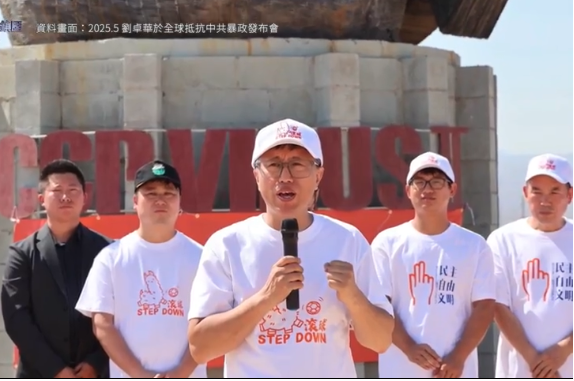
The dissident Liu Zhuohua, who has been persecuted by the Chinese communist regime for over a decade due to his involvement in the Chinese citizen movement and promotion of civic governance rules, has recently fled to the United States. In a recent interview with Epoch Times, Liu Zhuohua revealed how the Chinese Communist Party (CCP) uses various means such as economic blockade, targeting of family members, character assassination, and physical threats to suppress overseas dissidents and impose their “state terrorism” on the global stage, posing a threat to the free world.
To counter these threats, Liu Zhuohua encourages oppressed individuals to overcome fear, actively seek legal protections in various countries, and unite to expose and counter the infiltration of CCP forces.
Despite being in the United States across the Pacific Ocean, Liu Zhuohua still feels the high-pressure threats from the Chinese state machinery. As the Minister of the Regulation Department of the Overseas “Chinese Parliament” (Provisional) Preparatory Committee, he recalled an experience in 2024 that starkly exposed how the CCP extends its reach into the free world.
According to Liu Zhuohua’s account, shortly after hosting a public event and meeting, his family in Shenzhen received a phone call from the National Security Brigade explicitly demanding a “facial consultation” the next day for family members. The following day, the family reported back that the National Security Brigade had carried out “intense threats and intimidation” on relatives.
“The National Security Brigade clearly warned that if I continue engaging in these civic activities abroad, the first step would be to cut off all my connections with the country, sever my sources of income,” mentioned Liu Zhuohua in the interview. “If I still don’t ‘behave,’ they threatened to arrest me and bring me back to the country.”
To avoid harassment of his family, Liu Zhuohua reluctantly cut off contact with them.
This type of threat is not limited to overseas intimidation. Liu Zhuohua pointed out that in overseas public events, such as the June 4th Memorial Hall or activities involving the Epoch Times or Shen Yun Performing Arts, there are often unidentified individuals causing disturbances.
He pointed out, “These actions escalate into violence. The primary reason is that they (the CCP) fear the people knowing the truth.”
Liu Zhuohua also cited examples such as the destruction of works like “Tank Man” and “CCP Virus” by Chen Weiming, founder of the Free Sculpture Garden in California, or intentional loosening of screws on dissidents’ vehicles to create potentially fatal accidents. He described these actions as “another form of state terrorism.”
“The CCP disregards the laws of various countries. Even if their proxies are captured, they will use money or lawyers to escape, using the power of the entire state apparatus against individual citizens,” he criticized.
Initially working in international trade, Liu Zhuohua chose not to remain silent about social injustices despite China’s rapid economic growth. Around 2010, he publicly signed in support of the oppressed activist Liu Jiacai for pursuing basic rights, drawing immediate attention from authorities and being summoned for a “tea session,” a customary warning method employed by China’s National Security personnel.
Subsequently, he actively participated in activities emphasizing offline connections such as “City Dinner Talks” (citizen gatherings to discuss current affairs) and the “Southern Street Movement” in Guangdong.
Reflecting on these early grassroots activities, Liu Zhuohua pondered whether “simple anger and protest were sufficient.” He realized that to truly change the country, a path of institutionalization was necessary to empower citizens with the knowledge of democratic processes.
Therefore, starting in 2013, Liu Zhuohua underwent training related to “Robert’s Rules of Order.” After over two years of intensive study, he acquired the expert certification from the National Association of Parliamentarians (NAP) in the United States. This set of rules, modeled after parliamentary procedures in the United States and the United Kingdom, is renowned as the “Second Constitution.”
“If meetings do not have rules, various problems can arise, such as minority manipulation. The CCP’s National People’s Congress, the CCP’s Political Bureau meetings, are actually controlled by a few individuals,” Liu Zhuohua remarked.
Robert’s Rules of Order emphasizes safeguarding the interests of the majority, respecting minority opinions, and resolving disputes through rigorous procedures. Liu Zhuohua firmly believes that “these rules have a significant role in promoting people’s understanding of democracy, rule of law, equality, and freedom.”
To disseminate these principles, Liu Zhuohua joined the Shenzhen Citizen’s Federation, which is based on grassroots citizens and advocates nonviolent non-cooperation. According to him, the organization grew to around 100 to 200 members at its peak. However, the attempt to teach people how to “fairly conduct meetings” was viewed as a threat by the CCP. In 2016, the organization was infiltrated and members were collectively arrested.
In February 2017, as Liu Zhuohua held a significant position within the organization, he was sentenced to 3 years and 6 months in prison on charges of “subverting state power.”
Upon his release, Liu Zhuohua described his situation as one where his “survival and social environment were greatly damaged,” leading him to embark on the path to exile.
Before successfully arriving in the United States, Liu Zhuohua made five attempts to leave the country, each time being intercepted or monitored at border checkpoints due to technical issues. It wasn’t until his sixth attempt that he finally managed to escape to the first stop of his exile – Thailand. However, he soon received news from China indicating that the CCP was planning to illegally arrest him within Thailand.
Forced to flee Thailand once again, Liu Zhuohua chose to head to the United States. Subsequently, his phone incessantly rang with calls from the Shenzhen Criminal Investigation Brigade, the National Security Brigade, and local police station officers. The tone on the phone was filled with deceit and threats: “Come back, we’ll just make a record of you.”
Upon resolutely refusing and eventually arriving in the United States, the CCP immediately initiated economic retaliation mechanisms. All of Liu Zhuohua’s bank cards and WeChat accounts in China were instantly frozen, leaving him in a “pennyless” survival crisis.
Furthermore, Liu Zhuohua mentioned that the CCP also used media and even AI technology to smear and defame his reputation, simultaneously “shrinking your social circle or cutting off your social connections”; combined with pressure on relatives, creating a suffocating chain of oppression.
Liu Zhuohua added that in Southeast Asian countries with close ties to the Chinese government, dissidents face the possibility of being abducted by the CCP across borders. For instance, in the 2015 case of Dong Guangping, after being granted asylum in Canada, he was kidnapped in Thailand en route back to China.
Facing the increasingly rampant cross-border suppression, Liu Zhuohua issued a stern warning to the free world in the interview. He believed that if Western governments tacitly tolerate the actions of the CCP, it would eventually lead to a domino effect backfiring on the free world.
He likened the authoritarian model of the CCP to a “virus” that would spread “one by one” and influence other countries through economic, cultural, and institutional infiltration.
However, being in the United States, Liu Zhuohua expressed confidence in the country’s foundational principles of “separation of powers, media freedom, and military civil control” established over two centuries.
Simultaneously, Liu Zhuohua proposed three specific strategies for overseas democratic activists to combat CCP’s cross-border suppression. Firstly, it is to overcome fear. He stressed that “if we retreat due to intimidation, they will become increasingly arrogant.” He believed that only by demonstrating steadfast determination and making the CCP realize that intimidation is ineffective can suppression be curbed.
Secondly, it involves relying on the law and Western governments. Liu Zhuohua encouraged oppressed individuals to actively gather evidence, report illegal agents such as “overseas 110,” and utilize the legal systems of the free world to expose and sanction the CCP’s illegal agents overseas.
Lastly, it entails collective unity. He emphasized the spirit of “one person’s issue, everyone’s response,” meaning that when threats are posed to individuals or organizations such as Epoch Times or Shen Yun by the CCP, the community should collectively raise their voices to resist these threats.
For Liu Zhuohua, exile is not the end but the beginning of another form of resistance. He called upon people of goodwill worldwide to stand up, asserting that “only by stripping authoritarianism from the Earth can a free society thrive.” This effort is not only for Chinese democratic activists overseas but also to protect the justice and conscience of all humanity.