
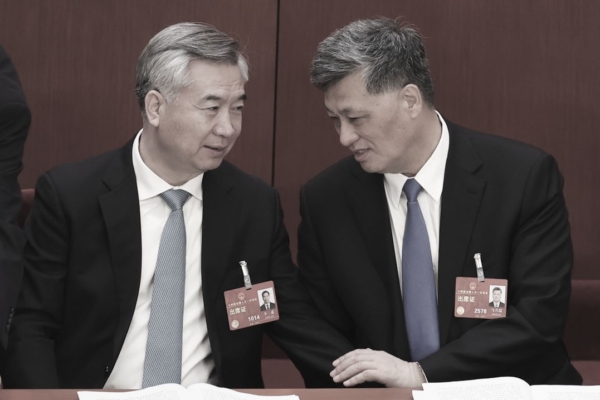
On April 3, Ma Xingrui, a member of the Chinese Communist Party’s Politburo, was officially announced to have been brought down from his position. He began his career in the aerospace industry and later held positions in Guangdong and Xinjiang. While Xinjiang Party Committee expressed firm support for the central government’s decision regarding Ma Xingrui on April 4, as of now (6th), there has been no similar official statement from Guangdong authorities. Analysts believe that the Ma Xingrui case may involve complex interest relationships within the Guangdong political arena and even reach high levels in Zhongnanhai. The Guangdong authorities are refraining from making a statement to avoid impacting political stability.
According to reports by the “Xinjiang Daily,” the Xinjiang Autonomous Region Party Committee held an enlarged meeting on April 4 to report on the investigation into Ma Xingrui, firmly expressing support for the central government and the Central Commission for Discipline Inspection’s decision regarding Ma Xingrui’s investigation.
Furthermore, there have been no statements from other provinces and central departments, especially from Guangdong Province where Ma Xingrui had worked for many years.
Ma Xingrui had a long career in the Chinese Communist aerospace system, serving as General Manager of the China Aerospace Science and Technology Corporation from 2007 to 2013. Starting in March 2013, he held positions such as Vice Minister of Industry and Information Technology, Director of the China National Space Administration, Director of the State Administration of Science, Technology, and Industry for National Defense. In November 2013, he succeeded Zhu Mingguo as Deputy Secretary of the Guangdong Provincial Committee and concurrently Secretary of the Political and Legal Affairs Committee, serving as the deputy to then-Provincial Party Secretary Hu Chunhua. In March 2015, Ma Xingrui became Deputy Secretary of the Guangdong Provincial Party Committee and Secretary of the Shenzhen Municipal Party Committee. On December 30, 2016, Ma Xingrui was appointed Deputy Governor and Acting Governor of Guangdong Province, rising to the rank of ministerial level. From January 23, 2017, to December 2021, Ma Xingrui served as the Governor of Guangdong Province, working alongside then-Provincial Party Secretary Li Xi.
In the Chinese Communist Party, whenever there are power struggles at the top or significant abnormal personnel changes, there will be instances of local warlords, various ministries, and even the military “declaring allegiance.” The victorious side of the power struggle typically rewards officials based on their declarations and loyalty, which has become a norm in Chinese political circles.
In contrast, when Chongqing Municipal Party Secretary Sun Zhengcai, once seen as a potential candidate for the sixth-generation leadership of the Chinese Communist Party, was officially removed from office, the four regions and departments where Sun had worked were the first to express support for the central authority’s investigation. The Chongqing Municipal Committee, where Sun had served most recently, issued a statement that evening. The following day, the Beijing Municipal Committee (where Sun had worked in Shunyi and at the Beijing Municipal Committee in 1997), the Ministry of Agriculture (now the Ministry of Agriculture and Rural Affairs, where Sun served as Minister from 2006 to 2009), and the Jilin Provincial Party Committee (where Sun served as Party Secretary from 2009 to 2012) successively issued statements. By the evening of July 26, nearly half of the provinces and municipalities had made declarations. Guangdong, led by Hu Chunhua, also issued a statement on July 28, slightly later.
Chinese affairs expert Wang He told Dajiyuan that in the Chinese Communist political system, maintaining unity between local and central authorities is a primary political rule. However, local officials do not have autonomous power in making statements; it could be a deliberate decision by the Chinese Communist authorities that Guangdong Province has not made a statement yet. For example, when Zhang Yuxia was investigated, the military did not make a statement which could be due to the authorities’ evaluation of the situation being complex, aiming to minimize public attention.
Wang He’s analysis suggests that there are reports indicating that in the Guangdong political arena, many of Ma Xingrui’s former subordinates may be under investigation. With various factions within the Chinese Communist Party intersecting in Guangdong, especially in Shenzhen, where various interests converge, Ma Xingrui’s investigation is likely to involve multiple aspects. Guangdong Province is not rushing to make a statement, waiting for the Ma Xingrui case to be definitively characterized before taking any action, adopting a conservative strategy in a particularly unstable political situation.
Commentator Li Linyi believes that the Ma Xingrui case may involve complex interest relationships within Zhongnanhai, including implications for Xi Jinping’s wife Peng Liyuan and the Secretary of the Central Commission for Discipline Inspection, Li Xi. It is possible that the Guangdong authorities have been instructed not to make a statement to reduce the impact on the political situation. However, the delay in making a statement could also be intentional.
Independent commentator Cai Shunkun, on the X platform, revealed that an important factor in Ma Xingrui’s political career is his relationship with Peng Liyuan. Ma Xingrui, originally from Shandong, had his family move to the northeast due to his father working as a miner there. However, the other brothers of his father remained in Yuncheng, Shandong, which is Peng Liyuan’s hometown, and they have deep family connections. Peng Liyuan had lived in the Ma family’s residence for a long time during her childhood, indicating a special relationship.
Cai Shunkun previously revealed in an interview with NTD Television that Shenzhen is the most crucial economic center in Guangdong, where Ma Xingrui cultivated many of his loyalists. After spending just over a year in Shenzhen, he was promoted to Governor of Guangdong Province. Therefore, his time in Guangdong was not just a routine experience but carried a certain “warlord” role, likely involving his influence in many major projects.
Cai Shunkun also mentioned that the Ma Xingrui case is likely to involve more individuals, possibly even affecting high-level figures like Hu Chunhua and Li Xi. The investigation might not necessarily be led by Li Xi but by Liu Jinguo, a member of the Central Secretariat of the Communist Party of China, Deputy Secretary of the Central Commission for Discipline Inspection, and Director of the National Supervisory Commission. If he is the one overseeing this case, even if higher-level figures are involved, he may report directly to Xi Jinping.