
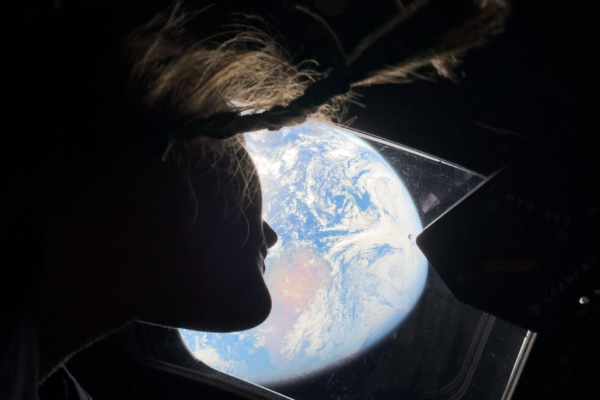
In the latest update on Saturday, April 4th, NASA’s manned mission “Artemis II” has surpassed the halfway mark of its lunar orbit journey. This space voyage marks the resumption of lunar exploration by humans after a lapse of 53 years and is expected to break the record for the farthest space flight set by “Apollo 13.”
The team consisting of three Americans and one Canadian is set to accomplish a historic lunar flyby mission on Monday, April 6th, capturing images of the mysterious far side of the moon. The spacecraft will perform a “free-return trajectory” directly back to Earth without stopping or entering lunar orbit.
During the passover of the far side of the moon, a temporary loss of communication with Earth is expected.
The mission is scheduled to last for 10 days. Upon completion, the spacecraft will splash down in the ocean and be recovered by a retrieval ship.
The significance of this mission lies in the fact that Artemis II will fly approximately 405,000 kilometers away from Earth, surpassing the record set by Apollo 13 in 1970 by pushing the farthest distance flown by humans about 6,500 kilometers further.
As the spacecraft approaches the moon, NASA has released multiple high-quality images, with the most striking being of the “Orientale Basin” on the moon’s surface.
Spanning a diameter of up to 600 miles (approximately 965 kilometers), the Orientale Basin is located at the boundary between the near and far sides of the moon. Astronauts onboard the Artemis II spacecraft have witnessed the magnificent landscape of the basin, which was primarily captured by unmanned probes in the past.
Similar to the Artemis I mission in 2022, Artemis II will offer several opportunities for self-portraits during the journey. The spacecraft’s solar panel arrays are equipped with high-definition cameras that can capture perfect “space selfies” in high resolution, framing the spacecraft alongside the distant sparkling Earth.
To allow astronauts a clear view of the cosmic beauty, the cabin’s lighting is sometimes dimmed to prevent glare. Canadian astronaut Jeremy Hansen has marveled at the extraordinary views outside the window in low light, exclaiming the scenery to be “extremely exceptional.”
Furthermore, the Earth photos transmitted by Artemis II have also amazed observers, revealing a panoramic view of the Earth unseen by the naked eye since the Apollo era. NASA continues to livestream the mission, showcasing the astronauts multiple times on camera, giving viewers a glimpse into their life in space.
This mission signifies a new era in space exploration. The four crew members include Commander Reid Wiseman, the first African American lunar astronaut Victor Glover, the first female lunar astronaut Christina Koch, and the first non-American citizen to fly to the moon, Canadian astronaut Hansen.
Canadian Space Agency (CSA) Director Lisa Campbell, while connecting with Hansen en route to the moon from Quebec, praised Canada’s contributions to the mission, citing Hansen as the first non-American citizen to fly to the moon.
Campbell stated, “Today, he is making history for Canada. As we watch him take this brave step into the unknown, may this journey remind us that Canada’s future is written by those who dare to reach higher.”
Moreover, the astronauts’ life in space is filled with ingenuity, with the choice of a plush toy named “Rise” as the zero-gravity indicator. The inspiration came from Apollo 8’s famous “Earthrise” photo and was designed by a California resident selected through a global competition.
In terms of food, astronauts can select from up to 189 space meals including corn tortillas, grilled beef brisket, macaroni and cheese, chocolates, and a variety of beverages according to their personal preferences. Additionally, they are required to exercise for at least 30 minutes each day through equipment to prevent bone loss and maintain normal muscle mass.
Although there won’t be a moon landing on this mission, it will validate the life support systems of the spacecraft in deep space and lay a crucial foundation for future Artemis III lunar landing missions. NASA plans to send two astronauts to the moon’s south pole.