
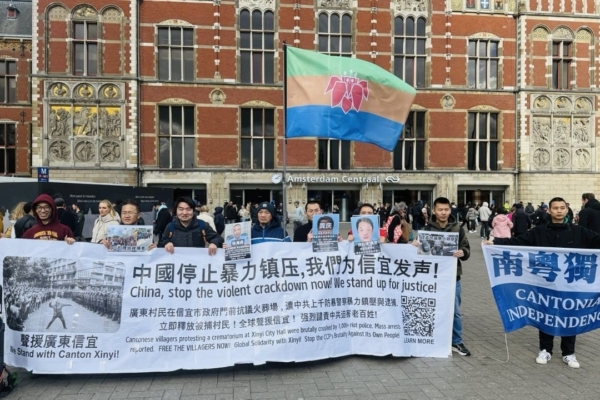
On the afternoon of March 28, the “Voice Against Communism” in the Netherlands held a rally at the central train station square in Amsterdam to support the rights-defending villagers in Xinyi City, Maoming, Guangdong Province. More than ten Chinese dissidents and democracy activists living in the Netherlands from various parts of the country participated in the rally to expose the true nature of the Communist Party’s tyranny to the international community.
According to public reports, the authorities in Xinyi City, Maoming, Guangdong Province, have been forcibly expropriating land under the pretext of constructing the “Liru Avenue.” It wasn’t until the public announcement on March 16, 2026, that villagers learned the true purpose of the project, which is to build a funeral parlor and crematorium called “Yifu Park.” The total investment in the project is approximately 145 million yuan, with the foundation nearly completed. The chosen site is only about 200 meters away from the nearest residential area, less than 700 meters from Wangyong Village, about 600 meters from a nearby school, and adjacent to a source of drinking water.
Xinyi City is one of the last two counties in Guangdong Province where funeral parlors have not yet been built. The authorities claim that the site is “within 500 meters with no residents around” and state that the project complies with the funeral management regulations of Guangdong Province. However, villagers point out that the official distance provided is significantly different from the actual situation. Moreover, the authorities deceived the villagers under the guise of “road construction” in the previous stages, raising suspicions of “building before approval” and procedural violations, as they never held a villagers’ representative assembly or sought residents’ opinions.
On March 17, hundreds of villagers went to the village committee to seek explanations and then proceeded to the entrance of the Xinyi City government for continuous petitions. The authorities not only refused to engage in dialogue but also deployed a large number of riot police to disperse the villagers. Images circulating online showed the authorities using water cannons and tear gas. An elderly woman stood alone in front of the riot police, throwing eggs and stones with all her might.
On March 25, the protests escalated further, with reports of over a thousand people gathering in the city center. The authorities mobilized a large number of riot police to suppress the protests, resulting in multiple people being beaten and dragged away. Following the crackdown, the authorities immediately blocked the entrances and exits of the village, cut off electricity, and conducted comprehensive surveillance on related videos and calls for help on the internet, leading to the summoning or detention of many individuals who posted live footage.
In the afternoon of March 28, at the central train station square in Amsterdam, a banner over six meters long fluttered in the wind, displaying images and texts in solidarity with the villagers of Xinyi. On the left side of the banner was a photo of an elderly person throwing eggs at riot police, while the right side was inscribed with the message in both Chinese and English: “China, stop the violent crackdown now! We stand up for justice!”
At the ongoing rally, participants, including Chinese residents from various provinces such as Guangdong, Guangxi, Hubei, Hunan, Henan, Anhui, Gansu, and Heilongjiang, voiced their support for the demands of the event organizers. They demanded the immediate lifting of the blockade on all villages in Xinyi, the restoration of communication and internet freedom, the unconditional release of all detained villagers, the thorough investigation and accountability of the responsible individuals including Gong Qing, the Secretary of the Xinyi City Committee, and Lin Haisen, the Deputy Mayor and Director of Public Security Bureau, for ordering the use of force, and the respect for public opinion by withdrawing the controversial project and conducting a legal reevaluation of the environment and site location.
In his statement, Xing Songlin stated, “They are silenced domestically, so it is our responsibility to speak up for them overseas. The truth cannot be silenced!”
The event organizer, Du Binghui from Luoyang, Henan, criticized the local government for failing to listen to public opinion and plan scientifically. Instead, they deployed a large number of riot police with batons, tear gas, and even violent means to brutally suppress unarmed citizens, causing many injuries and disabilities. He emphasized, “Any stability based on violence is like building a tower of sand.”
Jiang Peikun, a dissident from Shunde, Guangdong, used the example of the elderly woman in Xinyi throwing eggs to highlight that “she is not throwing at the shields of the police but at the face of the Communist Party!” He called on fellow countrymen in Guangdong to unite and awaken, stating, “Today it is Xinyi, but tomorrow it could be Foshan, Zhongshan, or Shenzhen! The tyrants of the Communist Party have never valued the lives and dignity of the people in Guangdong!”
Wei Zhijian, a democracy activist from Nanning, Guangxi, expressed that the events in Xinyi are not exclusive to Guangdong but exemplify the systemic oppression imposed by the centralized rule of the Communist Party in the southern regions. He advocated for standing up for freedom instead of begging for stability.
Wu Xianfen, a dissent from Harbin, Heilongjiang, who recently discharged from the hospital and was accompanied by his son Jiang Hong, insisted on attending the event. He urged relevant authorities to “publicize project information, listen to villagers’ opinions, and seek a more reasonable solution between public and resident interests.”
Yan Yang from Anhui pinpointed the root cause of the problem, stating, “When a government fears the expression of people’s opinions, when communication is replaced by control, when negotiation is replaced by coercion, this is not just a local issue but a systemic problem.”
Liu Bowen, a democracy activist from Xiaogan, Hubei, who traveled from Overijssel Province in the Netherlands, stressed, “We cannot allow them to be forgotten in silence, nor let lives pass away in silence.” He called on the international community to conduct an independent and transparent investigation into the situation.
Hao Wangyong, who traveled several hours by train from Qingyang, Gansu, emphasized, “If living means surrendering dignity, then resistance is the only breath left. History will not only remember the power of the oppressors but also the glory of the resisters.”
Liu Xiaobin, a dissent from Hengyang, Hunan, and a Christian, issued a warning directly to the police involved in the crackdown, stating, “This is the watershed testing your conscience. When democracy arrives, the so-called ‘accomplishments’ in suppressing the people today will be the irrefutable evidence of your heinous crimes, and you can’t escape from it.”
The rally concluded amidst a heightened atmosphere. Participants took turns trampling and spitting at the photos of the Communist Party’s leaders and the party flag placed on the ground, chanting slogans such as “Down with the Communist Party,” “Communist Party get out of China,” and “Long live freedom and democracy,” expressing their anger and contempt towards the authoritarian regime of the Communist Party and conveying their solidarity and willingness to resist to the suffering compatriots in Xinyi across the seas.
Local Dutch residents at the scene took photos to show support for the organizers.
Since 2024, the authorities in Xinyi City have been acquiring land under the name of the “Liru Avenue.” After the project was suspended in 2025, it suddenly resumed in March 2026. The project was publicly announced on March 16, triggering strong resistance from villagers. From March 17 to 19, villagers protested continuously at the village committee and city government gates, only to be dispersed by batons and water cannons, with authorities deploying water cannons. Starting from March 20, special police were stationed at the village entrance, roads were closed, checkpoints were set up, and internet and electricity supply were cut off. The second round of protests escalated on March 25, with over a thousand people gathering, leading to a large-scale crackdown by the authorities and multiple arrests. By March 26, the deadline for the Stable Risk Assessment (Suan Ping) public notice had passed, with over 20,000 opinions collected, and the project appeared to be proceeding rapidly. It was reported that some public officials and teachers were asked to submit a “support letter.” As of the time of writing, high-pressure stability maintenance measures were still in place around the village, and the number and whereabouts of detained villagers remained unknown.