
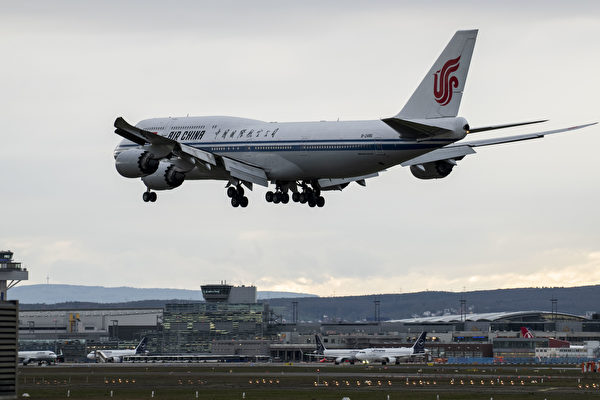
The ongoing conflict in Iran has pushed up international oil prices, impacting the global aviation industry. However, it has presented an opportunity for Chinese airlines with a surge in flights and increased ticket prices. Despite this, the stock prices of the three major airlines have plummeted, with investors showing pessimism. Analysts believe that soaring fuel costs, pricing constraints, overcapacity, and price competition have put Chinese airlines in a difficult situation.
The repercussions of the Iran conflict on the global aviation industry have quickly become apparent. Since the escalation of tensions back on February 28th, international oil prices have significantly increased, leading to a sharp rise in aviation fuel prices in China. According to industry sources cited by Jiemian News, as of mid-March, the ex-factory price of aviation kerosene in China has risen to around 8,500 yuan per ton, significantly higher than the threshold level exempt from fuel surcharges.
Bloomberg recently reported that on the Hong Kong stock market, the stock prices of China Airlines, China Eastern Airlines, and China Southern Airlines have collectively plunged by 26% to 30%, making them among the weakest performing aviation stocks during the same period.
Despite the Middle East crisis bringing opportunities for Chinese airlines—due to some Middle Eastern carriers facing airspace restrictions, Chinese airlines have capitalized on the advantage of being able to fly over Russia, thereby taking on some of the Europe-Asia transfer demand and significantly increasing flights to and from Europe.
Data from flight analytics company Cirium shows that the number of China-Europe flights this summer is expected to increase by around 20%. Business booking data from Flight Centre Travel Group also indicates an 88% increase in flight bookings with Beijing as a transfer point. Ticket prices have also noticeably surged. According to Bloomberg, ticket prices on some long-haul routes operated by China Eastern Airlines have surpassed 30,000 yuan.
However, these impressive figures have not reassured the market. Since the outbreak of the conflict on February 28th, the stock prices of the three major airlines in China have fallen by 26%, 30%, and 28% respectively in the Hong Kong market, positioning them as among the worst performing airlines on the Bloomberg World Airlines Index.
Furthermore, several Chinese airlines announced on Wednesday (April 1st) that starting from April 5th, they would raise domestic flight fuel surcharges by up to five times. For flights of 800 kilometers or less, tickets will be subject to an additional charge of 60 yuan, while flights exceeding 800 kilometers will see a surcharge of 120 yuan.
Why is the market choosing to sell off despite the apparent “full flights, expensive tickets”?
US economist Davy J. Wong explained to Dajiyuan that the core reason for the decline in stock prices of Chinese airlines is not just the surge in oil prices but rather the market reevaluating the profit model of the three major airlines.
He pointed out that the rapid increase in fuel costs, combined with the pressure on the Chinese yuan amplifying US dollar debt pressure, as well as airlines lacking sufficient pricing power, has resulted in cost constraints and limited revenue. Investors no longer see them as “recovery targets” but rather as “assets with unstable profits”.
Sun Guoxiang, a professor of International Affairs and Business at Nanhua University in Taiwan, also told Dajiyuan that Chinese airlines have indeed attracted more passengers and higher ticket prices in the short term due to the ability to fly over Russia and the disrupted Middle East routes.
“However, the issue lies in the rapid rise in costs, as well as the additional expenses incurred from detours in flight routes and increased risk management. Therefore, the market’s assessment is that while you may have earned some extra money, you are also spending more, and ultimately net profits may not improve, or even worsen.”
Sun emphasized that the aviation industry is inherently a “low-profit industry” where having full flights and higher ticket prices does not guarantee profitability. “Once fuel costs rise significantly, they will eat up a large portion of profits, and this cost is rigid and difficult to avoid.”
Financial data further exacerbates market concerns. According to Reuters, in the fourth quarter of 2025, China Eastern Airlines and China Airlines reported losses of 3.7 billion and 3.64 billion yuan, respectively, while China Southern Airlines also recorded quarterly losses. HSBC predicts that the three major airlines may see expanded losses in 2026, with profitability not expected to return until earliest in 2027.
Insufficient fuel hedging also poses a risk. Reports indicate that among the three major airlines, only China Eastern Airlines holds some fuel hedging positions for 2026, while the other airlines have almost no hedging operations, making their profits more susceptible to fluctuations in oil prices.
Sun Guoxiang pointed out the dilemma facing airlines: “Without raising prices, they lose money, but increasing prices too much can lead to customer loss.” The current scenario of high ticket prices and high load factors may not be able to sustain profits in the long run.
Davy J. Wong likened the current situation to a “scissors difference”: there are limits to income growth, but costs are unlimited. “Once ticket prices exceed demand capacity, the load factor will quickly decline, and fuel costs rise impulsively in conflict environments, while fuel surcharge adjustments lag behind and face limitations.”
He noted that against a backdrop of overcapacity and price competition, airlines find it challenging to pass on the complete cost increases. This is the fundamental structural weakness of the three major Chinese airlines in this crisis.