
“World, I have been here, not fun.” A farewell message that opened the life-and-death 48 minutes of the South Brooklyn subway rescue.
Last Wednesday (March 25) at 12:21 PM, the phone of Huang Nicole, the president of the New York Parent-Child Mutual Aid Association (PCR), lit up with a message that made her heart sink: “It turns out that people like us can only find solace in loneliness. I have been to this world, it’s not fun, nice to meet you.”
The sender was Miss Chen, a Chinese lady in her 30s who Huang had been following up on for a long time, just gave birth to her second child, had recently moved to New York from another state, had no health insurance, no job, and her husband worked long-term in another state. She was suffering from severe postpartum depression, started taking medication with the help of the mutual aid group, but her emotions remained low.
This message was a plea for help, as well as a farewell.
Huang Nicole immediately replied, asking where she was. The other party only replied, “At the subway station,” but refused company and was unwilling to reveal more.
She immediately called the 988 psychological crisis hotline and then called 911 as advised. However, the police said that there were many subway stations in New York, and without a clear location, it was difficult to take action.
So, she began activating the “community network”: contacting City Councilor Alexa Avilés, then connecting with Councilor Zhuang Wenyi. Alexa sent someone to visit Miss Chen’s home, while Zhuang assisted in coordinating with the 62nd Precinct of the police department. The police tried to contact but couldn’t reach her, the call went to voicemail, then through 911 initiated an on-site safety check with patrol supervisors leading a team, trying to contact the individual by phone and simultaneously initiating a location search. It was a collaborative race against time.
By the afternoon around 2 o’clock, Miss Chen had not responded for half an hour. The police knocking on her door yielded no results, and the neighbors didn’t know where she had gone.
“At that moment, I thought to myself: it’s over,” recalled Huang Nicole.
It was not until 2:45 PM that the police managed to reach Miss Chen on the phone and transferred the call to Huang Nicole. A 47-minute three-way call ensued: Huang Nicole, two neighbors, and the police taking turns speaking to her.
On the other end of the call, Miss Chen was crying, repeatedly saying: “I can’t go on.”
In such moments, any wrong words could push someone towards the abyss. Huang Nicole did not say “don’t think like that,” did not blame “you are young, how could you leave your children behind,” or lecture “you need to be strong;” she chose to accompany.
She did not negate the emotions, only responded with, “I know you are feeling very upset.” She avoided using accusatory language starting with “you,” and instead used “I-sentences” gently saying, “I’m here, I’m willing to listen to you,” she didn’t forcefully dissuade, but bought time, saying, “Can you stay with me a bit longer?” She also conveyed support and hope: “Let’s find a way to make you feel better, are you willing to trust me once again?” However, she stressed not to make commitments that can’t be fulfilled to avoid losing trust.
“Don’t provoke, don’t argue,” she said. When the other side’s emotions spiraled out of control, even saying, “I’m going to jump now,” instead of urgently shouting “don’t,” it is better to extend the conversation in a gentle tone. As for the specific location, it is often difficult to ask for, “but the longer you can hold her back, the better chance you have of saving her.”
It was during this long conversation that she stabilized the situation. Speaking about the pressure that day, she said she was not panicked at the moment because she had been prepared. “There may be moments when there’s nothing more to say, but I would adjust the conversation based on past training, and use some tools to assist.” She revealed that a colleague with a psychiatric background was there to support, and neighbors also participated, ultimately forming a support network.
Through continuous communication, she became more convinced that “what they want isn’t to be convinced, but to be seen.” She pointed out that in extreme pain, people could be engulfed in negative thoughts, but emotions fluctuate, and as long as they endure that moment, there can be a turnaround.
She also observed critical signs: the willingness to answer the phone signifies hesitation. “No one truly wants to die, they just want to end the pain.”
Around 3 PM, a turning point appeared. Miss Chen sent a photo – a scene of a subway tunnel.
With her familiarity with the Brooklyn terrain, Huang Nicole quickly deduced that the location was close to the N Line’s New Utrecht subway station. She immediately forwarded the photo to the police and rushed there herself.
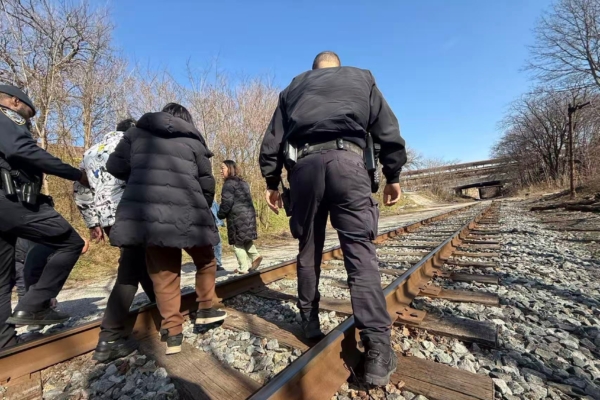
When she arrived, the subway had been completely shut down, with police cars and ambulances on site, officers searching along the tracks.
Huang Nicole and her companion climbed up from the hole between 13th and 14th avenues onto the tracks, ultimately finding Miss Chen near the tunnel – she was lingering beside the tracks, with the N Line train not far behind her.
Together, they removed her from the tracks and took her to the hospital.
Reflecting on the entire process, Huang Nicole repeatedly emphasized: “This wasn’t done by one person, but through the cooperation of various departments.”
She admitted that if it was just a simple police report, “it might not have been possible to find the person so quickly.” Because when the location couldn’t be clearly explained, action through the 911 system was challenging. The real key was: finding the right people and getting the correct systems to act simultaneously.
The success of this rescue operation was because of: elected officials helping to connect police resources; the police quickly mobilizing for the search; community organizations continuously keeping in touch with the individual; neighbors and family members joining in to prolong communications.
This “multi-point simultaneous effort” model bought crucial time for subsequent rescue missions.
She said: “Allowing an ordinary family to face this situation alone is very tough, they find it hard to cope.” The role of community organizations is to “become the one they can trust, help link them to the entire system.”
After the incident, Huang Nicole discussed the profound reflections this rescue brought about.
She pointed out that the progression of individuals with depression towards suicide is often not a spur of the moment decision but a result of long-term accumulation. “Once suicidal thoughts appear, it’s a very dangerous sign.”
She stressed that some family members think “once the person is found, everything’s fine, and they can just go home,” this is a serious misunderstanding. Because once the police or medical system gets involved, “it elevates to another level, procedures must be followed, this is not something you or I can decide, and it’s not something that can be passed off with ‘she was just impulsive,’ it’s a very serious matter.”
She urged that when facing individuals with mental conditions, especially teenagers, parents should not take them lightly. When the person expresses despair or seeks help, don’t dismiss them with “hang in there,” or deny them with “you seem fine,” because “sometimes, they really can’t hold on anymore.”
Regarding the condition of this woman, Huang Nicole said that before the incident, the individual had expressed multiple times that she “wanted to die.”
“Every time she mentioned ‘wanting to die,’ I repeatedly advised her to go to the hospital, but because she had unpleasant experiences with medical treatment before, she kept resisting,” she said. The woman had just started treatment then, and the treatment of mental illness wasn’t immediate.
“It’s not taking medication today and being fine tomorrow. Medication may have side effects, and may even make the person feel worse initially, or show more severe symptoms, causing some to stop treatment. But the problem is, without stable treatment, can you bear the next blow in life? Many breakdowns actually do not happen instantly, but are results of long-term stress.”
Huang Nicole emphasized that mental illness is fundamentally a disease that requires treatment, not just an emotional issue. “It can change a person’s way of thinking. The earlier the treatment, the better, and the longer you wait, the more irreversible the damage to the brain may become.”
She said that the Chinese community often responds to individuals with depression with “cheer up a bit,” or “you look fine,” which may deepen the person’s sense of isolation and pain.
“In reality, many psychological traumas stem from emotional neglect in the upbringing environment. Many ’80s” who are now in their 40s, grew up in a time of greater economic pressure, parents were busy making a living, emotional support was lacking. However, the harm from emotional neglect is often more profound than physical abuse, as it is invisible and easier to deny.”
Huang Nicole said that these untreated traumas often get triggered repeatedly in adulthood.
As for the timeline from depression to suicide, she stated that there isn’t a fixed pattern: “Sometimes it’s a long process, after one outburst, various events in life could retrigger, accumulate, until collapse.”
She described that many people “have an emotional icehouse inside them,” emotions are suppressed and frozen for a long time, the mind is filled with ice shards, and the people around them often struggle to understand this state. “Those who’ve received treatment can sense and adjust early; those who haven’t received treatment could let it deteriorate until losing control.”
She emphasized that complete treatment doesn’t just rely on medication, but also requires psychological counseling and long-term support. “Medication can only stabilize bodily functions, it can’t directly alter a person’s cognition and thinking pattern. Cognitive changes take time, and psychological treatment, like opening another door, allowing them to see another possibility and unconsciously altering them.”
Speaking of thinking patterns, Huang Nicole further said that modern people generally excessively pursue external goals, such as money, achievement, efficiency, while neglecting an awareness of their internal state. “Many people spend their days watching short dramas, useless things, not giving themselves any learning or settling space, their thinking remains stagnant, unable to update.”
She highlighted the importance of “looking inwards,” but also cautioned that it’s not something achieved by simply sitting down and closing your eyes; it’s an ability that needs practice and time to cultivate.
She said that many people are always busy, treating busyness as an automatic coping mechanism. “You feel like it should be like this, if not busy, you feel guilty, as if you wasted a day not making money, a day without earning an extra two hundred bucks. This is actually wrong, your day should not equate with money. A truly healthy state is: even when you stop, you can still enjoy the sun, enjoy nature, that’s balance.”
She pointed out that if stopping makes you anxious, guilty, or in a frenzy of thoughts, it often indicates being under high-pressure for a long time, overextending your body and mind.
Therefore, self-care is a skill that needs to be learned: allowing yourself to rest, lowering your demands on yourself, learning to recognize emotions, learning to counteract the brain’s negative presets.
She encouraged the public to cultivate healthy interests like sports, reading, etc., rather than relying on addictive behaviors such as gambling or drug use for relief. “These ways may temporarily alleviate anxiety on the surface, but once addicted, it’s essentially negative energy. What I emphasize is, you should cultivate hobbies that bring positive energy.”
Working with crisis cases for a long time can also take a toll on helpers. Huang Nicole admitted that, “Many times things don’t go as hoped, and I feel helpless.”
She said she maintains her mental health through writing journals, regular psychological counseling, discussing cases with colleagues and supervisors, and setting clear boundaries.
She said: “Our role is to accompany families through difficulties, not to walk the road for them.” “Once things are handed over to the medical system, I tell myself: I’ve done my best.”