
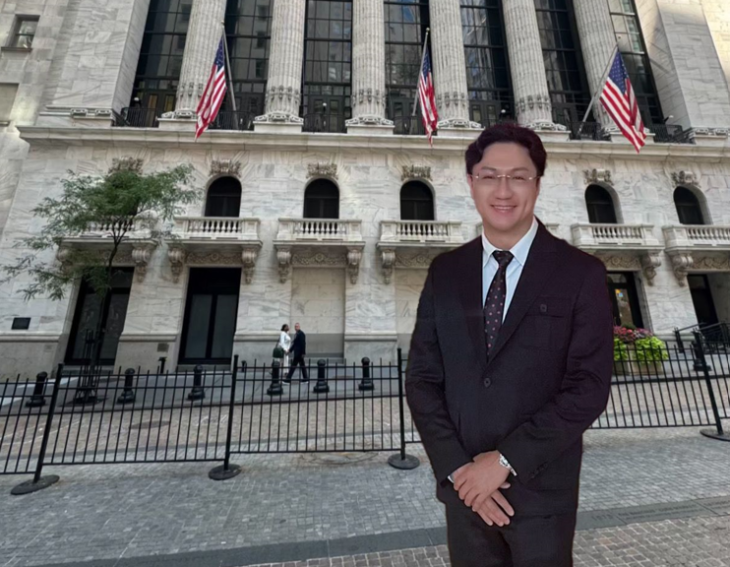
Family financial management is one of the important skills that Chinese immigrants must master after moving to the United States. In light of the U.S. “Financial Literacy Month,” industry veteran Jing Youlun, a former senior executive in Wall Street investment banking, emphasized the importance of long-term high-return assets such as real estate and stocks in the establishment of long-term asset structures for Chinese families.
Jing Youlun, who has long been studying capital markets, macro policies, and asset allocation, and serves as a visiting scholar at the Columbia Business School, believes that given the current high interest rates, high volatility, and rapidly changing regulations in the U.S., missing out on a certain stock market or real estate cycle does not equate to missing out on a lifetime of financial fortune. The key to long-term wealth lies in “whether you own assets that can appreciate and generate cash flow over the long term.”
According to Jing Youlun, two major long-term financial tools for Americans are “primary residence” and “long-term stock investments.” These are not mutually exclusive but serve as the “twin engines” for many households. “The primary residence, with long-term fixed leverage and forced savings, stabilizes the household asset-liability structure, while stocks, especially the role of low-cost broad-based ETFs, convert wage income into ‘long-term compounding profits.'”
“Real estate is more like ‘laying the foundation,’ while stocks are more like ‘raising the ceiling,'” Jing Youlun explained. A household without either of these assets may naturally feel anxious, but starting now still presents an opportunity.
Regarding stock market investments, Jing Youlun noted that the ups and downs of the stock market may lead some to regret missing out on a major upswing, but it’s not essential. He stated, “In the U.S., missing out on a single major uptrend doesn’t mean missing out on a lifetime; however, not participating in asset accumulation over ten or twenty years is the most costly outcome.”
Many people perceive the stock market as risky and are hesitant to engage. Jing Youlun believes that the core logic behind the long-term returns of the U.S. stock market does not rest on “buying at the lowest point forever” but on holding productive assets over the long term. Recent data from New York University professor Aswath Damodaran indicates a return rate of 17.78% for the U.S. stock market in 2025, with long-term sequences consistently showing that stocks significantly outperform cash and short-term debt. Therefore, selecting stocks and holding them for the long term is an important means of household financial management.
When it comes to housing, Jing Youlun suggests that only by extending the time of owning a house can one truly understand the role of real estate in family finance.
Based on academic research, in a long-term sample of 16 developed economies, the actual long-term returns of housing and stocks are very close: the actual stock returns in the overall U.S. sample are around 8.46%, and the actual housing returns are approximately 6.10%. Looking at the cross-country average return rates, both housing and stocks are considered long-term high-return assets.
Jing Youlun cited the National Association of Realtors (NAR) data from last month, which reported 4.09 million annualized existing-home sales in February, with a median price of $398,000 and a 3.8-month supply. He remarked, “This indicates that the housing market has not crashed, but it’s also not a loose market where ‘blind buying equals profit.'”
Freddie Mac reported on Thursday (2nd) that the average 30-year fixed mortgage rate is 6.46%, while the 15-year fixed rate is 5.77%. Under these rates, Jing Youlun pointed out that real estate investment has transitioned from “betting on price increases” to “calculating cash flow and financing costs.”
“If you ask me whether investing in real estate is still viable, my answer would be more realistic: for buying a primary residence, focus on whether you are prepared to hold it long-term, if the monthly mortgage payment is comfortable, and if you plan to move within the next 5 to 10 years; for buying rental property, focus on whether the rent can cover interest, taxes, insurance, maintenance, vacancies, and management costs.”
Jing Youlun believes that landlords grow wealthier not simply because “housing prices always rise,” but because tenants help pay off a portion of debts, time aids in accumulating net worth, inflation consistently raises rents, and asset nominal prices increase. Starting with a high-interest purchase where the cash flow is initially negative and lacking a buffer fund for repairs and vacancies can lead to a “cash flow trap.”
In conclusion, Jing Youlun emphasized, “Missing the past does not mean missing the future, but the next step must shift from ‘chasing highs and selling lows’ to establishing a long-term asset structure.”